
Modern Love
What Shamu Taught Me About a Happy Marriage
By AMY SUTHERLAND
Published: June 25, 2006 (N.Y.Times)
AS I wash dishes at the kitchen sink, my husband paces behind me, irritated. "Have you seen my keys?" he snarls, then huffs out a loud sigh and stomps from the room with our dog, Dixie, at his heels, anxious over her favorite human's upset.
In the past I would have been right behind Dixie. I would have turned off the faucet and joined the hunt while trying to soothe my husband with bromides like, "Don't worry, they'll turn up." But that only made him angrier, and a simple case of missing keys soon would become a full-blown angst-ridden drama starring the two of us and our poor nervous dog.
Now, I focus on the wet dish in my hands. I don't turn around. I don't say a word. I'm using a technique I learned from a dolphin trainer.
I love my husband. He's well read, adventurous and does a hysterical rendition of a northern Vermont accent that still cracks me up after 12 years of marriage.
But he also tends to be forgetful, and is often tardy and mercurial. He hovers around me in the kitchen asking if I read this or that piece in The New Yorker when I'm trying to concentrate on the simmering pans. He leaves wadded tissues in his wake. He suffers from serious bouts of spousal deafness but never fails to hear me when I mutter to myself on the other side of the house. "What did you say?" he'll shout.
These minor annoyances are not the stuff of separation and divorce, but in sum they began to dull my love for Scott. I wanted — needed — to nudge him a little closer to perfect, to make him into a mate who might annoy me a little less, who wouldn't keep me waiting at restaurants, a mate who would be easier to love.
So, like many wives before me, I ignored a library of advice books and set about improving him. By nagging, of course, which only made his behavior worse: he'd drive faster instead of slower; shave less frequently, not more; and leave his reeking bike garb on the bedroom floor longer than ever.
We went to a counselor to smooth the edges off our marriage. She didn't understand what we were doing there and complimented us repeatedly on how well we communicated. I gave up. I guessed she was right — our union was better than most — and resigned myself to stretches of slow-boil resentment and occasional sarcasm.
Then something magical happened. For a book I was writing about a school for exotic animal trainers, I started commuting from Maine to California, where I spent my days watching students do the seemingly impossible: teaching hyenas to pirouette on command, cougars to offer their paws for a nail clipping, and baboons to skateboard.
I listened, rapt, as professional trainers explained how they taught dolphins to flip and elephants to paint. Eventually it hit me that the same techniques might work on that stubborn but lovable species, the American husband.
The central lesson I learned from exotic animal trainers is that I should reward behavior I like and ignore behavior I don't. After all, you don't get a sea lion to balance a ball on the end of its nose by nagging. The same goes for the American husband.
Back in Maine, I began thanking Scott if he threw one dirty shirt into the hamper. If he threw in two, I'd kiss him. Meanwhile, I would step over any soiled clothes on the floor without one sharp word, though I did sometimes kick them under the bed. But as he basked in my appreciation, the piles became smaller.
I was using what trainers call "approximations," rewarding the small steps toward learning a whole new behavior. You can't expect a baboon to learn to flip on command in one session, just as you can't expect an American husband to begin regularly picking up his dirty socks by praising him once for picking up a single sock. With the baboon you first reward a hop, then a bigger hop, then an even bigger hop. With Scott the husband, I began to praise every small act every time: if he drove just a mile an hour slower, tossed one pair of shorts into the hamper, or was on time for anything.
I also began to analyze my husband the way a trainer considers an exotic animal. Enlightened trainers learn all they can about a species, from anatomy to social structure, to understand how it thinks, what it likes and dislikes, what comes easily to it and what doesn't. For example, an elephant is a herd animal, so it responds to hierarchy. It cannot jump, but can stand on its head. It is a vegetarian.
The exotic animal known as Scott is a loner, but an alpha male. So hierarchy matters, but being in a group doesn't so much. He has the balance of a gymnast, but moves slowly, especially when getting dressed. Skiing comes naturally, but being on time does not. He's an omnivore, and what a trainer would call food-driven.
Once I started thinking this way, I couldn't stop. At the school in California, I'd be scribbling notes on how to walk an emu or have a wolf accept you as a pack member, but I'd be thinking, "I can't wait to try this on Scott."
On a field trip with the students, I listened to a professional trainer describe how he had taught African crested cranes to stop landing on his head and shoulders. He did this by training the leggy birds to land on mats on the ground. This, he explained, is what is called an "incompatible behavior," a simple but brilliant concept.
Rather than teach the cranes to stop landing on him, the trainer taught the birds something else, a behavior that would make the undesirable behavior impossible. The birds couldn't alight on the mats and his head simultaneously.
At home, I came up with incompatible behaviors for Scott to keep him from crowding me while I cooked. To lure him away from the stove, I piled up parsley for him to chop or cheese for him to grate at the other end of the kitchen island. Or I'd set out a bowl of chips and salsa across the room. Soon I'd done it: no more Scott hovering around me while I cooked.
I followed the students to SeaWorld San Diego, where a dolphin trainer introduced me to least reinforcing syndrome (L. R. S.). When a dolphin does something wrong, the trainer doesn't respond in any way. He stands still for a few beats, careful not to look at the dolphin, and then returns to work. The idea is that any response, positive or negative, fuels a behavior. If a behavior provokes no response, it typically dies away.
In the margins of my notes I wrote, "Try on Scott!"
It was only a matter of time before he was again tearing around the house searching for his keys, at which point I said nothing and kept at what I was doing. It took a lot of discipline to maintain my calm, but results were immediate and stunning. His temper fell far shy of its usual pitch and then waned like a fast-moving storm. I felt as if I should throw him a mackerel.
Now he's at it again; I hear him banging a closet door shut, rustling through papers on a chest in the front hall and thumping upstairs. At the sink, I hold steady. Then, sure enough, all goes quiet. A moment later, he walks into the kitchen, keys in hand, and says calmly, "Found them."
Without turning, I call out, "Great, see you later."
Off he goes with our much-calmed pup.
After two years of exotic animal training, my marriage is far smoother, my husband much easier to love. I used to take his faults personally; his dirty clothes on the floor were an affront, a symbol of how he didn't care enough about me. But thinking of my husband as an exotic species gave me the distance I needed to consider our differences more objectively.
I adopted the trainers' motto: "It's never the animal's fault." When my training attempts failed, I didn't blame Scott. Rather, I brainstormed new strategies, thought up more incompatible behaviors and used smaller approximations. I dissected my own behavior, considered how my actions might inadvertently fuel his. I also accepted that some behaviors were too entrenched, too instinctive to train away. You can't stop a badger from digging, and you can't stop my husband from losing his wallet and keys.
PROFESSIONALS talk of animals that understand training so well they eventually use it back on the trainer. My animal did the same. When the training techniques worked so beautifully, I couldn't resist telling my husband what I was up to. He wasn't offended, just amused. As I explained the techniques and terminology, he soaked it up. Far more than I realized.
Last fall, firmly in middle age, I learned that I needed braces. They were not only humiliating, but also excruciating. For weeks my gums, teeth, jaw and sinuses throbbed. I complained frequently and loudly. Scott assured me that I would become used to all the metal in my mouth. I did not.
One morning, as I launched into yet another tirade about how uncomfortable I was, Scott just looked at me blankly. He didn't say a word or acknowledge my rant in any way, not even with a nod.
I quickly ran out of steam and started to walk away. Then I realized what was happening, and I turned and asked, "Are you giving me an L. R. S.?" Silence. "You are, aren't you?"
He finally smiled, but his L. R. S. has already done the trick. He'd begun to train me, the American wife.
Tuesday, July 04, 2006
"Zoning out" (Mindless reading) or...not comprehending
Mindless reading seen as fundamental
By BEN FELLER, AP Education Writer (from Yahoo News)
WASHINGTON - Better pay attention, reader. This whole story may be a blur.
For the first time, researchers have demonstrated the ill effects of mindless reading — a phenomenon in which people take in sentence after sentence without really paying attention.
Ever read the same paragraph three times? Or get to the end of a page and realize you don't know what you just read?
That's mindless reading. It is the literary equivalent of driving for miles without remembering how you got there — something so common many people don't even notice it.
In a new study of college students, researchers from the University of Pittsburgh and the University of British Columbia established a way to study mindless reading in a lab.
Their findings showed that daydreaming has its costs.
The readers who zoned out most tended to do the worst on tests of reading comprehension — a significant, if not surprising, result. The study also suggested that zoning out caused the poor test results, as opposed to other possible factors, such as the complexity of the text or the task.
The researchers hope their work inspires more research into why zoning out happens, and what can be done to stop it.
For now, they want the problem to be taken seriously.
"When you talk about this work at conferences, it does lend itself to a lot of jokes," acknowledges University of Pittsburgh professor Erik Reichle, co-leader of the study.
"It's so ubiquitous. Everybody does it," he said. "I think that's one of the main reasons it's been overlooked. And there's been a view that it is tough to study experimentally. Hopefully, now, there will be more interest in the topic."
The federal government is showing some.
Reichle and fellow psychology professor Jonathan Schooler did the study on a $691,000 grant from the Institute of Education Sciences, an arm of the Education Department. It is one of 178 federally backed projects aimed at giving schools a scientific basis for sound policies.
Over three experiments, students used computers to read the first five chapters of Leo Tolstoy's "War and Peace." (Reichle wanted some boring reading — better for zoning out.)
Reichle said the dry text itself did not skew the results toward mindless wandering. After all, the students were on alert, unlike the typical reader.
Participants were told to monitor and report instances of zoning out as they read text on a computer. Half of them got computer reminders, too: "Were you zoning out?"
Despite all that, many still reported zoning out at a regular pace.
"That's the amazing thing," Reichle said. "It shows how often this can happen even under conditions that are designed to keep it from happening."
The students said as their eyes scanned the words, their minds often were elsewhere.
They were hungry, or thirsty, or tired. They were thinking about plans, worries or memories. Some drifted into fantasies. Others stuck with the book, but their minds wandered into tangents about the plot.
Karen Wixson, a nationally recognized reading expert and professor of education at the University of Michigan, cautioned not to read too much into all this.
"This is a long ways away from having implications for reading instruction," Wixson said. "It could, eventually, down the line. But to draw inferences about this as a contributing factor toward reading comprehension would be a huge, huge leap."
To apply to younger kids — the target audience of reading classes — the findings would have to be replicated among school-age children, Wixson said.
She said participants may have zoned more often because they were reading off computer screens, and because they had no real incentive to pay attention, as they would in school.
But at the International Reading Association, Cathy Roller sees some direct payoff. She directs research and policy for the association, which represents literacy professionals.
By recognizing zoning out as problem, she said, teachers can do something.
Like asking students to put a checkmark next to paragraphs as they finish them and then summarize what they just read.
Or having students scan all the pictures and bold type before reading the text of a story, so that they have a general understanding of what's to come.
Zoning out may simply mean that the prose isn't interesting, Roller said. But it could also be a clear signal that students don't understand the work.
"You don't want to generalize narrow studies into large implications," Roller said. "But zoning out is probably not a whole lot different than not comprehending. And telling people to start using some good comprehension strategies is not likely to do any harm."
Roller knows. She had just been zoning out while reading a literature review.
By the way, last sentence here. If you missed anything, there's no shame in rereading.
By BEN FELLER, AP Education Writer (from Yahoo News)
WASHINGTON - Better pay attention, reader. This whole story may be a blur.
For the first time, researchers have demonstrated the ill effects of mindless reading — a phenomenon in which people take in sentence after sentence without really paying attention.
Ever read the same paragraph three times? Or get to the end of a page and realize you don't know what you just read?
That's mindless reading. It is the literary equivalent of driving for miles without remembering how you got there — something so common many people don't even notice it.
In a new study of college students, researchers from the University of Pittsburgh and the University of British Columbia established a way to study mindless reading in a lab.
Their findings showed that daydreaming has its costs.
The readers who zoned out most tended to do the worst on tests of reading comprehension — a significant, if not surprising, result. The study also suggested that zoning out caused the poor test results, as opposed to other possible factors, such as the complexity of the text or the task.
The researchers hope their work inspires more research into why zoning out happens, and what can be done to stop it.
For now, they want the problem to be taken seriously.
"When you talk about this work at conferences, it does lend itself to a lot of jokes," acknowledges University of Pittsburgh professor Erik Reichle, co-leader of the study.
"It's so ubiquitous. Everybody does it," he said. "I think that's one of the main reasons it's been overlooked. And there's been a view that it is tough to study experimentally. Hopefully, now, there will be more interest in the topic."
The federal government is showing some.
Reichle and fellow psychology professor Jonathan Schooler did the study on a $691,000 grant from the Institute of Education Sciences, an arm of the Education Department. It is one of 178 federally backed projects aimed at giving schools a scientific basis for sound policies.
Over three experiments, students used computers to read the first five chapters of Leo Tolstoy's "War and Peace." (Reichle wanted some boring reading — better for zoning out.)
Reichle said the dry text itself did not skew the results toward mindless wandering. After all, the students were on alert, unlike the typical reader.
Participants were told to monitor and report instances of zoning out as they read text on a computer. Half of them got computer reminders, too: "Were you zoning out?"
Despite all that, many still reported zoning out at a regular pace.
"That's the amazing thing," Reichle said. "It shows how often this can happen even under conditions that are designed to keep it from happening."
The students said as their eyes scanned the words, their minds often were elsewhere.
They were hungry, or thirsty, or tired. They were thinking about plans, worries or memories. Some drifted into fantasies. Others stuck with the book, but their minds wandered into tangents about the plot.
Karen Wixson, a nationally recognized reading expert and professor of education at the University of Michigan, cautioned not to read too much into all this.
"This is a long ways away from having implications for reading instruction," Wixson said. "It could, eventually, down the line. But to draw inferences about this as a contributing factor toward reading comprehension would be a huge, huge leap."
To apply to younger kids — the target audience of reading classes — the findings would have to be replicated among school-age children, Wixson said.
She said participants may have zoned more often because they were reading off computer screens, and because they had no real incentive to pay attention, as they would in school.
But at the International Reading Association, Cathy Roller sees some direct payoff. She directs research and policy for the association, which represents literacy professionals.
By recognizing zoning out as problem, she said, teachers can do something.
Like asking students to put a checkmark next to paragraphs as they finish them and then summarize what they just read.
Or having students scan all the pictures and bold type before reading the text of a story, so that they have a general understanding of what's to come.
Zoning out may simply mean that the prose isn't interesting, Roller said. But it could also be a clear signal that students don't understand the work.
"You don't want to generalize narrow studies into large implications," Roller said. "But zoning out is probably not a whole lot different than not comprehending. And telling people to start using some good comprehension strategies is not likely to do any harm."
Roller knows. She had just been zoning out while reading a literature review.
By the way, last sentence here. If you missed anything, there's no shame in rereading.


International Gay Parade, Jerusalem August 10
In Bucharest, one month ago , a gay parade provoked violent reactions from the public. Some tourists were molested in the metro, the police so it seems, used the “blame the victim” policy. For sure in Jerusalem, the Holly City, the religious community will react too in a tough way, let’s hope that the reason combined with good police work will insure a civilized event.
Parade of perversion is under way (Ha-Aretz)
By Shahar Ilan
The head of the Har Etzion Yeshiva, Rabbi Yaakov Madan, published an article about two weeks ago in which he called for "stopping the parade of abomination," referring to the International Gay Pride Parade that will take place in Jerusalem August 10. However, the real parade of abomination is already under way. One after another, rabbis and Orthodox and ultra-Orthodox thinkers, both eminent and those less so, are jumping on the bandwagon and publishing particularly repulsive defamations, invective and incitement against the homo-lesbian community. Madan, for example, compares the gay parade to the pagan "high places of Tophet" in the Valley of the Sons of Hinnom. These altars, according to the prophet Jeremiah, served to "burn their sons and daughters in the fire" ?(7:31?). And what can be expected for those who offer such sacrifices, according to the prophet? "The carcasses of these people shall be meat for the fowls of the heaven and for the beasts of the earth" ?(7.34?). Madan partnered with Professor Ruth Gavison to create the Gavison-Madan covenant ? an important attempt at dialogue between religious and secular people. The crude-spirited article renders Madan irrelevant for many secular people. Homosexuals and lesbians make up a large and important sector in the Jewish people. They are our brothers and sisters, no less than the rabbi. The Har Etzion Yeshiva is the cradle of the moderate religious movement Meimad. Are the values of hatred of those who are different, as well as the fanning of inclinations, the values that the yeshiva wishes to instill in its students?
Advertisement
The editor in chief of the ultra-Orthodox newspaper Mishpaha, Rabbi Moshe Garelik, writes that the religious protest against the gay pride parade will be joined by many national religious people, "who like us are disgusted by the perverts' attempt." Garelik warns that because of the parade, the third exile will come. The question arises as to whether the rabbi has forgotten that Jerusalem was destroyed not because men lay with men, but because of unnecessary hatred? Madan and Garelik are among the more moderate spokesmen of the religious public, but when it comes to homosexuals, it appears that there are those who believe that any excoriation is permissible. The ultra-Orthodox object, and with great justice, to the use of the word "parasite" against them, because a parasite is not human, and requires disinfection. But for some reason, they believe that it is permissible for them to compare homosexuals to beasts and to mention that in the Bible, their punishment is death, and that it is permissible to warn that they will spread AIDS. It is the full right of every individual to oppose the International Gay Pride Parade, to try to prevent it in legal ways, and to demonstrate against it, but the campaign of incitement and excoriation the rabbis are conducting against homosexuals is intolerable and unacceptable. This style is made possible partly because homophobes everywhere are convinced that everyone in the public is, deep down, a little homophobe who has yet to come out of the closet of hatred. Any argument about the gay pride parade will eventually arrive at the statement: "You too wouldn't want a homosexual child." The time has come to root out this assumption. Children's addiction to drugs and alcohol, to joining a cult ? including the cult of becoming religious ? and to crime is scary. Homosexual or lesbian? So what? Indeed, this is not simple, because of the homophobes. That's because they put both the child and parent into a persecuted minority. But this is no longer complicated. However, if the child grows up to become a benighted fanatic and homophobe, it will be really terrible. On many Internet forums, the self-righteous sentence, "Okay, let them be homos, but what do they have to be proud about?" often appears. The real meaning of this sentence is: If they can't restrain themselves, let them at least be underground. But the members of the homo-lesbian community do have much in which to take pride. They can take pride in that despite the hatred, racism, crudeness and ignorance, they have built a life and community, and have come out of the closet. They can take pride in that with great difficulty, they have achieved what is taken for granted by the heterosexual. And above all: They are proud of what they are. The entire public must come to Jerusalem on the day of the parade. Straight people, too, should be there. Especially straight people. Mass participation will make it clear that same-sex relations are something absolutely normal in an enlightened society, an inalienable part of human variety. And religious fanaticism and benighted hatred are especially repulsive and disgusting perversions.
Parade of perversion is under way (Ha-Aretz)
By Shahar Ilan
The head of the Har Etzion Yeshiva, Rabbi Yaakov Madan, published an article about two weeks ago in which he called for "stopping the parade of abomination," referring to the International Gay Pride Parade that will take place in Jerusalem August 10. However, the real parade of abomination is already under way. One after another, rabbis and Orthodox and ultra-Orthodox thinkers, both eminent and those less so, are jumping on the bandwagon and publishing particularly repulsive defamations, invective and incitement against the homo-lesbian community. Madan, for example, compares the gay parade to the pagan "high places of Tophet" in the Valley of the Sons of Hinnom. These altars, according to the prophet Jeremiah, served to "burn their sons and daughters in the fire" ?(7:31?). And what can be expected for those who offer such sacrifices, according to the prophet? "The carcasses of these people shall be meat for the fowls of the heaven and for the beasts of the earth" ?(7.34?). Madan partnered with Professor Ruth Gavison to create the Gavison-Madan covenant ? an important attempt at dialogue between religious and secular people. The crude-spirited article renders Madan irrelevant for many secular people. Homosexuals and lesbians make up a large and important sector in the Jewish people. They are our brothers and sisters, no less than the rabbi. The Har Etzion Yeshiva is the cradle of the moderate religious movement Meimad. Are the values of hatred of those who are different, as well as the fanning of inclinations, the values that the yeshiva wishes to instill in its students?
Advertisement
The editor in chief of the ultra-Orthodox newspaper Mishpaha, Rabbi Moshe Garelik, writes that the religious protest against the gay pride parade will be joined by many national religious people, "who like us are disgusted by the perverts' attempt." Garelik warns that because of the parade, the third exile will come. The question arises as to whether the rabbi has forgotten that Jerusalem was destroyed not because men lay with men, but because of unnecessary hatred? Madan and Garelik are among the more moderate spokesmen of the religious public, but when it comes to homosexuals, it appears that there are those who believe that any excoriation is permissible. The ultra-Orthodox object, and with great justice, to the use of the word "parasite" against them, because a parasite is not human, and requires disinfection. But for some reason, they believe that it is permissible for them to compare homosexuals to beasts and to mention that in the Bible, their punishment is death, and that it is permissible to warn that they will spread AIDS. It is the full right of every individual to oppose the International Gay Pride Parade, to try to prevent it in legal ways, and to demonstrate against it, but the campaign of incitement and excoriation the rabbis are conducting against homosexuals is intolerable and unacceptable. This style is made possible partly because homophobes everywhere are convinced that everyone in the public is, deep down, a little homophobe who has yet to come out of the closet of hatred. Any argument about the gay pride parade will eventually arrive at the statement: "You too wouldn't want a homosexual child." The time has come to root out this assumption. Children's addiction to drugs and alcohol, to joining a cult ? including the cult of becoming religious ? and to crime is scary. Homosexual or lesbian? So what? Indeed, this is not simple, because of the homophobes. That's because they put both the child and parent into a persecuted minority. But this is no longer complicated. However, if the child grows up to become a benighted fanatic and homophobe, it will be really terrible. On many Internet forums, the self-righteous sentence, "Okay, let them be homos, but what do they have to be proud about?" often appears. The real meaning of this sentence is: If they can't restrain themselves, let them at least be underground. But the members of the homo-lesbian community do have much in which to take pride. They can take pride in that despite the hatred, racism, crudeness and ignorance, they have built a life and community, and have come out of the closet. They can take pride in that with great difficulty, they have achieved what is taken for granted by the heterosexual. And above all: They are proud of what they are. The entire public must come to Jerusalem on the day of the parade. Straight people, too, should be there. Especially straight people. Mass participation will make it clear that same-sex relations are something absolutely normal in an enlightened society, an inalienable part of human variety. And religious fanaticism and benighted hatred are especially repulsive and disgusting perversions.
Monday, July 03, 2006
Deklen
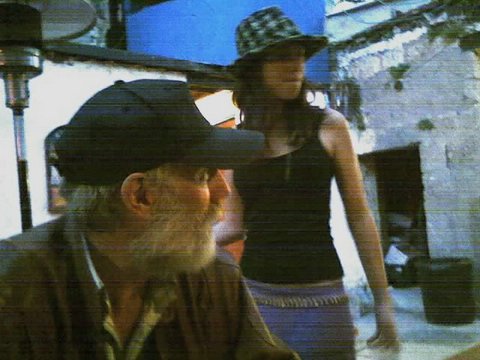 Deklen este prietenul meu irlandez. Are tot umorul, toata candoarea, tot farmecul si toata setea Irlandei. Cand ne intalnim, pericol mare pentru Guiness-ul locului, avem in general grija sa ajungem impreuna la pub. Caci nu e sanatos ca unul din noi sa aiba un start timpuriu, cand celalat i se alatura, primul venit este deja plecat la distante mari. Dar chiar si in aceste conditii vitrege, liniile de comunicatie sa pastreaza in bune conditii tehnice. Nu am un prieten mai placut la baut decat Deklen. O mare traditie de sugatori in Irlanda! Ce parere ai, JJ?
Asaf
 Asaf este un chitarist exceptional. Joaca si biliard foarte bine. Dar este proprietarul barului "Mike's Place", bar prezent si in Tel Aviv si in Ierusalim. Ascuns in curtile de piatra ale cartierului Nahlat Shiva, la Mike's in aceste seri Guiness-ul curge in valuri, intre doua jocuri de biliard tragi cu ochiul la Mondial. Si nu mai putin important, locul este foarte iubit de tineri in trecere prin Ierusalim, veniti din cele patru colturi ale lumii. Ochii care "nu imbatraneste" limpeziti de berea gustoasa, au o bucurie speciala in a privi fetiscanele departe de casa si parinti...
Shimi
 Shimi este etiopian la origina, din Adis Abeba. Zugrav de meserie, casatorit cu o englezoaica din Londra. S-au cunoscut si s-au luat la Ierusalim. O persoana delicata si de o mare sensibilitate, atent si dedicat, liberal in opinii dar inversunat in atitudini, Shimi este un reprezentant de onoare a unei rase nobile. Etiopienii ierusalemiti au doua puncte de mare interes in oras: strada Profetilor si Sfantul Mormant. Un al treilea se naste in piazza Rivlin, la parlamentul nostru de vineri.
Mana in mana cu James
 Nu stiu daca il iubesc pe JJ in calitatea lui de marele scriitor al veacului 20, sau il vreau ca prieten insotitor in odiseele mele, reale sau virtuale. Pornind nu de la ideea speculativa ca onorabilul domn LB este alter ego-ul lui JJ, ci de la certitudine, am hotarat sa fac impreuna cu bardul cativa pasi prin Ierusalimul meu, sa-l cinstesc cu o cantitate suficienta de Guiness, incat nu gura sa i-o deschid ci urechea sa o desfund. Si mai ales ochii. Sa vada ce vad si eu, sa auda ce aud si eu, si impreuna sa radem cu pofta celui care merge prin desert si da peste apa rece.
Sunday, July 02, 2006
If you want to be happy try "Tphilim" Friday evening...
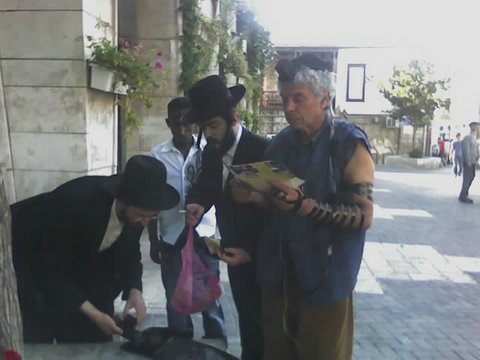 The two ultra orthodox guys , every Friday just before the Shabat, came to Jerusalem central area, visit every pub and offer to the clients to make a prayer and to use the "tphilim". They are nice, not agressive and they belong to the Habad community.
Here in the picture, my friend Eli (he works for the Israeli TV) perform his prayer. He does it every week.
Are Israelis really happy? (Ha-Aretz)
I have a warm feeling and a special friendship for Shahar Ilan. Today a writer for Ha-Aretz, some twenty years ago with “Kol Ha-Ir “ in Jerusalem, the local newspaper attached to Ha-Aretz. Town gossip, stories about the Ultra Orthodox community, and so on. He wrote some stories about me, I was than very much involved with the struggle of the “laics” against the “Ultra Orthodox” attempt to conquer large pieces of the town real estate and to close roads and shops on Shabbat. He wrote also about some projects I designed for the city.Ha-Aretz, a major newspaper in Israel , hired him to become a specialist and writer on matters concerning the religious and ultra orthodox communities in Jerusalem. And now I see him in charge with many feature stories….
Are Israelis really happy? (from Ha-Aretz)
By Shahar Ilan
It happens to us every year. Ever since the Central Bureau of Statistics began publicizing its "social survey" data in 2003, we are surprised each time to hear that four out of every five adults in Israel are content with their lives. Last week, the CBS issued the "happiness meter" statistics (in fact, no such formal appellation exists; it is the writer's invention) for 2005: 82 percent of Israelis are happy with their lives, including 88 percent of young people. Many of these young people, mind you, were too disheartened with the situation to even take the trouble of casting a vote in the election that took place earlier this year.Will the real Israeli people please stand up? Are we a people whose most fundamental human right is the right to grumble and whine? Or are we really so happy? Four years ago, when the CBS findings were first publicized, Haaretz conducted a poll of its own. In that poll, 80 percent of respondents also said they were happy with their lives. But then Haaretz expanded the menu of possible responses, at which point it became clear that the majority were only somewhat happy. It was also found that 85 percent were not happy with the "state of the state." One got the impression that the results in fact indicated that Israel was a country whose citizens had learned to accept the bad news with equanimity. When you ask people to sum up their situation in a single word, they say "Okay." When you ask them to sum it up into more than one word, they answer "Not so okay." This is how statistician Rafi Smith interprets the findings on "satisfaction with one's life." "It's as if you would ask someone how things are going," says Smith. "He answers you with 'okay,' without telling you straight away the entire tale of all his woes. But if you delve deep, you'll find that he has quite a few problems."
One way to explain this, adds Smith, is that "when people talk about their personal lives, they have a tendency to beautify reality." The question, he feels, "doesn't tell you anything about life in Israel, about its complexity, or about what bothers people here." "Israelis love life, like the Brazilians," says sociologist Prof. Oz Almog of the University of Haifa, who goes on to enumerate a few more reasons for our positive outlook: "All of the surveys show that it is alienation that leads to strongly negative feelings, and the key to enjoying life is the sensation that you belong. In Israel, there is a strong sense that the state belongs to me and I belong to the state. Israel is a country in which people wear few masks. They are less guarded; they look each other in the eye. There is an Israeli way of looking at a person. It's very comforting to live this way. There is a high standard of living here. There's also something in the climate." So why do we grumble? "Complaining doesn't mean you're not enjoying life," the sociologist declares. "Some people complain and enjoy the act of complaining." Explanations aside, Almog does not quite believe in these polls. "To a large extent, they're nonsense," he states. "They are the malignant disease of the social sciences."
Are Israelis really happy? (from Ha-Aretz)
By Shahar Ilan
It happens to us every year. Ever since the Central Bureau of Statistics began publicizing its "social survey" data in 2003, we are surprised each time to hear that four out of every five adults in Israel are content with their lives. Last week, the CBS issued the "happiness meter" statistics (in fact, no such formal appellation exists; it is the writer's invention) for 2005: 82 percent of Israelis are happy with their lives, including 88 percent of young people. Many of these young people, mind you, were too disheartened with the situation to even take the trouble of casting a vote in the election that took place earlier this year.Will the real Israeli people please stand up? Are we a people whose most fundamental human right is the right to grumble and whine? Or are we really so happy? Four years ago, when the CBS findings were first publicized, Haaretz conducted a poll of its own. In that poll, 80 percent of respondents also said they were happy with their lives. But then Haaretz expanded the menu of possible responses, at which point it became clear that the majority were only somewhat happy. It was also found that 85 percent were not happy with the "state of the state." One got the impression that the results in fact indicated that Israel was a country whose citizens had learned to accept the bad news with equanimity. When you ask people to sum up their situation in a single word, they say "Okay." When you ask them to sum it up into more than one word, they answer "Not so okay." This is how statistician Rafi Smith interprets the findings on "satisfaction with one's life." "It's as if you would ask someone how things are going," says Smith. "He answers you with 'okay,' without telling you straight away the entire tale of all his woes. But if you delve deep, you'll find that he has quite a few problems."
One way to explain this, adds Smith, is that "when people talk about their personal lives, they have a tendency to beautify reality." The question, he feels, "doesn't tell you anything about life in Israel, about its complexity, or about what bothers people here." "Israelis love life, like the Brazilians," says sociologist Prof. Oz Almog of the University of Haifa, who goes on to enumerate a few more reasons for our positive outlook: "All of the surveys show that it is alienation that leads to strongly negative feelings, and the key to enjoying life is the sensation that you belong. In Israel, there is a strong sense that the state belongs to me and I belong to the state. Israel is a country in which people wear few masks. They are less guarded; they look each other in the eye. There is an Israeli way of looking at a person. It's very comforting to live this way. There is a high standard of living here. There's also something in the climate." So why do we grumble? "Complaining doesn't mean you're not enjoying life," the sociologist declares. "Some people complain and enjoy the act of complaining." Explanations aside, Almog does not quite believe in these polls. "To a large extent, they're nonsense," he states. "They are the malignant disease of the social sciences."
Gigi, viitorul presedinte al Romaniei!
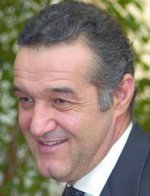
Imi amintesc de T-Shirts cu fata lui Arafat imprimata pe ele, si alaturi de portretul lui atragator, o intrebare:
"Ati cumpara o masina la mana a doua de la el?
Intreb aceeasi intrebare cu noua adresa:
GIGI BECALI....
O stire banala din Bucuresti.
In ziarul Atac din Bucuresti se publica stirea de mai jos, aflam -fara surprindere- ca Gigi Becali cumpara un palat din Bucuresti si cumpara odata cu el o adresa. Aleea Alexandru nr. 1. Adresa se pare ca are semnificatie electorala, Gigi si-a propus sa fie presedintele Romaniei. Veti descoperi in articolul de mai jos atat umorul individului, "jemanfutismul" lui, cat si veleitatile lui politice.
Curios, individul incepe sa-mi fie simpatic. Intr-adevar reprezinta Romania, asa cum este ea. Din punctul meu de vedere n-are decat sa fie presedinte, daca romanii il vor. Caci o tara democrata are si presedintele si primul ministru si politicienii pe care ii merita...
Pe de alta parte, cu ce era mai bun proprietarul de drept al casei, magnatul Auxschmidt?
Primise averea lui de la Dumnezeu direct? Sau fusese abil, smecher si lipsit de scrupule, ca orice individ care sta in spatele unei mari averi?
In concluzie: ce mi-e Auxscmidt, ce mi-e Becali!
Gigi Becali si-a mai cumparat un palat
Autor: A NICUSOR NICULAE (Postat la 30-06-2006)
nicusor.niculae@atac-0nline.ro
7 milioane de dolari.
Atat a platit Gigi Becali pentru vila de patrimoniu, din centrul Capitalei, pe care a cumparat-o miercuri. Casa este situata pe Aleea Alexandru numarul 1 si tocmai acest lucru l-a convins pe finantatorul Stelei sa scoata bani din contul personal.
„Am vrut sa trag asa, o aroganta, partidului PD, caci e langa mine si sunt mai puternic decat partidul PD, pentru ca palatul arata mai tare decat Palatul Modrogan. Nu zic numai de suprafat a construita de 3.000 de metri patrati si de curte, care are 3.200 de metri patrati, dar m-a atras placuta de la intrare. Are numarul 1. Daca era 2, n-o luam. Unu, eu trebuie sa fiu unu intotdeauna“.
Vila a fost a industriasului interbelic Max Auxschmidt, principalul sponsor al regelui Carol al II-lea si al principalelor partide politice. Ulterior, a intrat in administrarea RAPPS si a devenit ambasada pentru Argentina. Apropiatii l-au sfatuit pe Gigi Becali ca, inainte de inceperea renova rilor, sa scoata microfoanele cu care a fost intesata vila. Noul proprietar spune ca va investi cel putin 500 - un milion de euro in reparatii si renovari, pentru ca, „tot ce a fost inainte poleit cu aur, va fi poleit cu aur, iar la sfarsit va fi chiar mai frumos decat inainte. Apoi, instalez aici Comandamentul si pentru partid, si pentru clubul Steaua“. Deja, mai multi muncitori au fost adusi sa faca noi amenajari in curte, iar ieri, noul proprietar a primit un musafir important. Viorel Hrebenciuc a plecat de la Parlament pentru a onora invitatia lui Gigi Becali de a-i vizita cea mai recenta „aroganta“.
Curios, individul incepe sa-mi fie simpatic. Intr-adevar reprezinta Romania, asa cum este ea. Din punctul meu de vedere n-are decat sa fie presedinte, daca romanii il vor. Caci o tara democrata are si presedintele si primul ministru si politicienii pe care ii merita...
Pe de alta parte, cu ce era mai bun proprietarul de drept al casei, magnatul Auxschmidt?
Primise averea lui de la Dumnezeu direct? Sau fusese abil, smecher si lipsit de scrupule, ca orice individ care sta in spatele unei mari averi?
In concluzie: ce mi-e Auxscmidt, ce mi-e Becali!
Gigi Becali si-a mai cumparat un palat
Autor: A NICUSOR NICULAE (Postat la 30-06-2006)
nicusor.niculae@atac-0nline.ro
7 milioane de dolari.
Atat a platit Gigi Becali pentru vila de patrimoniu, din centrul Capitalei, pe care a cumparat-o miercuri. Casa este situata pe Aleea Alexandru numarul 1 si tocmai acest lucru l-a convins pe finantatorul Stelei sa scoata bani din contul personal.
„Am vrut sa trag asa, o aroganta, partidului PD, caci e langa mine si sunt mai puternic decat partidul PD, pentru ca palatul arata mai tare decat Palatul Modrogan. Nu zic numai de suprafat a construita de 3.000 de metri patrati si de curte, care are 3.200 de metri patrati, dar m-a atras placuta de la intrare. Are numarul 1. Daca era 2, n-o luam. Unu, eu trebuie sa fiu unu intotdeauna“.
Vila a fost a industriasului interbelic Max Auxschmidt, principalul sponsor al regelui Carol al II-lea si al principalelor partide politice. Ulterior, a intrat in administrarea RAPPS si a devenit ambasada pentru Argentina. Apropiatii l-au sfatuit pe Gigi Becali ca, inainte de inceperea renova rilor, sa scoata microfoanele cu care a fost intesata vila. Noul proprietar spune ca va investi cel putin 500 - un milion de euro in reparatii si renovari, pentru ca, „tot ce a fost inainte poleit cu aur, va fi poleit cu aur, iar la sfarsit va fi chiar mai frumos decat inainte. Apoi, instalez aici Comandamentul si pentru partid, si pentru clubul Steaua“. Deja, mai multi muncitori au fost adusi sa faca noi amenajari in curte, iar ieri, noul proprietar a primit un musafir important. Viorel Hrebenciuc a plecat de la Parlament pentru a onora invitatia lui Gigi Becali de a-i vizita cea mai recenta „aroganta“.
Friday, June 30, 2006
Despre presa romaneasca si o propunere interesanta
Cand sunt la Bucuresti, intr-o carciuma sau alta, la ora pranzului, citesc ca tot omul, ziarul. "Jurnalul National" de pilda, de mare popularitate, spatios, generos, cu informatile de care ai neaparata nevoie, cum ar fi vremea. Si vremurile. Ziarul il poti gasi distribuit generos cu o seara inainte de aparitia pe piata la Taverna Sarbului, carciuma si ea populara in propritatea (Minune!) a proprietarului Jurnalului National (parca Tuca pe nume).
O fituica de scandal pe care o poti vedea si pe net este "Atac"-(http://www.atac-online.ro/index.php) care astazi arunca o propunere interesanta catre judetele tarii:
"Info Media Press ofera franciza ATAC! Cotidianul ATAC si-a recastigat, in numai cateva zile de la relansare, pozitia importanta de pe piata media din Romania. Detinatoarea brandului ATAC, societatea Info Media Press, care editeaza ziarul, ofera franciza ATAC pe toate judetele tarii. Toti cei care sunt interesati de infiintarea unor ziare locale sau regionale sub sigla ATAC sunt rugati sa ne contacteze, pentru detalii, la numerele de telefon: (021)2.60.20.70 sau 0742.09.09.02 "
Asa ca, daca dintre cititorii mei, cineva este interesat, iata informatia necesara pentru o afacere, cine stie?, manoasa...
Un avantaj au cu siguranta ziarele romanesti. Se citesc repede. Ori stapanesc eu bine limba romana, ori continutul lor este...subtire.
O fituica de scandal pe care o poti vedea si pe net este "Atac"-(http://www.atac-online.ro/index.php) care astazi arunca o propunere interesanta catre judetele tarii:
"Info Media Press ofera franciza ATAC! Cotidianul ATAC si-a recastigat, in numai cateva zile de la relansare, pozitia importanta de pe piata media din Romania. Detinatoarea brandului ATAC, societatea Info Media Press, care editeaza ziarul, ofera franciza ATAC pe toate judetele tarii. Toti cei care sunt interesati de infiintarea unor ziare locale sau regionale sub sigla ATAC sunt rugati sa ne contacteze, pentru detalii, la numerele de telefon: (021)2.60.20.70 sau 0742.09.09.02 "
Asa ca, daca dintre cititorii mei, cineva este interesat, iata informatia necesara pentru o afacere, cine stie?, manoasa...
Un avantaj au cu siguranta ziarele romanesti. Se citesc repede. Ori stapanesc eu bine limba romana, ori continutul lor este...subtire.
Tomorow's pilots
 Palestinian kids from Gaza Strip watching the sky where deadly Israeli planes fly over them .
If you look carefuly at their faces you see no fear, just interest for those "wonderful flying machines".
Kids are the same all over the world. Women and kids should negotiate peace treaties...
Thursday, June 29, 2006

Dead Sea is dying
In prea putinele sambete cand sunt acasa la Ierusalim, ma sui inmasina si in cca. 10 minute clima si peisajul se schimba, am plecatspre soare rasare, spre Marea Moarta. Cobor rapid serpentinele, dela cca 800 de metrii deasupra nivelului marii ajung in 20 de minutela borna care marcheaza nivelul 0, adica nivelul marilor si oceanelor(si unde un beduin cu o camila asteapta turisti pentru o poza de pusin rama). Dupa inca 15 minute sunt deja pe malul marii, pe drumulcare duce pana la Eilat si mai departe pana la Sharm El Sheih. Darma opresc pe lplaja numita "Mineral" unde un bazin cu izvoare desulf fac minune pentru piciorul meu cotonogit. Peisajul esteuluitor, lunatic, undeva exista umbra lui Lot, Sodoma (plina deHoteluri) si Gomora, unde o fi ea.Nivelul Marii Moarte scade in fiecare an. Odata alimentata de apeleIordanului, astazi nu mai primeste cantitatea de apa necesaramentinerii nivelului, si incet incet piere. Trist.Pun pentru informatii interesante un material aparut astazi in Ha-Aretz. Sunt pana la urma optimist, dezastrul va fi oprit.:
No quick fixes for the Dead Sea
By Zafrir Rinat (Ha Aretz)
"The desert and the barren hills gleam painfully in the sun, aroundthe Dead Sea, and there is no pleasant thing or living creature uponit or about its borders to cheer the eye. It is a scorching, arid,repulsive solitude. A silence broods over the scene that isdepressing to the spirits. It makes one think of funerals anddeath."This was Mark Twain's impression of the Dead Sea's environs. Twain,who actually enjoyed bathing in the sea itself, would probably besurprised by the abundance of activity at the place that so deeplydepressed him. Nowadays factories, hotels and communities stretchalong the sea's shores.However, their fate - and that of regional plans - are unclear atthe moment. A report in circulation says the region must bedeveloped completely differently than is currently planned. Thereason: Unlike as in Twain's days, dropping water levels are causingthe Dead Sea to disappear gradually, and the surrounding area isbeing destroyed as a result.This report, "The Dead Sea Basin Policy Paper," was commissioned bythe government and prepared by the Ministry of Environment, theGeological Institute, the Jerusalem Institute for Israel Studies'Center for Environmental Policy, and environmental planner MotiKaplan. Attached to it is a letter from the Environment Ministrydirector general, Dr. Miki Haran, which contains the report's mainmessage: The Dead Sea's problems will not disappear in the next 30or 40 years, if not longer, and this must be taken into account inregional development plans.No immediate solutionGeologists and water experts have thorougly researched the problemsstemming from the dropping water level, and the report describesthem at length. The water has been declining by about a meter peryear due to the diversion of the Jordan River and its tributaries,which used to flow into the Dead Sea, and the use of the Dead Sea'swater by factories in Israel and Jordan. (The latter is responsiblefor approximately 40 percent of the annual decline.)The most serious side effect of the receding sea is the suddencreation of large sinkholes. In the northern Dead Sea, close to 200sinkholes appear each year, and they have already caused seriousinfrastructure damage and shut down various tourist facilities.Another serious problem is the changes underway in nearby rivers,which are fed primarily by floodwater. In the past, these riversflowed directly into the Dead Sea. But the receding shoreline haschanged the paths of the rivers, which now threaten buildingfoundations and the main highway in the region. Around Nahal David,a major tourist attraction in the area, the river is expected tocause the road to collapse within 25 years.The geologists Dr. Amir Eidelman and Dr. Amos Bein, who were keycollaborators in preparing the policy paper, say these problems willnot disappear quickly, even if the state promptly finds ways tostabilize the water level. One possible solution involves divertingwater from Lake Kinneret back to the Jordan River, and from there tothe Dead Sea. Another option is channeling a large quantity of waterfrom the Gulf of Eilat via Jordanian territory."Channeling water through the Jordan River in the quantities underdiscussion could only slow the process of declining water levels,"says Dr. Bein. "You have to take into account that the influx offresh water would create layers in the sea. The fresh water would beon top, and it would evaporate faster."Bein believes bringing water from Eilat would be more effective, buthe notes that the feasibility studies for such a project could takeclose to 20 years, during which time the water level would continuedropping - and then it would take another 20 years before theproject could restore the sea to its current level, which in and ofitself is problematically low."It is hard for people to understand that there is no immediatesolution to the Dead Sea's problem," says document author GalitCohen, of the Environment Ministry."It has to be clear, no matter what we do, that we will be livingwith this situation for another 20 years," adds Dr. Eidelman.Shuttles to the shoreSo much for the pessimistic part. But the authors of the policypaper say it contains an optimistic message as well. Development ofthe Dead Sea region can be planned in such a way to enablesettlement and tourism even as the water level continues dropping.In maps accompanying the policy paper, the authors illustrate howfar the sea is expected to recede, and where sinkholes are expectedto form as a result. They recommend against building in these areas,near Ein Gedi, Avnat and Mitzpeh Shalem - where several largetourism-related projects, including hotels, baths and beachdevelopment, are in the works. Instead, the report proposesdeveloping to the west of the road running along the Dead Sea. "Ifthey continue to build hotels close to the sea, they will find thearea gradually disappearing and filling with pits," says Bein. "Thisis not how to establish a hotel adjacent to the sea. We suggestmoving to safe ground and having shuttles bring people to bathe."The paper's authors say that in order to promote this approach, amaster plan should be created that defines precisely the areasdesignated for development and the building restrictions. They arenow working on a proposal to be submitted to the government, whichwill delegate future management of the area to various ministries.For example, the paper suggests that the interior and tourismministries survey existing tourist facilities in threatened areasand decide what steps should be taken, including issuing warnings tothe public."We believe it is possible to manage the area properly, and if thereis peace, it can be a regional process," says Eidelman.The process of preparing the Dead Sea policy paper raised the hopesof officials at the Tamar Regional Council, which is responsible forsome of the shoreline communities. They had hoped to receiveguidelines on how to proceed with planned development for the area,and they were sorely disappointed."We think that the policy paper describes the current situationthoroughly and in depth," says the head of the regional council, DovLitwinoff. "However, the significance of the recommendations is thatthe only thing left to do is get compensation and leave, becausethere is no possibility of developing the region. Whoever wrote thedocument understands a lot about geology, but not about tourism.Tourism in the region is based entirely on the sea. They suggest weconcentrate all development in areas far away from it, which areactually located inside nature reserves. Who will let us buildhotels in nature reserves?"The document's authors respond that they marked areas where futurebuilding is indeed possible.Litwinoff and the regional council engineer, Avi Rotem, say tourismdevelopment can be promoted even in areas where there may be pits,by, among other ways, pumping groundwater out of the areas fromwhere the sea has receded. The sweet water dissolves undergroundchunks of salt, forming sinkholes."Other places in the world have sinkholes, and people haven'tabandoned them," says Rotem."You don't need to develop in an area where there already are pitsso long as there are engineering solutions," says Litwinoff. "But incertain areas that the paper's authors feel should not be developed,we can drill to check for salt chunks and assess the risk ofsinkholes.""A multidisciplinary engineering team was recently working in thearea, and it was supposed to set planning guidelines for the DeadSea, including determining what can and cannot be built," saysRotem. "For some reason, they decided the regional council shouldfinance such a national project, which would cost NIS 15 million. Wedon't have the budget for that, and as a result the team'soperations were halted.""If there are funds, then there will be solutions, such as buildingdesalination plants, which would enable the transfer of water fromLake Kinneret to the Dead Sea," adds Litwinoff. "This would notreverse the situation, but would moderate the drop in the waterlevel."
No quick fixes for the Dead Sea
By Zafrir Rinat (Ha Aretz)
"The desert and the barren hills gleam painfully in the sun, aroundthe Dead Sea, and there is no pleasant thing or living creature uponit or about its borders to cheer the eye. It is a scorching, arid,repulsive solitude. A silence broods over the scene that isdepressing to the spirits. It makes one think of funerals anddeath."This was Mark Twain's impression of the Dead Sea's environs. Twain,who actually enjoyed bathing in the sea itself, would probably besurprised by the abundance of activity at the place that so deeplydepressed him. Nowadays factories, hotels and communities stretchalong the sea's shores.However, their fate - and that of regional plans - are unclear atthe moment. A report in circulation says the region must bedeveloped completely differently than is currently planned. Thereason: Unlike as in Twain's days, dropping water levels are causingthe Dead Sea to disappear gradually, and the surrounding area isbeing destroyed as a result.This report, "The Dead Sea Basin Policy Paper," was commissioned bythe government and prepared by the Ministry of Environment, theGeological Institute, the Jerusalem Institute for Israel Studies'Center for Environmental Policy, and environmental planner MotiKaplan. Attached to it is a letter from the Environment Ministrydirector general, Dr. Miki Haran, which contains the report's mainmessage: The Dead Sea's problems will not disappear in the next 30or 40 years, if not longer, and this must be taken into account inregional development plans.No immediate solutionGeologists and water experts have thorougly researched the problemsstemming from the dropping water level, and the report describesthem at length. The water has been declining by about a meter peryear due to the diversion of the Jordan River and its tributaries,which used to flow into the Dead Sea, and the use of the Dead Sea'swater by factories in Israel and Jordan. (The latter is responsiblefor approximately 40 percent of the annual decline.)The most serious side effect of the receding sea is the suddencreation of large sinkholes. In the northern Dead Sea, close to 200sinkholes appear each year, and they have already caused seriousinfrastructure damage and shut down various tourist facilities.Another serious problem is the changes underway in nearby rivers,which are fed primarily by floodwater. In the past, these riversflowed directly into the Dead Sea. But the receding shoreline haschanged the paths of the rivers, which now threaten buildingfoundations and the main highway in the region. Around Nahal David,a major tourist attraction in the area, the river is expected tocause the road to collapse within 25 years.The geologists Dr. Amir Eidelman and Dr. Amos Bein, who were keycollaborators in preparing the policy paper, say these problems willnot disappear quickly, even if the state promptly finds ways tostabilize the water level. One possible solution involves divertingwater from Lake Kinneret back to the Jordan River, and from there tothe Dead Sea. Another option is channeling a large quantity of waterfrom the Gulf of Eilat via Jordanian territory."Channeling water through the Jordan River in the quantities underdiscussion could only slow the process of declining water levels,"says Dr. Bein. "You have to take into account that the influx offresh water would create layers in the sea. The fresh water would beon top, and it would evaporate faster."Bein believes bringing water from Eilat would be more effective, buthe notes that the feasibility studies for such a project could takeclose to 20 years, during which time the water level would continuedropping - and then it would take another 20 years before theproject could restore the sea to its current level, which in and ofitself is problematically low."It is hard for people to understand that there is no immediatesolution to the Dead Sea's problem," says document author GalitCohen, of the Environment Ministry."It has to be clear, no matter what we do, that we will be livingwith this situation for another 20 years," adds Dr. Eidelman.Shuttles to the shoreSo much for the pessimistic part. But the authors of the policypaper say it contains an optimistic message as well. Development ofthe Dead Sea region can be planned in such a way to enablesettlement and tourism even as the water level continues dropping.In maps accompanying the policy paper, the authors illustrate howfar the sea is expected to recede, and where sinkholes are expectedto form as a result. They recommend against building in these areas,near Ein Gedi, Avnat and Mitzpeh Shalem - where several largetourism-related projects, including hotels, baths and beachdevelopment, are in the works. Instead, the report proposesdeveloping to the west of the road running along the Dead Sea. "Ifthey continue to build hotels close to the sea, they will find thearea gradually disappearing and filling with pits," says Bein. "Thisis not how to establish a hotel adjacent to the sea. We suggestmoving to safe ground and having shuttles bring people to bathe."The paper's authors say that in order to promote this approach, amaster plan should be created that defines precisely the areasdesignated for development and the building restrictions. They arenow working on a proposal to be submitted to the government, whichwill delegate future management of the area to various ministries.For example, the paper suggests that the interior and tourismministries survey existing tourist facilities in threatened areasand decide what steps should be taken, including issuing warnings tothe public."We believe it is possible to manage the area properly, and if thereis peace, it can be a regional process," says Eidelman.The process of preparing the Dead Sea policy paper raised the hopesof officials at the Tamar Regional Council, which is responsible forsome of the shoreline communities. They had hoped to receiveguidelines on how to proceed with planned development for the area,and they were sorely disappointed."We think that the policy paper describes the current situationthoroughly and in depth," says the head of the regional council, DovLitwinoff. "However, the significance of the recommendations is thatthe only thing left to do is get compensation and leave, becausethere is no possibility of developing the region. Whoever wrote thedocument understands a lot about geology, but not about tourism.Tourism in the region is based entirely on the sea. They suggest weconcentrate all development in areas far away from it, which areactually located inside nature reserves. Who will let us buildhotels in nature reserves?"The document's authors respond that they marked areas where futurebuilding is indeed possible.Litwinoff and the regional council engineer, Avi Rotem, say tourismdevelopment can be promoted even in areas where there may be pits,by, among other ways, pumping groundwater out of the areas fromwhere the sea has receded. The sweet water dissolves undergroundchunks of salt, forming sinkholes."Other places in the world have sinkholes, and people haven'tabandoned them," says Rotem."You don't need to develop in an area where there already are pitsso long as there are engineering solutions," says Litwinoff. "But incertain areas that the paper's authors feel should not be developed,we can drill to check for salt chunks and assess the risk ofsinkholes.""A multidisciplinary engineering team was recently working in thearea, and it was supposed to set planning guidelines for the DeadSea, including determining what can and cannot be built," saysRotem. "For some reason, they decided the regional council shouldfinance such a national project, which would cost NIS 15 million. Wedon't have the budget for that, and as a result the team'soperations were halted.""If there are funds, then there will be solutions, such as buildingdesalination plants, which would enable the transfer of water fromLake Kinneret to the Dead Sea," adds Litwinoff. "This would notreverse the situation, but would moderate the drop in the waterlevel."
Wednesday, June 28, 2006
Pedeapsa lui Ahmadinejad. Arhivele naziste si arhivele securitatii...

Arhivele naziste si arhivele securitatii.
Dupa lupte seculare care au durat aproape 60 de ani, guvernul german a hotarat sa deschida arhivele naziste. Aceste arhive contin milioane de dosare, explica pentru cine e curios mecanismul Holocaustului si bineinteles satisfac cerintele ultimilor supravietuitori.
Decizia guvernului german va fi parafata in luna Iulie. Amanunte pot fi citite la :
http://tinyurl.com/qct77
In orice caz este de presupus ca primul ministru Iranian nu va consulta aceste dosare, nu esantioane si nu dosare alese.
Personal, daca as pune mana pe el, l-as inchide intr-o cusca de sticla, I-as da in fiecare zi un dosar sa-l invete, si daca stie lectia a doua zi, primeste o bucata de paine si un pahar cu apa. 365 de dosare pe an, 7300 pentru 20 de ani. I-as da drumul dupa ani sa lucreze liber “shoe shine boy.”Cat despre arhivele securitatii, inteleg ca accesul la ele pare a fi liber. Nu stiu insa daca dosarele securitatii au fost pastrate lustruite si in ordine, asa cum presupun ca au fost pastrate de iubitul popor german. Pentru ordine ii iubim noi pe ei. Iar ei pe noi...mai putin.
Blogs -----Terrible story (Ha-Aretz)
Blog of a death foretold
By Oded Yaron
The suicide of Meirav Kanner, known online as Rapunzel, continues to resound through the Israeli blogosphere. Following her death on June 17, there have been calls to define the limits of online discourse in order to minimize harm to the people behind the blogs. Kanner, who wrote that she had emotional problems as a result of physical abuse suffered as a child, revealed her plight for the first time in 2004 in posts accusing her father of the abuse. She was interviewed by various mass media outlets and began a blog, in which she told her story through her political struggle as a feminist and an emotionally troubled woman. Over the past two years she received warm and sympathetic responses ? as well as hurtful and disparaging ones. Kanner herself did not respond only to the gentler comments, and often conducted stinging verbal fights with surfers. In the last few weeks of her life, Kanner's emotional state apparently deteriorated, and she hurled harsh accusations at various people, even mentioning their names on her blog. Yariv Habot, the founder and operator of Israelblog, felt compelled to remove her blog from the Internet to avoid the risk of a lawsuit. .
Kanner responded by launching an independent blog with the help of Internet columnist and blogger Hanan Cohen. Kanner declared a hunger strike and continued her verbal assault. After her death, and at her request, Cohen deleted her blog and had it removed from Google's archives. A few days later, however, Kanner's partner restored her blog's archives to the Internet . The suicide sparked a flood of reactions, discussions and personal accountings in the blogosphere, starting with people who eulogized Kanner with great sadness and ending with others incapable of forgiving the woman who had hurt so many of them. The most burning question among many of the writers, however, was, "Could we have prevented such a bitter ending?" Leora Arnon, director of Sahar, an Internet-based emotional support service for people with suicidal tendencies and psychologist Yael Doron, manager of support for the Yelem Web site, are uncertain whether anyone could have helped in this specific case. Still, they are convinced that in similar cases help could make a difference. In the five years since Sahar's founding, Arnon says the organization's volunteers have called the police in more than a dozen cases, and the officers arrived in time to find the would-be victim after he or she had already swallowed pills. "Suicide notes are posted on the Internet almost daily," says Arnon, but not every such letter ends in suicide. Still, she says, assistance should be offered before the situation becomes critical, so most of Sahar's efforts are invested in listening and offering support and advice. No answerThe death of Kanner, and the hostility that surrounded her blog, sparked a serious discussion of the blogosphere's debate culture. Kanner's case may have been extreme, but it was not unique. The verbal assaults and vitriol often found online have prompted at least some people to withdraw from the arena. Just last week one young blogger, who runs a popular Web diary, announced he was ending his blog. "You knew this would happen. You knew it. You cursed me and made me feel miserable. There is no point in continuing. I have no reason to," he writes. ?(He later relented in response to encouragement from fans?). One woman who works in the communications field and is a former blogger says she stopped blogging because she felt the online interaction was hurting her. Still, she says that from the outset she felt that she, like many others, had become addicted to this medium. "This possibility of receiving immediate feedback on anything that happens is addictive," concurs Habot. That feedback, explains the former blogger, can lead to extremism. "You say something and no one responds, so you say it again, stronger," she says. "Suddenly, I realized that everyone wants to express himself and practically no one wants to listen. The blogosphere is a radical version of the real world, and it is a terribly violent and unsafe environment." She, like others, believes this dynamic contributed to Kanner's suicide. Doron, of Yelem, disagrees, contending that the Web is nothing more than a reflection of society, and that our society today is very intense and instantaneous. The heated debate over the influence of the Internet is a new extension of the never-ending debate on television ? does it reflect society's violence, or does it create it? Doron cites an article by Sahar's founder, Prof. Azy Barak , in which he explains that the Internet contains addiction, alienation, isolation and violence, but also supportive shoulders, help and a lot of good will. Culture researcher Carmel Weissman, who is writing her doctoral thesis on blogs, explains that many bloggers do not feel they are publicizing their works and thoughts: They perceive the medium as their personal space. They consider it speaking with friends. These two contradictory spheres ? the private and the public ? coexist in blogs, and the mixture is very confusing. As noted above, lately there have been calls for the establishment of a convention regulating relationships in the blogosphere . Some prominent voices among them are Uri Katzir, a blogger and spokesman for the Israel Securities Authority; Jonathan Klinger, a lawyer and active Internet contributor; and Sarit Frankel, a journalist . Frankel even foretells of the blogosphere's demise if the violence is not curtailed. "There must be some commitment to ground rules, a certain 'gentlemanliness,'" says Katzir. "For example, not humiliating someone publicly online, certainly not before he has been found guilty of wrongdoing. Not that someone who violates the rules would be ostracized, but one could hope for a place in which you accept certain rules of behavior."
By Oded Yaron
The suicide of Meirav Kanner, known online as Rapunzel, continues to resound through the Israeli blogosphere. Following her death on June 17, there have been calls to define the limits of online discourse in order to minimize harm to the people behind the blogs. Kanner, who wrote that she had emotional problems as a result of physical abuse suffered as a child, revealed her plight for the first time in 2004 in posts accusing her father of the abuse. She was interviewed by various mass media outlets and began a blog, in which she told her story through her political struggle as a feminist and an emotionally troubled woman. Over the past two years she received warm and sympathetic responses ? as well as hurtful and disparaging ones. Kanner herself did not respond only to the gentler comments, and often conducted stinging verbal fights with surfers. In the last few weeks of her life, Kanner's emotional state apparently deteriorated, and she hurled harsh accusations at various people, even mentioning their names on her blog. Yariv Habot, the founder and operator of Israelblog, felt compelled to remove her blog from the Internet to avoid the risk of a lawsuit. .
Kanner responded by launching an independent blog with the help of Internet columnist and blogger Hanan Cohen. Kanner declared a hunger strike and continued her verbal assault. After her death, and at her request, Cohen deleted her blog and had it removed from Google's archives. A few days later, however, Kanner's partner restored her blog's archives to the Internet . The suicide sparked a flood of reactions, discussions and personal accountings in the blogosphere, starting with people who eulogized Kanner with great sadness and ending with others incapable of forgiving the woman who had hurt so many of them. The most burning question among many of the writers, however, was, "Could we have prevented such a bitter ending?" Leora Arnon, director of Sahar, an Internet-based emotional support service for people with suicidal tendencies and psychologist Yael Doron, manager of support for the Yelem Web site, are uncertain whether anyone could have helped in this specific case. Still, they are convinced that in similar cases help could make a difference. In the five years since Sahar's founding, Arnon says the organization's volunteers have called the police in more than a dozen cases, and the officers arrived in time to find the would-be victim after he or she had already swallowed pills. "Suicide notes are posted on the Internet almost daily," says Arnon, but not every such letter ends in suicide. Still, she says, assistance should be offered before the situation becomes critical, so most of Sahar's efforts are invested in listening and offering support and advice. No answerThe death of Kanner, and the hostility that surrounded her blog, sparked a serious discussion of the blogosphere's debate culture. Kanner's case may have been extreme, but it was not unique. The verbal assaults and vitriol often found online have prompted at least some people to withdraw from the arena. Just last week one young blogger, who runs a popular Web diary, announced he was ending his blog. "You knew this would happen. You knew it. You cursed me and made me feel miserable. There is no point in continuing. I have no reason to," he writes. ?(He later relented in response to encouragement from fans?). One woman who works in the communications field and is a former blogger says she stopped blogging because she felt the online interaction was hurting her. Still, she says that from the outset she felt that she, like many others, had become addicted to this medium. "This possibility of receiving immediate feedback on anything that happens is addictive," concurs Habot. That feedback, explains the former blogger, can lead to extremism. "You say something and no one responds, so you say it again, stronger," she says. "Suddenly, I realized that everyone wants to express himself and practically no one wants to listen. The blogosphere is a radical version of the real world, and it is a terribly violent and unsafe environment." She, like others, believes this dynamic contributed to Kanner's suicide. Doron, of Yelem, disagrees, contending that the Web is nothing more than a reflection of society, and that our society today is very intense and instantaneous. The heated debate over the influence of the Internet is a new extension of the never-ending debate on television ? does it reflect society's violence, or does it create it? Doron cites an article by Sahar's founder, Prof. Azy Barak , in which he explains that the Internet contains addiction, alienation, isolation and violence, but also supportive shoulders, help and a lot of good will. Culture researcher Carmel Weissman, who is writing her doctoral thesis on blogs, explains that many bloggers do not feel they are publicizing their works and thoughts: They perceive the medium as their personal space. They consider it speaking with friends. These two contradictory spheres ? the private and the public ? coexist in blogs, and the mixture is very confusing. As noted above, lately there have been calls for the establishment of a convention regulating relationships in the blogosphere . Some prominent voices among them are Uri Katzir, a blogger and spokesman for the Israel Securities Authority; Jonathan Klinger, a lawyer and active Internet contributor; and Sarit Frankel, a journalist . Frankel even foretells of the blogosphere's demise if the violence is not curtailed. "There must be some commitment to ground rules, a certain 'gentlemanliness,'" says Katzir. "For example, not humiliating someone publicly online, certainly not before he has been found guilty of wrongdoing. Not that someone who violates the rules would be ostracized, but one could hope for a place in which you accept certain rules of behavior."
Conferinte bune pentru afaceri
Mi-am petrecut dimineta la Centrul de Congrese al Ierusalimului (Binianei Ha-uma).
Conferinta pentru Ierusalim, in prezenta anuntata a primului ministru,primarului, minstrului de externe (o doamna si ea, foarte atragatoare –Tzipi Livni), GM-ii marlor companii de constructii, functionarii primariei si guvernului responsabili pentru dezvoltare si finante.
Primul ministru n-a venit, dar si-a transmis discursul prin video, n-a ochit camera de filmare cum trebuie sin u privea participantii in ochi…straniu.
Altfel, nimic nou pentru mine, cam aceleasi texte cu care ne-am obisnuit, cu exceptia ministrului de externe care a profitat de ocazie pentru a face declaratii importante legate de evenimentele arzatoare la ordinea zilei, care sunt intr-adevar arzatoare si daca nu se intampla o minune, e mult sange vinovat si nevinovat pe drum.
Un singur lucru e cert insa. Mi-am castigat painea pe ziua de astazi. Am intalnit o caruta de personae extreme de importante pentru "gesheftul" meu, pe care, ca sa-I intalnesc sis a stau de vorba cu ei mi-ar fi trebuit vre-o doi ani.
Voi propune primarului sa organizam aceasta conferinta odata la sase luni, cel putin.
Conferinta pentru Ierusalim, in prezenta anuntata a primului ministru,primarului, minstrului de externe (o doamna si ea, foarte atragatoare –Tzipi Livni), GM-ii marlor companii de constructii, functionarii primariei si guvernului responsabili pentru dezvoltare si finante.
Primul ministru n-a venit, dar si-a transmis discursul prin video, n-a ochit camera de filmare cum trebuie sin u privea participantii in ochi…straniu.
Altfel, nimic nou pentru mine, cam aceleasi texte cu care ne-am obisnuit, cu exceptia ministrului de externe care a profitat de ocazie pentru a face declaratii importante legate de evenimentele arzatoare la ordinea zilei, care sunt intr-adevar arzatoare si daca nu se intampla o minune, e mult sange vinovat si nevinovat pe drum.
Un singur lucru e cert insa. Mi-am castigat painea pe ziua de astazi. Am intalnit o caruta de personae extreme de importante pentru "gesheftul" meu, pe care, ca sa-I intalnesc sis a stau de vorba cu ei mi-ar fi trebuit vre-o doi ani.
Voi propune primarului sa organizam aceasta conferinta odata la sase luni, cel putin.
Tuesday, June 27, 2006
If we are not for ourselves, who will be for us- from Ha-Aretz
"Cainii latra, caravana trece" este un adevar care sta la baza scurtei existente in istorie a Statului Israel. Astazi, acum aproape 40 de ani -"razboiul de sase zile"-, "razboiul pentru independenta" din 1948, si se pare si mai departe, pe drumul anevoios spre o existenta pasnica a neamului lui Israel.
The unilateral way
By Yoel Marcus (Ha -Aretz)
On his trips to America and Europe, Prime Minster Ehud Olmert was greeted with honor and a great deal of sympathy. They clapped him on the shoulder, but behind the gestures of respect and encouragement, they hid their disagreement with unilateral steps by Israel, which borders on a veto of the convergence (or "realignment") plan. Not a unilateral initiative, they said, but rather an agreement through dialogue and negotiations. But with Hamas in the Palestinian Authority government and terror organizations bombarding, fighting, shooting, killing and abducting, there is no partner for dialogue. Israel evacuated the Gaza Strip to the last millimeter of the 1967 lines. Was this not a sufficient signal to the Palestinians that there is something to discuss? After the ambush that was carried out by Hamas on Sunday and the kidnapping of IDF soldier Gilad Shalit, Olmert said to me that the test of Palestinian Authority Chairman Mahmoud Abbas (Abu Mazen) is here and now, the test of whether there can be a move of dialogue here. Contrary to the advice of his hosts across the sea, Olmert stressed that convergence is his only option. He is sticking to it, and he will implement it. From the establishment of the state till this day, most of the important decisions and moves by Israel's governments have been taken unilaterally, without listening to the advice of world leaders. David Ben-Gurion decided on the establishment of the state on May 14 contrary to the demand and pressures from the State Department "to postpone the date." From then until prime minister Ariel Sharon's turnaround to "shelve the dream of the Greater Land of Israel," most of Israel's big decisions have been unilateral, sometimes taken over domestic political opposition and sometimes over international objections.
Advertisement
Jerusalem's liberation and the occupation of the Golan Heights in 1967 were against international public opinion. The Six Day War was carried out despite an ultimatum from Charles de Gaulle: "Don't fire the first shot." He punished us with an embargo on weapons shipments and reversed his pro-Israeli policy in favor of the Arabs. He could not forgive us for having won. The 1956 Sinai Campaign, which was aimed at putting an end to terror attacks from Gaza under Egyptian guidance, was carried out with opposition and threats by America and the Soviet Union. Within several months, we were compelled to withdraw from all of Sinai, but we achieved 10 years of quiet. We built our nuclear strength without the agreement of the United States, and the bombing of the Iraqi reactor was carried out solely based on our own judgment. The United States was not in the picture when Moshe Dayan and Menachem Begin secretly cooked up Egyptian president Anwar Sadat's historic visit to Jerusalem - the administration, which was at the stage of convening an international summit, heard about Sadat's visit on Walter Cronkite's news broadcast. The administration, which had been massively assuring Israel it would not recognize the Palestinian Liberation Organization and Yasser Arafat, did not know that at the same time, the Oslo agreement was cooking. And finally: Sharon's historic move of shelving the dream of the Greater Land of Israel - it was unilateral, without America's prior knowledge, without the knowledge of his party, and without the knowledge of his government. But most of the public accepted the unilateral disengagement with a sigh of relief. At long last a spark of hope. We are leaving unilaterally. If they want to, they will start to talk to us; if they don't want to, they will remain in the poverty and suffering they brought upon themselves. The convergence is not for the Palestinians, but for us. The more you are converged and cut off, the fewer the points of friction with the Palestinians. The Western countries fear that in this way we are establishing our permanent borders. But this is not the case. The intention is to converge into convenient temporary borders, until the Palestinians come to their senses. When Rabbi Ovadia Yosef asks what we are getting in return for the disengagement, he is proving that perhaps he is a great Torah scholar, but he hasn't got a clue about politics. It is the Palestinians who should be afraid of the continuation of the terror, of non-recognition of Israel, of laying down unreasonable conditions for dialogue, and in this, they are losing all their cards for negotiations. Israel cannot be in a situation in which every terrorist will dictate its agenda to it. The motto that emerges from Olmert's words is simple and logical: If we are not for ourselves, who will be for us.
The unilateral way
By Yoel Marcus (Ha -Aretz)
On his trips to America and Europe, Prime Minster Ehud Olmert was greeted with honor and a great deal of sympathy. They clapped him on the shoulder, but behind the gestures of respect and encouragement, they hid their disagreement with unilateral steps by Israel, which borders on a veto of the convergence (or "realignment") plan. Not a unilateral initiative, they said, but rather an agreement through dialogue and negotiations. But with Hamas in the Palestinian Authority government and terror organizations bombarding, fighting, shooting, killing and abducting, there is no partner for dialogue. Israel evacuated the Gaza Strip to the last millimeter of the 1967 lines. Was this not a sufficient signal to the Palestinians that there is something to discuss? After the ambush that was carried out by Hamas on Sunday and the kidnapping of IDF soldier Gilad Shalit, Olmert said to me that the test of Palestinian Authority Chairman Mahmoud Abbas (Abu Mazen) is here and now, the test of whether there can be a move of dialogue here. Contrary to the advice of his hosts across the sea, Olmert stressed that convergence is his only option. He is sticking to it, and he will implement it. From the establishment of the state till this day, most of the important decisions and moves by Israel's governments have been taken unilaterally, without listening to the advice of world leaders. David Ben-Gurion decided on the establishment of the state on May 14 contrary to the demand and pressures from the State Department "to postpone the date." From then until prime minister Ariel Sharon's turnaround to "shelve the dream of the Greater Land of Israel," most of Israel's big decisions have been unilateral, sometimes taken over domestic political opposition and sometimes over international objections.
Advertisement
Jerusalem's liberation and the occupation of the Golan Heights in 1967 were against international public opinion. The Six Day War was carried out despite an ultimatum from Charles de Gaulle: "Don't fire the first shot." He punished us with an embargo on weapons shipments and reversed his pro-Israeli policy in favor of the Arabs. He could not forgive us for having won. The 1956 Sinai Campaign, which was aimed at putting an end to terror attacks from Gaza under Egyptian guidance, was carried out with opposition and threats by America and the Soviet Union. Within several months, we were compelled to withdraw from all of Sinai, but we achieved 10 years of quiet. We built our nuclear strength without the agreement of the United States, and the bombing of the Iraqi reactor was carried out solely based on our own judgment. The United States was not in the picture when Moshe Dayan and Menachem Begin secretly cooked up Egyptian president Anwar Sadat's historic visit to Jerusalem - the administration, which was at the stage of convening an international summit, heard about Sadat's visit on Walter Cronkite's news broadcast. The administration, which had been massively assuring Israel it would not recognize the Palestinian Liberation Organization and Yasser Arafat, did not know that at the same time, the Oslo agreement was cooking. And finally: Sharon's historic move of shelving the dream of the Greater Land of Israel - it was unilateral, without America's prior knowledge, without the knowledge of his party, and without the knowledge of his government. But most of the public accepted the unilateral disengagement with a sigh of relief. At long last a spark of hope. We are leaving unilaterally. If they want to, they will start to talk to us; if they don't want to, they will remain in the poverty and suffering they brought upon themselves. The convergence is not for the Palestinians, but for us. The more you are converged and cut off, the fewer the points of friction with the Palestinians. The Western countries fear that in this way we are establishing our permanent borders. But this is not the case. The intention is to converge into convenient temporary borders, until the Palestinians come to their senses. When Rabbi Ovadia Yosef asks what we are getting in return for the disengagement, he is proving that perhaps he is a great Torah scholar, but he hasn't got a clue about politics. It is the Palestinians who should be afraid of the continuation of the terror, of non-recognition of Israel, of laying down unreasonable conditions for dialogue, and in this, they are losing all their cards for negotiations. Israel cannot be in a situation in which every terrorist will dictate its agenda to it. The motto that emerges from Olmert's words is simple and logical: If we are not for ourselves, who will be for us.
Merkava Tank going green?
 This is the Merkava Tank of I.D.F.
It stinks when in action. Not because of its fire power. Because it drinks and burns oil....
The Israelis discover now the good use of gas, not just for cooking.
They are quick to introduce new technologies, but somehow slow when "other" interests are involved. Let's hope that as a first stage, just before becoming obsolate, the tanks will use natural gas...
Ecological tanks on gas?
In the IDF, not only the uniforms are green
By Sharon Kedmi (Ha-aretz)
The global trend toward the use of alternative fuels, primarily in the wake of rising oil and fuel prices, has not evaded the Israel Defense Forces. The army is currently converting all its bases so that they will depend on liquid petroleum gas (LPG), which will be joined in the not-too-distant future by natural gas. These are two totally different products: LPG is better known as domestic cooking gas and is produced from refined crude oil, while natural gas is created, like crude, in the bowels of the earth. The IDF recently completed the conversion of the Israel Air Force base in Uvda to LPG, at a reported cost of about NIS 1.2 million. Lieutenant Colonel Avi Harel of the logistics department explained that this sum covered the conversion of all facilities that until now have operated on crude oil, or diesel fuel which derives from it. "This is the first stage in a process, costing about NIS 40 million," says Harel, "for the conversion of all IDF bases to LPG compatibility. This process is part of the army's environmental-awareness project."
Advertisement
Harel explains that the completion of the project was originally scheduled for 2012, but due to budgetary and ecological considerations, the date was brought forward such that the conversion of all IDF bases will be completed by the middle of 2007. "We received a special loan from the Finance Ministry and I believe that we will be able to repay it within two years," Harel adds. What exactly did you do at the Uvda base? Harel: "The Uvda base consumes some 750,000 liters of diesel fuel and crude oil annually, at a cost of some NIS 3 million. [The conversion] will save about NIS 2 million a year, so we will be able to recoup the investment in the conversion in just 8 months. The fuel efficiency level with diesel at Uvda was 75 percent, which means that each year 190,000 liters of diesel was burned for nothing. Fuel efficiency with LPG is 95 percent. The conversions were done by Supergas, which won an IDF tender, and the company will be supplying the base until the end of the year, at which time we will issue a new tender." What about fuel conversion where vehicles are concerned? This is also in vogue just now. "We are aware of this, but have not yet determined our position. The army is constantly considering the conversion of small systems from expensive and pollutant diesel fuel and crude oil, to cleaner and cheaper LPG. This includes the conversion of motor vehicles. What about natural gas? "The army is well aware of developments in the natural gas sector in Israel, and has begun examining the IDF's transition to using natural gas. The first step will be the establishment of a natural gas administration in the IDF. The idea is to connect all the bases with high energy consumption, such as the main training bases, to the natural gas [pipeline]. We have already begun to map all the bases in this category and examine the feasibility of connecting them to the pipeline. I believe it is important to address this issue now, in order to be ready when the national pipeline is finished. A decision in this matter will be made within a few weeks." The IDF is one of the state's largest fuel consumers, if not the largest. "The IDF's fuel budget is NIS 1.4 billion a year, out of the entire NIS 35 billion defense budget, most of which comes from financial aid from the United States. In fact, the IDF imports some 90 percent of its fuel from the U.S. Half of that quantity is jet fuel for the IAF. The refined fuel arrives from the United States on tanker ships, from which it is transferred to the fuel company with which we have a contract - at present Paz, which won a Defense Ministry tender - and the army takes what it needs as required. At any given moment some 12 million liters of fuel are available from a total of about 200 military filling stations and emergency fuel reserves. "The army markets and stores the jet fuel on its own, while the fuel for the rest of the IDF is transferred to Paz, which buys it at a price set by Israel Oil Refineries. The IDF then buys it as required. When oil prices are low, the army buys as much as possible and stores it, and when the price is high, the army uses up its inventory, such that the IDF can regulate its fuel purchases in keeping with the price. This saves the IDF significant millions of shekels, but the recent hikes in global oil prices breached the budget framework." Next year, Harel says, the IDF will start using a fuel inventory management system that will keep better track of reserves and streamline costs even more.
By Sharon Kedmi (Ha-aretz)
The global trend toward the use of alternative fuels, primarily in the wake of rising oil and fuel prices, has not evaded the Israel Defense Forces. The army is currently converting all its bases so that they will depend on liquid petroleum gas (LPG), which will be joined in the not-too-distant future by natural gas. These are two totally different products: LPG is better known as domestic cooking gas and is produced from refined crude oil, while natural gas is created, like crude, in the bowels of the earth. The IDF recently completed the conversion of the Israel Air Force base in Uvda to LPG, at a reported cost of about NIS 1.2 million. Lieutenant Colonel Avi Harel of the logistics department explained that this sum covered the conversion of all facilities that until now have operated on crude oil, or diesel fuel which derives from it. "This is the first stage in a process, costing about NIS 40 million," says Harel, "for the conversion of all IDF bases to LPG compatibility. This process is part of the army's environmental-awareness project."
Advertisement
Harel explains that the completion of the project was originally scheduled for 2012, but due to budgetary and ecological considerations, the date was brought forward such that the conversion of all IDF bases will be completed by the middle of 2007. "We received a special loan from the Finance Ministry and I believe that we will be able to repay it within two years," Harel adds. What exactly did you do at the Uvda base? Harel: "The Uvda base consumes some 750,000 liters of diesel fuel and crude oil annually, at a cost of some NIS 3 million. [The conversion] will save about NIS 2 million a year, so we will be able to recoup the investment in the conversion in just 8 months. The fuel efficiency level with diesel at Uvda was 75 percent, which means that each year 190,000 liters of diesel was burned for nothing. Fuel efficiency with LPG is 95 percent. The conversions were done by Supergas, which won an IDF tender, and the company will be supplying the base until the end of the year, at which time we will issue a new tender." What about fuel conversion where vehicles are concerned? This is also in vogue just now. "We are aware of this, but have not yet determined our position. The army is constantly considering the conversion of small systems from expensive and pollutant diesel fuel and crude oil, to cleaner and cheaper LPG. This includes the conversion of motor vehicles. What about natural gas? "The army is well aware of developments in the natural gas sector in Israel, and has begun examining the IDF's transition to using natural gas. The first step will be the establishment of a natural gas administration in the IDF. The idea is to connect all the bases with high energy consumption, such as the main training bases, to the natural gas [pipeline]. We have already begun to map all the bases in this category and examine the feasibility of connecting them to the pipeline. I believe it is important to address this issue now, in order to be ready when the national pipeline is finished. A decision in this matter will be made within a few weeks." The IDF is one of the state's largest fuel consumers, if not the largest. "The IDF's fuel budget is NIS 1.4 billion a year, out of the entire NIS 35 billion defense budget, most of which comes from financial aid from the United States. In fact, the IDF imports some 90 percent of its fuel from the U.S. Half of that quantity is jet fuel for the IAF. The refined fuel arrives from the United States on tanker ships, from which it is transferred to the fuel company with which we have a contract - at present Paz, which won a Defense Ministry tender - and the army takes what it needs as required. At any given moment some 12 million liters of fuel are available from a total of about 200 military filling stations and emergency fuel reserves. "The army markets and stores the jet fuel on its own, while the fuel for the rest of the IDF is transferred to Paz, which buys it at a price set by Israel Oil Refineries. The IDF then buys it as required. When oil prices are low, the army buys as much as possible and stores it, and when the price is high, the army uses up its inventory, such that the IDF can regulate its fuel purchases in keeping with the price. This saves the IDF significant millions of shekels, but the recent hikes in global oil prices breached the budget framework." Next year, Harel says, the IDF will start using a fuel inventory management system that will keep better track of reserves and streamline costs even more.
Monday, June 26, 2006
A friend from Calcutta
My friend Venkataswar Ramaswami from Calcutta will be with us, I hope as much as possible. Rama and myself met in Salzburg 14 years ago and since we are together , here, there, everywhere.
In the meantime he send this for us:
http://tinyurl.com/l2ul7
In the meantime he send this for us:
http://tinyurl.com/l2ul7
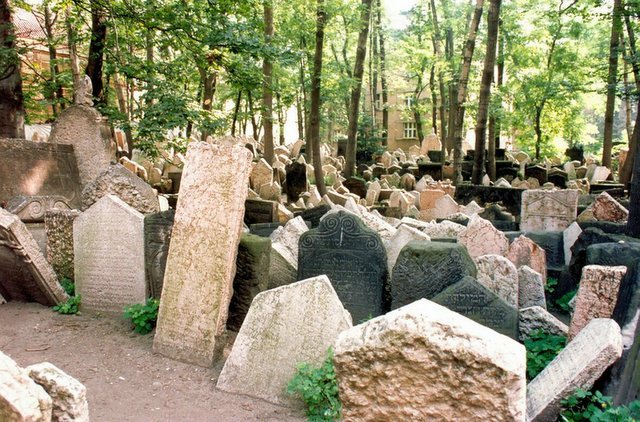
PRO MEMORIA de la Edelina Sterling-Stoian
PRO MEMORIA
In prezenta ambasadorilor Romaniei si Israelului in Republica Ceha, precum si a presedintelui Comunitatii Evreiesti din Praga si a numerosi invitati, a fost vernisata in capitala ceha o expozitie a pictoritei romance Marilena Morariu.
Picturile, expuse intr-una dintre cele mai frumoase sinagogi pragheze, Sinagoga Jubileului, au ca tema pietrele funerare din cimitire evreiesti aflate in zona in care s-a nascut artista, unele dintre ele vechi de peste 200 de ani.
ES: Ce anume v-a determinat sa pictati tocmai motive ale pietrelor de mormint evreiesti?
MM: Am avut norocul sa ma nasc in nordul Moldovei, zona cu o comunitate evreiasca destul de mare, unde am copilarit, am locuit in aceeasi curte cu prieteni care o parte dintre ei au plecat in Israel, altii au plecat spre lumi poate… sa spunem, mai bune…
Intorcindu-ma dupa citiva ani, am mers in cimitirul romanesc din Hirlau sa pun flori la mormintele stramosilor mei. Nu am putut sa nu trec alaturi, unde celalalt cimitir – evreiesc, parasit, singur – astepta venirea cuiva. Am pus cite o piatra pe mormintele cunoscute si n-am putut, ca artist, sa nu observ frumusetea motivelor plastice de pe acele pietre funerare. Mi-am propus sa ma intorc cu o hirtie, cu un creion, cu un capat de culoare si sa-mi notez citeva din acele minunate suprafete, sa le redau cumva, sa le dau viata, sa le spun prietenilor mei ca nu sint singuri, ca nu i-am uitat, ca eu sint aici si ii astept.
ES: Cum de a ajuns expozitia de picturi la Praga? Cine a avut initiativa acestei expozitii si cine a sprijinit-o?
MM: M-am intilnit cu Excelenta sa, domnul ambasador Gheorghe Tinca, pentru a perfecta o expozitie pe care o proiectasem de mult si care a fost si la Centrul Ceh din Bucuresti: Praga – Jurnal de calatorie, pe care am deschis-o pe 25 septembrie aici, in frumoasele saloane ale ambasadei noastre din Praga. Observind printre peisajele mele unul care i-a atras atentia – vechea sinagoga din Praga – mi-a spus: „Ce lucru frumos, ce lucru minunat! O sa-mi invit prietenii din Praga sa vada expozitia“. Si atunci i-am spus ca pe mine de mult ma pasioneaza o alta tema si chiar as dori sa o pun in valoare cumva, sa circule, sa fie vazuta. Dumnealui a fost extraordinar de generos si a facut toate demersurile posibile pe linga prietenii dumnealui praghezi, presedintele Comunitatii Evreiesti din Praga si alte persoane la fel de generoase care mi-au oferit acest spatiu minunat.
***
Pe zidurile sinagogii, printre tablourile cu forme si simboluri ale pietrelor tombale evreiesti – rozeta solara, funia impletita, pomul vietii, scara vietii, miinile ridicate a binecuvintare, leii care pazesc Tablele Legii, candelabrul cu sapte brate (Menora) – au fost intercalate textele unor poezii in germana, franceza, engleza, scrise cu litere mari, negre, pe fond alb. Rostul lor mi-a fost explicat de Daniela Popescu, de la Comisia Nationala a Romaniei pentru UNESCO, unul din organizatorii expozitiei:
DP: De data aceasta, artista propune o expozitie inedita, alaturind imaginii plastice textul scris – poezia. Celor 31 de lucrari plastice, artista le alatura numele a cinci mari poeti evrei, nascuti in Romania interbelica, nume de referinta pentru literatura mondiala. Marilena Morariu a ales din opera lor lucrari semnificative cunoscute in intreaga lume, care transpun in limbaj liric traditia poporului evreu in sec. XX. La fel ca opera lor, biografia celor cinci poeti este dramatica si reprezentativa: Benjamin Fondane a fost asasinat la 2 octombrie 1944 in lagarul de la Auschwitz-Birchenau, Ilarie Voronca si Paul Celan s-au sinucis la sfirsitul razboiului nerezistind urmarilor acestuia, Rose Auslaender si Alfred Kittner fiind supravietuitori ai lagarului din Transnistria. Poemele celor cinci autori trateaza atit tragedia poporului evreu, cit si speranta ca din aceasta suferinta se va putea cladi o lume mai buna.
***
Expozitia 'Pro memoria' a fost conceputa de Marilena Morariu „ca o declaratie de dragoste pentru poporul evreu, nutrind speranta ca razboaiele incep in mintea oamenilor si tot in mintea oamenilor trebuie construite fortaretele pacii“.
[potrivit cifrelor oficiale, dintre cei peste 850.000 de evrei care traiau cindva in Romania se mai afla acum in tara numai citeva mii. La ora actuala, in Romania exista peste 800 de cimitire evreiesti, dintre care 600 se afla in localitati in care nu mai traieste nici un evreu].
Edelina Sterling-Stoian

Poveste cu ta^lc, de la lume adunata si iarasi la lume data...
Povestea :POVESTE TARANEASCA
'Afurisita de baba asa cu capul retezat sarea prin casa de colopana colo, cautand cada cu sufletele, ca sa le soarba, si daca n-ogasi, cazu jos si crapa.'
A fost odata ca niciodata etc.
A fost odata un imparat. El avea trei feciori. Cand fu la ceasul mortii, isi chema feciorii si le zise:- Fetii mei, sunt cu sufletul la gura, precum ma vedeti; un lucru numai va cer: in cele trei nopti dupa inmormantarea mea,sa-mi paziti mormantul, cate unul din voi.Cum auzi fagaduiala din gura feciorilor sai, casca gura si-si dete sufletul.Gatire se facu de ingropaciune, ma rog, ca la moartea unui imparat, si cu mare alai si jale fu pus la odihna de veci.
Feciorii, care stiau ce glasuise tatal lor cand ii iesi sufletul, se puse de paza, in noaptea dintai feciorul cel mai mare al imparatului.Pandi el ce pandi, si in puterea noptii, pe cand si apele dormeau,se pomeni fiul de imparat cu un oarecine ca vine si vrea sa dezgroape pe mort. Nici ca e de gandit a-l fi lasat feciorul de imparat sa faca asa o nelegiuire, fara decat se lua cu dansul la lupta.
Si lupte-se, si lupte-se, pana ce, cand incepu sa cante cocosii, acel cineva pieri ca o naluca.
A doua noapte, feciorul de imparat cel mijlociu pati ca si cel mare.Cand se intalnira ei, se vorbira sa spuie fratelui lor celui mic patenia lor si sa-l imbie a primi ca unul din ei, pe carele il va alege el, sa-l insoteasca in noaptea cand va avea sa pazeasca dansul, de teama, ca sa nu se rapuie, ca unul ce era mai tanar.
Dara feciorul cel mic al imparatului nici nu voi sa asculte de unele ca acestea, ci zise:- Duce-ma-voi singur, caci trebuie sa fi stiut tata ce zice, cand ne-a poruncit sa pazim cate unul singur. Si astfel, cum veni seara, se duse la locul de panda. si deoarece stia ce-l asteapta, el isi lua cu dansul armele si se gati bine de lupta. Pe la miezul noptii se pomeni si el cu cineva ca vine. Vru el sa intrebuinteze armele; dara unde ii dadu ala pas; caci el se arata ca o vedenie iesind ca din pamant, si se luara la tranta. Lupta fu crancena, caci duhul necurat, duh necurat era cel ce venea sa dezgroape pe imparat, isi pusese toate puterile ca sa dovedeasca pe fiul cel mai mic al imparatului. Vezi ca duhul stia ca de nu va putea nici in a treia seara sa izbuteasca, apoi trebuia sa-si mute gandul; nu mai putea adica sa-l dezgroape, nici la amin. Fie insa ca si baiatul nu se lasa mai pe jos. Si cum spusei, se luptara pe capete; dara lupta nu gluma. Curgeau sudorile de pe fiul imparatului siroaie, si nu se da netezului nicicat. Lupta tinu, si o lupta de moarte, pana despre cantatori. Cum se auzi cocosul, duhul pieri ca o naluca, dara si baiatul cazu jos de ostenit. De mai tinea lupta, numai cat ai atata un foc, s-ar fi muiat, si cine stie ce se intampla. Cum cazu fiul de imparat pe mormantul tatane-sau, acolo si adormi. Atat era de rupt de oboseala.
Cand se destepta, ce sa vedeti d-voastra? Soarele rasarise demult si se urcase ca de trei sulite. Ce sa faca el? Sa se intoarca acasa ziua-n amiaza mare, sa treaca prin oras asa inarmat de sus pana jos, ii era rusine; sa ramaie acolo, nu se putea. Ce-i veni lui in gand, ca numai o lua rara, rara, catre o padure ce era p-acolo p-aproape, ca sa-si petreaca ziua cu vanatul, si mai catre seara sa se intoarca acasa. Si asa, mergand el prin padurea aceea, il apuca gandurile. El cugeta, ca ce sa fie pricina de le-azis tata-sau sa-i pazeasca mormantul in trei seri d-a randul. Si mergand asa, fara sa stie nici el unde merge, si cu gandurile duse, se pomeni ca pierde poteca si nu mai stie unde merge. Da in sus, da in jos, drumul nu-l mai gasea. Mai se intoarse in dreapta,mai la stanga, asi! in loc sa iasa la lumina, el se ratacea si mai mult. Dibuind prin codru, si cercetand sa dea peste poteca, iesi la un luminis, si acolo in mijlocul luminisului zareste un foc mare si pe foc o cracatita, din care iesea un fel de glas, dara fara sa stie el ca ce sa fie. Stete locului, si mai asculta. Auzi ca si intai. Se mai uita o data, dara nu vazu pe nimeni. Ce sa faca? Sa se duca acolo, nu-i damesii, caci nu stia ca ce dracovenie o fi aia. Atunci intinse si el arcul, dete drumul sagetii si, tranc! lovi drept in capacul cracatitei,si il si dete jos. Intr-aceeasi clipeala toata padurea incepu a haui, de-ti lua auzul,si deodata se aratara inaintea lui sapte zmei, il inconjoara, pun mana pe el, si sfatuiesc cum sa-l pedepseasca, pentru ce sa dea el drumul Agerului pamantului, pe carele ei l-au fost inchis in cracatita aceea.Unul zicea sa-l taie. Altul sa-l spanzure. Altul sa-l jupoaie de viu. Altii in fel de fel de chipuri sa-l chinuiasca pana l-o omori.Iara cel mai batran dintre dansii zise sa-l lase cu viata, caci cine stie la ce le-o fi si el bun, poate ca va izbuti el sa fure pe fata unui imparat dupa care umblau ei sa o rapeasca, si nu puteau.
Fata aceasta se afla inchisa de tata-sau intr-o casa, ale carei usi erau inchise. Tat-sau o data pe an o lasa descuiata, si atunci, la o usa sta de paza un cocos, si la cealalta era un clopotel; si nu putea nimeni sa se apropie, caci cum punea cineva piciorul pe prag, ori clopotelul se tragea, ori cocosul canta. Fiul de imparat se fagadui ca va cerca si el. si asa il lasara zmeii viu. El se duse binisor, si pana a nu pune piciorul pe prag, intinse mana fara sa-l simta nici maiestrele, apuca cocosul de gatsi i-l rasuci, de nu mai zise nici pis! apoi deschise usa incetisor, trecu la cealalta usa, fura clopotelul, si se intoarse de spuse zmeilor sa intre unul cate unul, ca el ii astepta la usa, pe dinauntru. Zmeii il ascultara, orbiti de lacomia ce aveau ei sa puie mana pe fata. Si apoi, de! de zmei, zmei; de voinici, voinici; dara se vede ca erau cam natafleti, de ascultara la gura baiatului sa intre dupa dansul cate unul, unul; caci fiul cel mic al imparatului sta acolo inauntru cu palosul in mana, fara sa stie zmeii, si cum intrau, el, harst! le lua capul si ii tragea cu totul in camara. Facu unuia, facu la doi, pana la al saselea. Dracul de zmeu cel de-al saptelea, pesemne ca el nu era tocmai atat de nataflete, caci parca-i spuse dracul la ureche ce prapad li se gateste acolo inauntru, ca nu-i veni sa intre si fugi.
Baiatul asa de incet si usor lucrase, incat fata nu simti nimic. Ea dormea dusa in pat, fara sa aiba vreun habar. Atunci si el se apropie de fata - si, dreptul lui Dumnezeu! nici ca mai vazuse pana atunci asa frumusete - ii lua inelul ce avea in degetul cel mic si marama de pe fata. Cu aceste doua lucruri se intoarse el acasa la fratii sai, fara sa le spuie ceva, din cele ce i s-au intamplat. Tatal fetei, imparatul, carele stia ca umbla niste zmei sa-i rapeasca copila, nu mai putu de bucurie cand ii vazu macelariti. Si cu socoteala ca de aci inainte fata ii va fi scapata, puse sa se strige prin toate raspantiile cetatilor din lume ca cine va fi acel viteaz care a rapus pe zmei, sa se infatiseze ca sa-i dea fata dupa dansul, si jumatate imparatia.
Nu trecu mult si iata ca vine la imparat un tigan urat si buzat, si negru, ciuma nu altceva, si spune ca el a omorat pe zmei. si ca sa incredinteze pe imparatul de spusele lui, isi arata cu mandrie satarul plin de sange si hainele stropite. El isi umpluse satarul si hainele cu sangele unui cal al sau, statut de batran si plin de tecnefes, cu care nu mai avea ce face, si-l ucisese ca sa-i ia pielea. Imparatului nu-i prea venea la socoteala sa aiba ginere pe un tigan, dara fiindca apucase de-si dedese cuvantul, voia acum ca sa si-l tie. si pana sa se faca logodna, pofti pe tigan la o masa pe care o dadu imparatul pentru mantuirea fie-sei de zmei.
Tiganul sedeala masa pe sapte perne si d-a dreapta imparatului.Pe cand mancau ei acolo si se chefuiau, iata ca vine si feciorul imparatului cel cu izbanda, si d-abia, d-abia, izbuti sa intre ca sa vorbeasca imparatului.Intrand la masa imparateasca, fiul imparatului incepu sa laude pe cel ce facuse izbanda, si sa heretiseasca pe imparat pentru scaparea fie-sei de la rele.
- Eu am omorat pe zmei, zise tiganul fudul, fudul. Ce socotesti tu, baiete, cat m-am mai luptat!
- Asa o fi, veriscane, dara mie pare ca tot nu-mi vine a crede ca tu sa fi facut o asa isprava.
- Ce stati de mai ascultati la barfele mojicului asta? slujitori!dati-l afara!
- O! o! voinicule, mai incet, mai incet, te-ai prea grabit; nu e de nasul tau o asemenea bucatica! Ca sa te credem ca tu ai facut o asa vitejie, arata-ne vrun semn care sa ne scoata din banuiala.
- Dara mai semn ca satarul si hainele mele cele stropite cu sange, ce mai poftesti?
- Cel ce a facut o asemenea vitejie nu crez eu sa fi fost el asa de usurel, incat sa nu fi luat vrun semn, cu care sa-si dovedeascafapta.
- Ce mai asteptati, slujitori? Dati afara pe smintitul asta carele vine sa ne strice cheful.
- Ia, mai stai olecuta, ii zise atunci si imparatul, carele ascultase cum nu se intelegeau ei la cuvinte. Cum cam dai tu sa se inteleaga,parca ar veni la prochimen.
- Eu socotesc, marite imparate, ca cel ce a facut o asemenea vitejie, nu crez sa se fi culcat pe urechea aia si sa fi stat numai asa cu degetul in gura, dupa ce a ucis pe zmei si s-a vazut stapan pe camara unde dormea imparateasa, trebuie sa fi luat el vrun semn cu care sa dea la iveala vitejia lui.Pe cand vorbea feciorul imparatului, pernele sarea una cateuna de sub tigan. Pesemne ca se tot sacaia pe scaun de neastampar si de frica pentru miselia ce facu.Iara fiul de imparat, inca vorbind, scoase marama si inelul celuase fetei din deget.
- Aoleo! astea sunt ale mele, zise si fata, si mi-au pierit in invalmaseala cu omorul zmeilor.
- N-au pierit, domnita, ii raspunse fiul de imparat, eu ti le-am luat, dupa ce am ucis sase zmei si imi pare rau ca mi-a scapat si celvd-al saptelea.
Atunci imparatul rasufla de bucurie ca a scapat cu fata curata pe fie-sa de o insotire ce nu-i venea la socoteala deloc, deloc. si infruntand pe tigan, dupa cum i se si cadea, porunci de aduse doi armasari neinvatati. Lega pe tigan de coadele cailor si impreuna cu dansul si un sac de nuci. Apoi dete drumul armasarilor de se dusera in lume si unde cadea nuca, cadea si bucatica din tigan,pana ce nu se alese nici praful de el. Apoi se facu gatire de nunta pentru feciorul de imparat cel viteaz cu fata cea frumoasa ca o zana. si gatindu-se, si ziua demult sosind, pornira cu totii la biserica. Lume dupa lume se luasera dupa dansii sa-i petreaca la biserica. imparatul si imparateasa,mirii si rudele lor erau in carute ferecate numai in aur.Cand fura aproape si mai aveau numai cativa pasi sa faca pana la biserica odata se auzi o vajiitura groaznica, si numai iata ca zmeul d-al saptelea da navala peste dansii. Odata plesni dintr-un bici, si toate carutele se facura stane de piatra, fara numai imparatul si mirii scapara. Pe mireasa o inhata zmeul de mijloc, o rapeste dintre ai sai, se inalta in aer si se facu nevazut cu fata cu tot.Toti ramasera buimaciti de spaima.
Iara ginerele se supara mai cu asupra decat toti. isi musca mainile de suparare cum de n-a putut el sa puie mana si pe acest blestemat de zmeu sa-l omoare, caci iata acum ce neajuns ii facu. Ce sa faca acum? Fara logodnica lui nu putea sa ramaie; sa se duca sa o caute; dar unde? Se framanta, bietul, si nu stia cum s-o nimereasca mai bine. in cele din urma se hotari, ca, orice o fi, sa fie, el sa se duca sa-si caute scrisa. Se cerca bietul tatal fetei sa-l opreasca, ca sa nu se rapuie si dansul in desert; dar geaba, nu fu cu putinta a-l opri; si-o pusese el in cap, si cata sa se duca. isi lua deci nitele merinde cu dansul si pleca.
Iesind la campie, lua drumul d-a lungul si aide, aide, trecu paduri si vai, trecu pustiuri, dumbravi, munti si valcele pana ce ajunse la un codru mare, mare, fara capatai. Orbecaind el p-acolo prin desis, dete de o poiana. Acolo in poiana sedea cineva la foc.Tocmai si el isi ispravise merindele si se duse drept la omul ce sedea la foc. Acela cum il vazu, il cunoscu si incepu sa-i multumeascaca l-a scos din ghiarele zmeului. Pasamite era Agerul pamantului. Acolo traia el. Statura ei ce statura de vorba, se intrebara de ale sanatatii, isispusera pasurile, si apoi feciorul de imparat zise:
- Acum ma duc sa-mi caut logodnica pe care mi-a rapit-o zmeul. Nu stii tu, vericule, incotro va fi sezand spurcatul?
- Cam greu lucru este ce vrei tu. si eu te-as sfatui mai bine sa-ti cauti de treaba si sa lasi la naiba si zmeu si tot, ca poate sa-ti rapuie viata.- Se vede ca tu nu intelegi, ii raspunse voinicul, ca fara de logodnica mea nu mai pot trai, sunt hotarat a ma duce dupa dansa si dincolo de lumea asta, si ori voi izbuti sa-mi iau sotia, ori imi voi frange si eu junghietura umbland dupa dansa.
Atunci Agerul pamantului vazand asa, ii spuse ca zmeul nu este tocmai, tocmai de temut, dara muma-sa, ca e si vrajitoare de n-are capatai, si pe ea trebuie s-o omoare mai intai. Apoi ilindrepta pe unde sa mearga ca sa ajunga la casele zmeoaicei si ce sa faca casa puie mana pe odorul ce cauta el. Atata voi sa stie feciorul de imparat si dupa ce primi de la Agerul pamantului cate ceva de ale gurii, porni si se duse, si se duse, pana ce ajunse la hotarele zmeilor. si ca sa nu ne pierdem vremea degeaba insirand greutatile ce intampina bietul fecior de imparat in cale, sa va spui cum a ajuns si cum si-a izbandit. Aci daca ajunse, facu tocmai pe tocmai cum il invatase Agerul pamantului. Dracoaica de muma a zmeului dormea, numai la namiezi cand soarele sta in cruci. si cand veni fiul imparatului, si statu la poarta, ea tocmai adormise, catandu-i in cap slujnica sa. Aceasta slujnica,si ea tot rapita era si vita de boier. Stand el acolo si uitandu-se la cotoroanta de baba cum ii cauta in cap, fata aceasta il zari. El ii facu semn. Fata puse binisor capul babei pe o perna, si veni numaidecat la feciorul de imparat sa vaza ce voieste. si dupa ce se intelesera la cuvinte, fata il baga intr-o camara si acolo il invata cum sa faca, dupa ce el ii fagadui ca o va scapa si pe dansa de robia zmeoaicei.
- Baba cloanta, muma zmeului, zise ea, are darul sa nu moara cat va fi cada (tocitoarea) ce sta ici dupa usa. in ea sunt o multimev de suflete, si cand s-ar intampla sa o rapuie cineva, ea da fuga si soarbe din sufletele inchise in cada, si castiga putere si viata din nou. Fiul imparatului pana sa se scoale baba, se apuca de ingropa cada in pivnita. Dupa ce se destepta baba si auzi ca nescine a venit si vrea sa se intalneasca cu dansa, se duse numaidecat in camara unde oastepta fiul imparatului; vezi ca acolo voia sa vorbeasca ea cu ceice veneau la dansa.
Aoleo! era sa uit a va spune ca in curtea zmeoaicei era de jur imprejur pari infipti in pamant, si in fiecare par cate un cap de om din cei ce ii tragea ata la moarte si ii impingeau pacatele sa-icalce hotarele. Numai unul mai ramasese fara de cap, si acela striga babei: cap! cap! Nu e vorba, fiul imparatului o cam bagase pe maneca de frica, dara imbarbatat de fata, slujnica babei, isi lua inima in dinti zicand:"vei mai capata si tu cap la mosii ai verzi, ori la pastele cailor". Viind baba la dansul, incepu sa-i vorbeasca cu niste graiuri mieroase si ademenitoare, de ar fi supus pe nu stiu ce voinic dear fi fost. Fiul imparatului stia la ce sa se astepte, si sta si el gatade lupta. inca vorbind, baba se facea ca nu stiu ce cauta prin casa,si luand niste ite ce erau agatate intr-un cui, le puse pe dansa. Odata se schimba intr-o catana (ostean), cu sabia goala in mana. Atunci si fiul imparatului, fara a mai zabovi nici o clipa, si mai iute decat ai gandi, scoase palosul si ii taie capul, retezandu-l de noua ori. Vezi ca asa il invatase fata. Afurisita de baba asa cu capul retezat sarea prin casa de colo pana colo, cautand cada cu sufletele, ca sa le soarba, si daca n-o gasi, cazu jos si crapa.
Dupa aceea fata din casa a babei arata voinicului fiu de imparat calea ce ducea la casele zmeului, si il invata ce sa faca si acolo. si ajungand la locuinta zmeului, merse fara frica drept la camara unde sedea logodnica sa, caci ziua zmeul se ducea la vanat, de unde se intorcea tocmai seara. Fata de imparat cum il vazu, nu mai putu de bucurie. Pana una alta, el o ruga sa intrebe pe zmeu in ce ii sta puterea, iara fiul de imparat se intoarse la curtea babei si mase acolo peste noapte. Venind zmeul acasa, fata il intreba unde ii sta puterea? El ii trase o palma ca la urlati. Ea, prefacandu-se a plange si a fi bolnava, zmeul se cai ca s-a iutit si ii spuse o minciuna:- Puterea mea, zise el, sta in stalpul portii. A doua zi spuse lui Fat-Frumos, si el nu crezu. Fata prefa-candu-se mahnita ca nu stie in ce ii sta puterea, pati insa ca si derandul trecut, apoi zmeul ii spuse inca o minciuna.Daca vazu fata ca fiul de imparat nu crede, vezi ca stia el cestia, ea se facu bolnava. Cand veni zmeul a treia zi de la vanat, gasi pe fata in pat. Se duse el s-o intrebe ce are, si ea ii raspunse:- Am cazut la pat de intristare, pentru ca tu tainuiesti de mine in ce sta puterea ta. Zmeul trase fetei si de asta data o calcavura de auzii cainii in Giurgiu. Atunci ea se prefacu asa de bolnava, incat zmeul crezuca o sa dea mana cu moartea. si caindu-se de ceea ce facuse, si voind s-o mangaie, ii spuse drept:- Puterea mea, zise el, sta intr-o scroafa care se tavaleste cate ziulica intr-o lacoviste de lapte dulce. Acea lacoviste nu este tocmai departe de aci. in scroafa este un iepure, in iepure o prepelita, si in prepelita sunt trei viermi. Acestia sunt puterea mea.
Atata voi si fata sa stie.Cum se facu ziua si zmeul se duse la vanat, iata ca vine si fiul de imparat sa cerceteze despre cele ce aflase fata de la zmeu, caci dorul de a-si vedea cu un ceas mai nainte logodnica acasa, nu-i da ragaz sa zaboveasca mai mult. Fata ii spuse tot ce afla, din firpana in ata; iara el pleca numaidecat. De mila de sila, lua el si nitele merinde ce-i dase fata; dara lui nu-i ardea de mancare.
Merse, merse, si iara merse. Merindele se sfarsi. El merse voiniceste pana ce in deseara ajunse lihnit de foame, si setos, de sa fereasca Dumnezeu, intr-un codru, unde dete de o coliba. Intra inauntru si gasi un om orb ce-si manca mamaliguta cu lapte dulce.Se apropie si el binisor, fara sa prinza de veste orbul, si manca pana ce-si momi foamea oarecum. Orbul baga de seama ca prea se sfarseste curand leguma de pe masa. Se mira. El stia ca de altadata ii era de-ajuns mancarea; de asta data insa nu se saturase. intelese el ca trebuie sa se joace vreo dracie la mijloc. Atunci intreba:
- Cine este de-mi ajuta la mancare? De este om bun, fie binevenit, iara de este om rau, sa se departeze, ca nu va fi bine de el.- Om bun, mosicule; sunt calator, si pana una alta, as voi sa gasesc ceva de lucru. Unchiasul cel orb primi bucuros sa intre la dansul in slujba. il puse sa-i duca turmulita de oi la pasune; dara avu grija a-i spune sa nu care cumva sa treaca peste hotarele mosiei lui, pe locul scroafei din lacovistea de lapte dulce, ca va fi vai de capul lui ,si va pierde si oile.Fiul imparatului se fagadui ca va asculta de cuvantul orbului; dara chiar in ziua dintai trecu, si oile pascura iarba cea mare si moale ca matasea ce se afla pe mosia scroafei cu nesat. Cand veniseara acasa, laptele ce detera oile fu de-ajuns pentru amandoi, si inca ramase. Orbul se minuna si zise fie-sei sa se ia dupa dansul a doua zi si sa vaza d-a minune ce face argatul.
Cum pleca cu oile argatul in dimineata urmatoare, fata facu precum ii zisese tata-sau. El se duse drept, ca pe ciripie, tocmai pe mosia scroafei cu oile la pasune. Fata se sperie, dara se piti si tacu din gura, sa vaza ce se va intampla.Ce sa vedeti d-voastra? Unde veni scroafa cu o falca in cer si cu una in pamant, si navala la argatul orbului sa-l sfasie, si mai multe nu. Fiul imparatului sta tantos cu palosul in mana, si se luara lalupta; si lupte-se, si lupte-se, pana ce amandoi obosira de abia se miscau. Atunci zise scroafa:- Dac-ar fi cineva sa-mi dea nitel lastar de trestie si un ciob de lapte din lacovistea mea de lapte dulce, ti-as arata eu cum sa cutezitu a-mi calca hotarele.
- Dac-ar fi cineva sa-mi dea si mie un colac sa-mbuc, si o bardaca de apa de izvor sa beau, ti-as arata si eu tie cine sunt eu, zise si fiul imparatului. Cand, iaca fata unchiasului celui orb, care privea la lupta lor,ca vine si da fiului de imparat sa imbuce colacul ce si-l luase ea, ca sa aiba ce manca la panda, si fuga se repezi de-i aduse si o bardaca de apa de la izvor. Flacaul manca si bau, si prinzand putere, rasturna pe scroafa, se puse calare pe dansa, si-i taie capul. Apoi o spinteca si ingriji sa nu scape iepurele. Puse mana pe dansul si spintecand si iepurele, prinse prepelita. si scotand din rarunchii prepelitei cei trei viermi, ii baga in san dupa ce le suci nitel gaturile. intorcandu-se la unchias, isi lua ziua buna de la orb si de la fata, spuindu-le ca in curand va afla despre dansul, si intr-un suflet se intoarse la curtea zmeului. Aci daca ajunse isi schimba vesmintele, se facu doftor, si incepua striga:- Leacuri de vanzare, leacuri!
Zmeul cum auzi, trimise de-l chema, ca lui nu-i prea era bine.De cateva zile, gainea asa lancezind. Nu-i erau toti boii acasa, vezi bine, ca puterea lui se afla acum in sanul fiului de imparat. Se imbolnavise.Daca veni fiul imparatului si il intreba zmeul de poate sa-l faca sanatos, prefacutul doftor ii spuse ca se va insanatosi, daca se vascalda in lapte de iepe. Zmeul porunci numaidecat si i se facu obaie din laptele iepelor lui, pe care le pusese dansul de le mulse.Cand intra in baie zmeul, fiul imparatului mai rasuci o toana gaturile viermilor; iar zmeul o data sari in sus, zicand:- Acum mi-e bine ca si cand eram la sanul mamei.si dand doftorului daruri scumpe, il pofti la masa. Vezi ca zmeul nu cunostea cine era doftorul. Ospatandu-se, si stand ei la taifas,fiul imparatului intreba pe zmeu:
- De ce treaba sunt bicele alea ce le tii atarnate fiecare incuiul sau pe peretele din fund?
- Cu unul, raspunse zmeul, daca voi plesni o data, toate turmele mele se fac o nuca. Daca voi plesni cu al doilea, toate cuprinsurile mele se fac un mar. Iara cu al treilea bici cand plesnesc la spatele oricarui lucru, il schimb in stana de piatra si cand plesnesc cu el in fata, se desface facutul, si vine la adevarata lui fiinta lucrul impietrit.
Cum afla despre asta fiul imparatului, iesi afara si suci de totgaturile viermilor, iara zmeul crapa indata. Apoi lua bicele, plesni cu unul si toate turmele si cirezile zmeului le facu o nuca, pe care o baga in san; si plesnind cu altul, toate cuprinsurile zmeului se schimbara intr-un mar, pe care iarasi il baga in san. si luandu-si logodnica, se duse la orb, dara nu-l mai gasi, caci murise; lua deci cu dansul pe fata; si mergand la curtile babei, lua si pe fata ce slujea zmeoaicei si se intoarse cu toatele acasa la imparatul, socrul lui.si mergand in fata carelor si cailor care ramasesera stane depiatra, de cand rapise zmeul pe fata imparatului, plesni de trei ori in fata lor si se facura la loc cum erau in ziua cand mersesera la cununie ei si toti cei de prin carute. Cele doua fete ce le adusese cu sine fiul de imparat le dete de neveste fratilor lui.si se facu o nunta infricosata, d-alea imparatestile, cum seaman nu mai avu pe fata pamantului, si se facu o veselie de o tinura aminte cat traira locuitorii acelei imparatii.
Am fost si eu acolo si am vazut toate chefurile, caci de n-as fi fost, de unde as fi stiut eu sa va povestesc.
O lingura scurta pe la
nasul cui n-asculta.
'Afurisita de baba asa cu capul retezat sarea prin casa de colopana colo, cautand cada cu sufletele, ca sa le soarba, si daca n-ogasi, cazu jos si crapa.'
A fost odata ca niciodata etc.
A fost odata un imparat. El avea trei feciori. Cand fu la ceasul mortii, isi chema feciorii si le zise:- Fetii mei, sunt cu sufletul la gura, precum ma vedeti; un lucru numai va cer: in cele trei nopti dupa inmormantarea mea,sa-mi paziti mormantul, cate unul din voi.Cum auzi fagaduiala din gura feciorilor sai, casca gura si-si dete sufletul.Gatire se facu de ingropaciune, ma rog, ca la moartea unui imparat, si cu mare alai si jale fu pus la odihna de veci.
Feciorii, care stiau ce glasuise tatal lor cand ii iesi sufletul, se puse de paza, in noaptea dintai feciorul cel mai mare al imparatului.Pandi el ce pandi, si in puterea noptii, pe cand si apele dormeau,se pomeni fiul de imparat cu un oarecine ca vine si vrea sa dezgroape pe mort. Nici ca e de gandit a-l fi lasat feciorul de imparat sa faca asa o nelegiuire, fara decat se lua cu dansul la lupta.
Si lupte-se, si lupte-se, pana ce, cand incepu sa cante cocosii, acel cineva pieri ca o naluca.
A doua noapte, feciorul de imparat cel mijlociu pati ca si cel mare.Cand se intalnira ei, se vorbira sa spuie fratelui lor celui mic patenia lor si sa-l imbie a primi ca unul din ei, pe carele il va alege el, sa-l insoteasca in noaptea cand va avea sa pazeasca dansul, de teama, ca sa nu se rapuie, ca unul ce era mai tanar.
Dara feciorul cel mic al imparatului nici nu voi sa asculte de unele ca acestea, ci zise:- Duce-ma-voi singur, caci trebuie sa fi stiut tata ce zice, cand ne-a poruncit sa pazim cate unul singur. Si astfel, cum veni seara, se duse la locul de panda. si deoarece stia ce-l asteapta, el isi lua cu dansul armele si se gati bine de lupta. Pe la miezul noptii se pomeni si el cu cineva ca vine. Vru el sa intrebuinteze armele; dara unde ii dadu ala pas; caci el se arata ca o vedenie iesind ca din pamant, si se luara la tranta. Lupta fu crancena, caci duhul necurat, duh necurat era cel ce venea sa dezgroape pe imparat, isi pusese toate puterile ca sa dovedeasca pe fiul cel mai mic al imparatului. Vezi ca duhul stia ca de nu va putea nici in a treia seara sa izbuteasca, apoi trebuia sa-si mute gandul; nu mai putea adica sa-l dezgroape, nici la amin. Fie insa ca si baiatul nu se lasa mai pe jos. Si cum spusei, se luptara pe capete; dara lupta nu gluma. Curgeau sudorile de pe fiul imparatului siroaie, si nu se da netezului nicicat. Lupta tinu, si o lupta de moarte, pana despre cantatori. Cum se auzi cocosul, duhul pieri ca o naluca, dara si baiatul cazu jos de ostenit. De mai tinea lupta, numai cat ai atata un foc, s-ar fi muiat, si cine stie ce se intampla. Cum cazu fiul de imparat pe mormantul tatane-sau, acolo si adormi. Atat era de rupt de oboseala.
Cand se destepta, ce sa vedeti d-voastra? Soarele rasarise demult si se urcase ca de trei sulite. Ce sa faca el? Sa se intoarca acasa ziua-n amiaza mare, sa treaca prin oras asa inarmat de sus pana jos, ii era rusine; sa ramaie acolo, nu se putea. Ce-i veni lui in gand, ca numai o lua rara, rara, catre o padure ce era p-acolo p-aproape, ca sa-si petreaca ziua cu vanatul, si mai catre seara sa se intoarca acasa. Si asa, mergand el prin padurea aceea, il apuca gandurile. El cugeta, ca ce sa fie pricina de le-azis tata-sau sa-i pazeasca mormantul in trei seri d-a randul. Si mergand asa, fara sa stie nici el unde merge, si cu gandurile duse, se pomeni ca pierde poteca si nu mai stie unde merge. Da in sus, da in jos, drumul nu-l mai gasea. Mai se intoarse in dreapta,mai la stanga, asi! in loc sa iasa la lumina, el se ratacea si mai mult. Dibuind prin codru, si cercetand sa dea peste poteca, iesi la un luminis, si acolo in mijlocul luminisului zareste un foc mare si pe foc o cracatita, din care iesea un fel de glas, dara fara sa stie el ca ce sa fie. Stete locului, si mai asculta. Auzi ca si intai. Se mai uita o data, dara nu vazu pe nimeni. Ce sa faca? Sa se duca acolo, nu-i damesii, caci nu stia ca ce dracovenie o fi aia. Atunci intinse si el arcul, dete drumul sagetii si, tranc! lovi drept in capacul cracatitei,si il si dete jos. Intr-aceeasi clipeala toata padurea incepu a haui, de-ti lua auzul,si deodata se aratara inaintea lui sapte zmei, il inconjoara, pun mana pe el, si sfatuiesc cum sa-l pedepseasca, pentru ce sa dea el drumul Agerului pamantului, pe carele ei l-au fost inchis in cracatita aceea.Unul zicea sa-l taie. Altul sa-l spanzure. Altul sa-l jupoaie de viu. Altii in fel de fel de chipuri sa-l chinuiasca pana l-o omori.Iara cel mai batran dintre dansii zise sa-l lase cu viata, caci cine stie la ce le-o fi si el bun, poate ca va izbuti el sa fure pe fata unui imparat dupa care umblau ei sa o rapeasca, si nu puteau.
Fata aceasta se afla inchisa de tata-sau intr-o casa, ale carei usi erau inchise. Tat-sau o data pe an o lasa descuiata, si atunci, la o usa sta de paza un cocos, si la cealalta era un clopotel; si nu putea nimeni sa se apropie, caci cum punea cineva piciorul pe prag, ori clopotelul se tragea, ori cocosul canta. Fiul de imparat se fagadui ca va cerca si el. si asa il lasara zmeii viu. El se duse binisor, si pana a nu pune piciorul pe prag, intinse mana fara sa-l simta nici maiestrele, apuca cocosul de gatsi i-l rasuci, de nu mai zise nici pis! apoi deschise usa incetisor, trecu la cealalta usa, fura clopotelul, si se intoarse de spuse zmeilor sa intre unul cate unul, ca el ii astepta la usa, pe dinauntru. Zmeii il ascultara, orbiti de lacomia ce aveau ei sa puie mana pe fata. Si apoi, de! de zmei, zmei; de voinici, voinici; dara se vede ca erau cam natafleti, de ascultara la gura baiatului sa intre dupa dansul cate unul, unul; caci fiul cel mic al imparatului sta acolo inauntru cu palosul in mana, fara sa stie zmeii, si cum intrau, el, harst! le lua capul si ii tragea cu totul in camara. Facu unuia, facu la doi, pana la al saselea. Dracul de zmeu cel de-al saptelea, pesemne ca el nu era tocmai atat de nataflete, caci parca-i spuse dracul la ureche ce prapad li se gateste acolo inauntru, ca nu-i veni sa intre si fugi.
Baiatul asa de incet si usor lucrase, incat fata nu simti nimic. Ea dormea dusa in pat, fara sa aiba vreun habar. Atunci si el se apropie de fata - si, dreptul lui Dumnezeu! nici ca mai vazuse pana atunci asa frumusete - ii lua inelul ce avea in degetul cel mic si marama de pe fata. Cu aceste doua lucruri se intoarse el acasa la fratii sai, fara sa le spuie ceva, din cele ce i s-au intamplat. Tatal fetei, imparatul, carele stia ca umbla niste zmei sa-i rapeasca copila, nu mai putu de bucurie cand ii vazu macelariti. Si cu socoteala ca de aci inainte fata ii va fi scapata, puse sa se strige prin toate raspantiile cetatilor din lume ca cine va fi acel viteaz care a rapus pe zmei, sa se infatiseze ca sa-i dea fata dupa dansul, si jumatate imparatia.
Nu trecu mult si iata ca vine la imparat un tigan urat si buzat, si negru, ciuma nu altceva, si spune ca el a omorat pe zmei. si ca sa incredinteze pe imparatul de spusele lui, isi arata cu mandrie satarul plin de sange si hainele stropite. El isi umpluse satarul si hainele cu sangele unui cal al sau, statut de batran si plin de tecnefes, cu care nu mai avea ce face, si-l ucisese ca sa-i ia pielea. Imparatului nu-i prea venea la socoteala sa aiba ginere pe un tigan, dara fiindca apucase de-si dedese cuvantul, voia acum ca sa si-l tie. si pana sa se faca logodna, pofti pe tigan la o masa pe care o dadu imparatul pentru mantuirea fie-sei de zmei.
Tiganul sedeala masa pe sapte perne si d-a dreapta imparatului.Pe cand mancau ei acolo si se chefuiau, iata ca vine si feciorul imparatului cel cu izbanda, si d-abia, d-abia, izbuti sa intre ca sa vorbeasca imparatului.Intrand la masa imparateasca, fiul imparatului incepu sa laude pe cel ce facuse izbanda, si sa heretiseasca pe imparat pentru scaparea fie-sei de la rele.
- Eu am omorat pe zmei, zise tiganul fudul, fudul. Ce socotesti tu, baiete, cat m-am mai luptat!
- Asa o fi, veriscane, dara mie pare ca tot nu-mi vine a crede ca tu sa fi facut o asa isprava.
- Ce stati de mai ascultati la barfele mojicului asta? slujitori!dati-l afara!
- O! o! voinicule, mai incet, mai incet, te-ai prea grabit; nu e de nasul tau o asemenea bucatica! Ca sa te credem ca tu ai facut o asa vitejie, arata-ne vrun semn care sa ne scoata din banuiala.
- Dara mai semn ca satarul si hainele mele cele stropite cu sange, ce mai poftesti?
- Cel ce a facut o asemenea vitejie nu crez eu sa fi fost el asa de usurel, incat sa nu fi luat vrun semn, cu care sa-si dovedeascafapta.
- Ce mai asteptati, slujitori? Dati afara pe smintitul asta carele vine sa ne strice cheful.
- Ia, mai stai olecuta, ii zise atunci si imparatul, carele ascultase cum nu se intelegeau ei la cuvinte. Cum cam dai tu sa se inteleaga,parca ar veni la prochimen.
- Eu socotesc, marite imparate, ca cel ce a facut o asemenea vitejie, nu crez sa se fi culcat pe urechea aia si sa fi stat numai asa cu degetul in gura, dupa ce a ucis pe zmei si s-a vazut stapan pe camara unde dormea imparateasa, trebuie sa fi luat el vrun semn cu care sa dea la iveala vitejia lui.Pe cand vorbea feciorul imparatului, pernele sarea una cateuna de sub tigan. Pesemne ca se tot sacaia pe scaun de neastampar si de frica pentru miselia ce facu.Iara fiul de imparat, inca vorbind, scoase marama si inelul celuase fetei din deget.
- Aoleo! astea sunt ale mele, zise si fata, si mi-au pierit in invalmaseala cu omorul zmeilor.
- N-au pierit, domnita, ii raspunse fiul de imparat, eu ti le-am luat, dupa ce am ucis sase zmei si imi pare rau ca mi-a scapat si celvd-al saptelea.
Atunci imparatul rasufla de bucurie ca a scapat cu fata curata pe fie-sa de o insotire ce nu-i venea la socoteala deloc, deloc. si infruntand pe tigan, dupa cum i se si cadea, porunci de aduse doi armasari neinvatati. Lega pe tigan de coadele cailor si impreuna cu dansul si un sac de nuci. Apoi dete drumul armasarilor de se dusera in lume si unde cadea nuca, cadea si bucatica din tigan,pana ce nu se alese nici praful de el. Apoi se facu gatire de nunta pentru feciorul de imparat cel viteaz cu fata cea frumoasa ca o zana. si gatindu-se, si ziua demult sosind, pornira cu totii la biserica. Lume dupa lume se luasera dupa dansii sa-i petreaca la biserica. imparatul si imparateasa,mirii si rudele lor erau in carute ferecate numai in aur.Cand fura aproape si mai aveau numai cativa pasi sa faca pana la biserica odata se auzi o vajiitura groaznica, si numai iata ca zmeul d-al saptelea da navala peste dansii. Odata plesni dintr-un bici, si toate carutele se facura stane de piatra, fara numai imparatul si mirii scapara. Pe mireasa o inhata zmeul de mijloc, o rapeste dintre ai sai, se inalta in aer si se facu nevazut cu fata cu tot.Toti ramasera buimaciti de spaima.
Iara ginerele se supara mai cu asupra decat toti. isi musca mainile de suparare cum de n-a putut el sa puie mana si pe acest blestemat de zmeu sa-l omoare, caci iata acum ce neajuns ii facu. Ce sa faca acum? Fara logodnica lui nu putea sa ramaie; sa se duca sa o caute; dar unde? Se framanta, bietul, si nu stia cum s-o nimereasca mai bine. in cele din urma se hotari, ca, orice o fi, sa fie, el sa se duca sa-si caute scrisa. Se cerca bietul tatal fetei sa-l opreasca, ca sa nu se rapuie si dansul in desert; dar geaba, nu fu cu putinta a-l opri; si-o pusese el in cap, si cata sa se duca. isi lua deci nitele merinde cu dansul si pleca.
Iesind la campie, lua drumul d-a lungul si aide, aide, trecu paduri si vai, trecu pustiuri, dumbravi, munti si valcele pana ce ajunse la un codru mare, mare, fara capatai. Orbecaind el p-acolo prin desis, dete de o poiana. Acolo in poiana sedea cineva la foc.Tocmai si el isi ispravise merindele si se duse drept la omul ce sedea la foc. Acela cum il vazu, il cunoscu si incepu sa-i multumeascaca l-a scos din ghiarele zmeului. Pasamite era Agerul pamantului. Acolo traia el. Statura ei ce statura de vorba, se intrebara de ale sanatatii, isispusera pasurile, si apoi feciorul de imparat zise:
- Acum ma duc sa-mi caut logodnica pe care mi-a rapit-o zmeul. Nu stii tu, vericule, incotro va fi sezand spurcatul?
- Cam greu lucru este ce vrei tu. si eu te-as sfatui mai bine sa-ti cauti de treaba si sa lasi la naiba si zmeu si tot, ca poate sa-ti rapuie viata.- Se vede ca tu nu intelegi, ii raspunse voinicul, ca fara de logodnica mea nu mai pot trai, sunt hotarat a ma duce dupa dansa si dincolo de lumea asta, si ori voi izbuti sa-mi iau sotia, ori imi voi frange si eu junghietura umbland dupa dansa.
Atunci Agerul pamantului vazand asa, ii spuse ca zmeul nu este tocmai, tocmai de temut, dara muma-sa, ca e si vrajitoare de n-are capatai, si pe ea trebuie s-o omoare mai intai. Apoi ilindrepta pe unde sa mearga ca sa ajunga la casele zmeoaicei si ce sa faca casa puie mana pe odorul ce cauta el. Atata voi sa stie feciorul de imparat si dupa ce primi de la Agerul pamantului cate ceva de ale gurii, porni si se duse, si se duse, pana ce ajunse la hotarele zmeilor. si ca sa nu ne pierdem vremea degeaba insirand greutatile ce intampina bietul fecior de imparat in cale, sa va spui cum a ajuns si cum si-a izbandit. Aci daca ajunse, facu tocmai pe tocmai cum il invatase Agerul pamantului. Dracoaica de muma a zmeului dormea, numai la namiezi cand soarele sta in cruci. si cand veni fiul imparatului, si statu la poarta, ea tocmai adormise, catandu-i in cap slujnica sa. Aceasta slujnica,si ea tot rapita era si vita de boier. Stand el acolo si uitandu-se la cotoroanta de baba cum ii cauta in cap, fata aceasta il zari. El ii facu semn. Fata puse binisor capul babei pe o perna, si veni numaidecat la feciorul de imparat sa vaza ce voieste. si dupa ce se intelesera la cuvinte, fata il baga intr-o camara si acolo il invata cum sa faca, dupa ce el ii fagadui ca o va scapa si pe dansa de robia zmeoaicei.
- Baba cloanta, muma zmeului, zise ea, are darul sa nu moara cat va fi cada (tocitoarea) ce sta ici dupa usa. in ea sunt o multimev de suflete, si cand s-ar intampla sa o rapuie cineva, ea da fuga si soarbe din sufletele inchise in cada, si castiga putere si viata din nou. Fiul imparatului pana sa se scoale baba, se apuca de ingropa cada in pivnita. Dupa ce se destepta baba si auzi ca nescine a venit si vrea sa se intalneasca cu dansa, se duse numaidecat in camara unde oastepta fiul imparatului; vezi ca acolo voia sa vorbeasca ea cu ceice veneau la dansa.
Aoleo! era sa uit a va spune ca in curtea zmeoaicei era de jur imprejur pari infipti in pamant, si in fiecare par cate un cap de om din cei ce ii tragea ata la moarte si ii impingeau pacatele sa-icalce hotarele. Numai unul mai ramasese fara de cap, si acela striga babei: cap! cap! Nu e vorba, fiul imparatului o cam bagase pe maneca de frica, dara imbarbatat de fata, slujnica babei, isi lua inima in dinti zicand:"vei mai capata si tu cap la mosii ai verzi, ori la pastele cailor". Viind baba la dansul, incepu sa-i vorbeasca cu niste graiuri mieroase si ademenitoare, de ar fi supus pe nu stiu ce voinic dear fi fost. Fiul imparatului stia la ce sa se astepte, si sta si el gatade lupta. inca vorbind, baba se facea ca nu stiu ce cauta prin casa,si luand niste ite ce erau agatate intr-un cui, le puse pe dansa. Odata se schimba intr-o catana (ostean), cu sabia goala in mana. Atunci si fiul imparatului, fara a mai zabovi nici o clipa, si mai iute decat ai gandi, scoase palosul si ii taie capul, retezandu-l de noua ori. Vezi ca asa il invatase fata. Afurisita de baba asa cu capul retezat sarea prin casa de colo pana colo, cautand cada cu sufletele, ca sa le soarba, si daca n-o gasi, cazu jos si crapa.
Dupa aceea fata din casa a babei arata voinicului fiu de imparat calea ce ducea la casele zmeului, si il invata ce sa faca si acolo. si ajungand la locuinta zmeului, merse fara frica drept la camara unde sedea logodnica sa, caci ziua zmeul se ducea la vanat, de unde se intorcea tocmai seara. Fata de imparat cum il vazu, nu mai putu de bucurie. Pana una alta, el o ruga sa intrebe pe zmeu in ce ii sta puterea, iara fiul de imparat se intoarse la curtea babei si mase acolo peste noapte. Venind zmeul acasa, fata il intreba unde ii sta puterea? El ii trase o palma ca la urlati. Ea, prefacandu-se a plange si a fi bolnava, zmeul se cai ca s-a iutit si ii spuse o minciuna:- Puterea mea, zise el, sta in stalpul portii. A doua zi spuse lui Fat-Frumos, si el nu crezu. Fata prefa-candu-se mahnita ca nu stie in ce ii sta puterea, pati insa ca si derandul trecut, apoi zmeul ii spuse inca o minciuna.Daca vazu fata ca fiul de imparat nu crede, vezi ca stia el cestia, ea se facu bolnava. Cand veni zmeul a treia zi de la vanat, gasi pe fata in pat. Se duse el s-o intrebe ce are, si ea ii raspunse:- Am cazut la pat de intristare, pentru ca tu tainuiesti de mine in ce sta puterea ta. Zmeul trase fetei si de asta data o calcavura de auzii cainii in Giurgiu. Atunci ea se prefacu asa de bolnava, incat zmeul crezuca o sa dea mana cu moartea. si caindu-se de ceea ce facuse, si voind s-o mangaie, ii spuse drept:- Puterea mea, zise el, sta intr-o scroafa care se tavaleste cate ziulica intr-o lacoviste de lapte dulce. Acea lacoviste nu este tocmai departe de aci. in scroafa este un iepure, in iepure o prepelita, si in prepelita sunt trei viermi. Acestia sunt puterea mea.
Atata voi si fata sa stie.Cum se facu ziua si zmeul se duse la vanat, iata ca vine si fiul de imparat sa cerceteze despre cele ce aflase fata de la zmeu, caci dorul de a-si vedea cu un ceas mai nainte logodnica acasa, nu-i da ragaz sa zaboveasca mai mult. Fata ii spuse tot ce afla, din firpana in ata; iara el pleca numaidecat. De mila de sila, lua el si nitele merinde ce-i dase fata; dara lui nu-i ardea de mancare.
Merse, merse, si iara merse. Merindele se sfarsi. El merse voiniceste pana ce in deseara ajunse lihnit de foame, si setos, de sa fereasca Dumnezeu, intr-un codru, unde dete de o coliba. Intra inauntru si gasi un om orb ce-si manca mamaliguta cu lapte dulce.Se apropie si el binisor, fara sa prinza de veste orbul, si manca pana ce-si momi foamea oarecum. Orbul baga de seama ca prea se sfarseste curand leguma de pe masa. Se mira. El stia ca de altadata ii era de-ajuns mancarea; de asta data insa nu se saturase. intelese el ca trebuie sa se joace vreo dracie la mijloc. Atunci intreba:
- Cine este de-mi ajuta la mancare? De este om bun, fie binevenit, iara de este om rau, sa se departeze, ca nu va fi bine de el.- Om bun, mosicule; sunt calator, si pana una alta, as voi sa gasesc ceva de lucru. Unchiasul cel orb primi bucuros sa intre la dansul in slujba. il puse sa-i duca turmulita de oi la pasune; dara avu grija a-i spune sa nu care cumva sa treaca peste hotarele mosiei lui, pe locul scroafei din lacovistea de lapte dulce, ca va fi vai de capul lui ,si va pierde si oile.Fiul imparatului se fagadui ca va asculta de cuvantul orbului; dara chiar in ziua dintai trecu, si oile pascura iarba cea mare si moale ca matasea ce se afla pe mosia scroafei cu nesat. Cand veniseara acasa, laptele ce detera oile fu de-ajuns pentru amandoi, si inca ramase. Orbul se minuna si zise fie-sei sa se ia dupa dansul a doua zi si sa vaza d-a minune ce face argatul.
Cum pleca cu oile argatul in dimineata urmatoare, fata facu precum ii zisese tata-sau. El se duse drept, ca pe ciripie, tocmai pe mosia scroafei cu oile la pasune. Fata se sperie, dara se piti si tacu din gura, sa vaza ce se va intampla.Ce sa vedeti d-voastra? Unde veni scroafa cu o falca in cer si cu una in pamant, si navala la argatul orbului sa-l sfasie, si mai multe nu. Fiul imparatului sta tantos cu palosul in mana, si se luara lalupta; si lupte-se, si lupte-se, pana ce amandoi obosira de abia se miscau. Atunci zise scroafa:- Dac-ar fi cineva sa-mi dea nitel lastar de trestie si un ciob de lapte din lacovistea mea de lapte dulce, ti-as arata eu cum sa cutezitu a-mi calca hotarele.
- Dac-ar fi cineva sa-mi dea si mie un colac sa-mbuc, si o bardaca de apa de izvor sa beau, ti-as arata si eu tie cine sunt eu, zise si fiul imparatului. Cand, iaca fata unchiasului celui orb, care privea la lupta lor,ca vine si da fiului de imparat sa imbuce colacul ce si-l luase ea, ca sa aiba ce manca la panda, si fuga se repezi de-i aduse si o bardaca de apa de la izvor. Flacaul manca si bau, si prinzand putere, rasturna pe scroafa, se puse calare pe dansa, si-i taie capul. Apoi o spinteca si ingriji sa nu scape iepurele. Puse mana pe dansul si spintecand si iepurele, prinse prepelita. si scotand din rarunchii prepelitei cei trei viermi, ii baga in san dupa ce le suci nitel gaturile. intorcandu-se la unchias, isi lua ziua buna de la orb si de la fata, spuindu-le ca in curand va afla despre dansul, si intr-un suflet se intoarse la curtea zmeului. Aci daca ajunse isi schimba vesmintele, se facu doftor, si incepua striga:- Leacuri de vanzare, leacuri!
Zmeul cum auzi, trimise de-l chema, ca lui nu-i prea era bine.De cateva zile, gainea asa lancezind. Nu-i erau toti boii acasa, vezi bine, ca puterea lui se afla acum in sanul fiului de imparat. Se imbolnavise.Daca veni fiul imparatului si il intreba zmeul de poate sa-l faca sanatos, prefacutul doftor ii spuse ca se va insanatosi, daca se vascalda in lapte de iepe. Zmeul porunci numaidecat si i se facu obaie din laptele iepelor lui, pe care le pusese dansul de le mulse.Cand intra in baie zmeul, fiul imparatului mai rasuci o toana gaturile viermilor; iar zmeul o data sari in sus, zicand:- Acum mi-e bine ca si cand eram la sanul mamei.si dand doftorului daruri scumpe, il pofti la masa. Vezi ca zmeul nu cunostea cine era doftorul. Ospatandu-se, si stand ei la taifas,fiul imparatului intreba pe zmeu:
- De ce treaba sunt bicele alea ce le tii atarnate fiecare incuiul sau pe peretele din fund?
- Cu unul, raspunse zmeul, daca voi plesni o data, toate turmele mele se fac o nuca. Daca voi plesni cu al doilea, toate cuprinsurile mele se fac un mar. Iara cu al treilea bici cand plesnesc la spatele oricarui lucru, il schimb in stana de piatra si cand plesnesc cu el in fata, se desface facutul, si vine la adevarata lui fiinta lucrul impietrit.
Cum afla despre asta fiul imparatului, iesi afara si suci de totgaturile viermilor, iara zmeul crapa indata. Apoi lua bicele, plesni cu unul si toate turmele si cirezile zmeului le facu o nuca, pe care o baga in san; si plesnind cu altul, toate cuprinsurile zmeului se schimbara intr-un mar, pe care iarasi il baga in san. si luandu-si logodnica, se duse la orb, dara nu-l mai gasi, caci murise; lua deci cu dansul pe fata; si mergand la curtile babei, lua si pe fata ce slujea zmeoaicei si se intoarse cu toatele acasa la imparatul, socrul lui.si mergand in fata carelor si cailor care ramasesera stane depiatra, de cand rapise zmeul pe fata imparatului, plesni de trei ori in fata lor si se facura la loc cum erau in ziua cand mersesera la cununie ei si toti cei de prin carute. Cele doua fete ce le adusese cu sine fiul de imparat le dete de neveste fratilor lui.si se facu o nunta infricosata, d-alea imparatestile, cum seaman nu mai avu pe fata pamantului, si se facu o veselie de o tinura aminte cat traira locuitorii acelei imparatii.
Am fost si eu acolo si am vazut toate chefurile, caci de n-as fi fost, de unde as fi stiut eu sa va povestesc.
O lingura scurta pe la
nasul cui n-asculta.
Following the herd:Pastorul pe urmele turmei (Haaretz)
Following the herd
By Shahar Ilan
The new communications minister, Ariel Atias, last week provided an astonishing figure in the ultra-Orthodox newspaper Bakehila. The Haredi public, which totals an estimated 600,000 people, has purchased to date only 30,000 "kosher" mobile phones, which exclude content services. This despite the clear and vociferous directives by Torah sages to use only such cell phones. This is not the Torah sages' only failure recently. Even more embarrassing was their attempt to ban Internet use. There can hardly be another public so active in the area of online forums as the Haredim (ultra-Orthodox). There you do not need to identify yourself, and under the protection of anonymity may write whatever you think and feel. Haredi businesses have long since learned that whoever is not on the Internet is essentially non-existent. Ultra-Orthodox rabbis do not internalize the rule that you don't impose a decree the public cannot fulfill. Like a deluge, the modern world is flooding the Haredi street, and the rabbis, instead of instructing their people to wear life jackets, are trying to stop the water with their hands. The result: The Haredi public continues to respect the Torah sages; it just doesn't heed them so much.
Advertisement
There are many possible explanations for the decline in the power and influence of the Torah sages over the past few years. One of the most important is the split of the Council of Torah Sages into three councils - of Agudat Yisrael, Degel Hatorah and Shas. But the main reason is that the rabbis have made themselves irrelevant. They are battling the modern world instead of trying to serve as regulators. And mainly, they completely fail in dealing with the truly important crisis facing the Haredi society of learners - the economic crisis. The most prominent scholar on Haredi society, Prof. Menachem Friedman, has been warning for 30 years that this crisis is waiting to happen, but none of the rabbis have tried to preempt the foreknown economic tsunami. Friedman warned, for example, that a time would come when the secular public would no longer be prepared to bankroll the yeshiva students. And yet, when the child allowances were slashed, the rabbis and their public were caught completely off-guard. In the general public, that would be termed a fiasco. The Haredim quietly grumble. It's not that stuff isn't happening in Haredi society. The Israel Defense Forces' Haredi Nahal battalion was created. Vocational training courses are opening. Dozens of men and women received law degrees last week. But everything is happening too slowly, in a faint trickle. The reason for this is that all of the processes are occuring without the overt support of the rabbis. Their uncourageous consent is expressed merely through turning a blind eye. The conservative rabbis are trying to hang on by their fingernails to a society in which two out of three men study. They fail to grasp that this is untenable from an economic standpoint. Other rabbis know what has to be done, but they haven't the guts, nor broad enough shoulders. They haven't the guts to announce that only those who excel ought to study their entire lives, while the rest should study for several years at a kollel - a yeshiva for married men - and then go out to work. They haven't the guts to initiate academic tracks at yeshivas, like in the United States, and to permit the establishment of Haredi high-school yeshivas. Fear of the zealots is stronger than concern for the public. Within this so very mediocre leadership, Rabbi Aharon Leib Steinman, the Number 2 man in Degel Hatorah, stands out positively. Steinman favors jobs for those who do not wish to continue studying, and also backed the Tal Law. But he too lacks the courage, and perhaps the ability, to take it all the way and express his positions publicly. He is especially admired among Haredim in the Diaspora, but cannot seem to become a prophet in his own city. And to finish up, a moment of Haredi logic: If this generation was deserving, a leader would surely arise who knows how to contend with the current challenges. Since the generation was not found worthy, the Haredi public has become a herd whose shepherds follow it.
By Shahar Ilan
The new communications minister, Ariel Atias, last week provided an astonishing figure in the ultra-Orthodox newspaper Bakehila. The Haredi public, which totals an estimated 600,000 people, has purchased to date only 30,000 "kosher" mobile phones, which exclude content services. This despite the clear and vociferous directives by Torah sages to use only such cell phones. This is not the Torah sages' only failure recently. Even more embarrassing was their attempt to ban Internet use. There can hardly be another public so active in the area of online forums as the Haredim (ultra-Orthodox). There you do not need to identify yourself, and under the protection of anonymity may write whatever you think and feel. Haredi businesses have long since learned that whoever is not on the Internet is essentially non-existent. Ultra-Orthodox rabbis do not internalize the rule that you don't impose a decree the public cannot fulfill. Like a deluge, the modern world is flooding the Haredi street, and the rabbis, instead of instructing their people to wear life jackets, are trying to stop the water with their hands. The result: The Haredi public continues to respect the Torah sages; it just doesn't heed them so much.
Advertisement
There are many possible explanations for the decline in the power and influence of the Torah sages over the past few years. One of the most important is the split of the Council of Torah Sages into three councils - of Agudat Yisrael, Degel Hatorah and Shas. But the main reason is that the rabbis have made themselves irrelevant. They are battling the modern world instead of trying to serve as regulators. And mainly, they completely fail in dealing with the truly important crisis facing the Haredi society of learners - the economic crisis. The most prominent scholar on Haredi society, Prof. Menachem Friedman, has been warning for 30 years that this crisis is waiting to happen, but none of the rabbis have tried to preempt the foreknown economic tsunami. Friedman warned, for example, that a time would come when the secular public would no longer be prepared to bankroll the yeshiva students. And yet, when the child allowances were slashed, the rabbis and their public were caught completely off-guard. In the general public, that would be termed a fiasco. The Haredim quietly grumble. It's not that stuff isn't happening in Haredi society. The Israel Defense Forces' Haredi Nahal battalion was created. Vocational training courses are opening. Dozens of men and women received law degrees last week. But everything is happening too slowly, in a faint trickle. The reason for this is that all of the processes are occuring without the overt support of the rabbis. Their uncourageous consent is expressed merely through turning a blind eye. The conservative rabbis are trying to hang on by their fingernails to a society in which two out of three men study. They fail to grasp that this is untenable from an economic standpoint. Other rabbis know what has to be done, but they haven't the guts, nor broad enough shoulders. They haven't the guts to announce that only those who excel ought to study their entire lives, while the rest should study for several years at a kollel - a yeshiva for married men - and then go out to work. They haven't the guts to initiate academic tracks at yeshivas, like in the United States, and to permit the establishment of Haredi high-school yeshivas. Fear of the zealots is stronger than concern for the public. Within this so very mediocre leadership, Rabbi Aharon Leib Steinman, the Number 2 man in Degel Hatorah, stands out positively. Steinman favors jobs for those who do not wish to continue studying, and also backed the Tal Law. But he too lacks the courage, and perhaps the ability, to take it all the way and express his positions publicly. He is especially admired among Haredim in the Diaspora, but cannot seem to become a prophet in his own city. And to finish up, a moment of Haredi logic: If this generation was deserving, a leader would surely arise who knows how to contend with the current challenges. Since the generation was not found worthy, the Haredi public has become a herd whose shepherds follow it.
From Jerusalem - the memory of David Appelbaum
The angels we owe
By Bradley Burston (Ha-aretz)
What is faith, if not optimism without a shred of cause for optimism?What are angels, if not pure creatures of faith?They walk among us here. So much so, that it can seem as though there are more of them in the Holy Land than in other places. That, it turns out, is an illusion, caused by the fact that here, they simply have more work to do.This, then, is nothing more than a word of thanks. Thanks for those who cannot be thanked nearly enough, and aren't.Angels here come in a multitude of forms and uniforms. They are Israeli and Palestinian, Muslim and Jewish and Christian. They are nurses and physicians, paramedics and orderlies, surgeons and ambulance attendants, fire fighters, volunteers, physical therapists, occupational therapists, lab techs and orthopedists and surgeons and anesthetists and psychologists and psychiatrists and social workers.They don't just save lives here. They save life itself.When the slain and the maimed are forgotten, already in the public consciousness little more fodder for revenge, it is an earthly host of unsung, overwhelmingly outnumbered angels, who make life possible for individuals and families shattered forever by an unendable war.We, the peoples of the Holy Land, have made a science of killing. We have made an industry of maiming. We have made a culture, a religion, of the doctrine of self-defense. We use everything we can. We use rocks and rockets, slingshots and self-propelled cannon, suicide belts packed with bolts and large carpentry nails, assault rifles and sniper rifles and rocket propelled grenade launchers and artillery shells and tank shells and roadside charges.When weapons work, we may meet the victims for a fleeting moment on television screens and front pages, only to be immediately diverted by scenes of the escalation in bloodshed that is the obscene and inevitable legacy of the suffering of the victims.This, then, is a word of thanks to the forgotten, the never-known, the angels whose very lives are corrosive, endangering their spirits, often costing them their own health. This year will mark the fifth anniversary of the September 11 attacks. On September 9, another anniversary will be marked, more quietly, less widely, but no less profoundly.On that night in 2003, David Appelbaum, 51, took a rare break from work to invite his 20-year-old daughter Nava out for coffee. It was the eve of her wedding. They sat in a cafe on teeming Emek Refaim Street, Jerusalem's closest approximation of the Upper West Side of Manhattan. David Appelbaum's work was saving lives. A physician who had also been ordained an Orthodox rabbi, Appelbaum was head of the emergency medicine department of Shaarei Tzedek hospital in the city and a world authority on treating the casualties of terrorism.At times he had seemed to be everywhere at once, often reaching the still-burning and still potentially deadly scene of a terrorist attack before rescue crews did. "He would appear at the site of every attack, volunteer, get in the ambulances to evacuate the injured to the emergency room," said Dr. Kobi Assaf of Hadassah University Hospital, Ein Kerem.David Appelbaum touched thousands of people with kindness, courage, humanity and skill. Seven years before that night, the Knesset had given him an award for treating terror victims on King George Street in the heart of the city, while under fire. He had earned a night off. He had earned a lifetime of them. So the night before his daughter's wedding, they went out to Cafe Hillel. The Hamas suicide bomber came in only a little while later.Seven people were killed that night. On Emek Refaim, the Valley of Ghosts. David Appelbaum and his daughter Nava never made it to the hospital.This is nothing but a word of thanks.A word of gratitude for the people who most truly engage in self-defense.For the people who do the work of angels. The work of the Lord.For the people who defend us from ourselves.
By Bradley Burston (Ha-aretz)
What is faith, if not optimism without a shred of cause for optimism?What are angels, if not pure creatures of faith?They walk among us here. So much so, that it can seem as though there are more of them in the Holy Land than in other places. That, it turns out, is an illusion, caused by the fact that here, they simply have more work to do.This, then, is nothing more than a word of thanks. Thanks for those who cannot be thanked nearly enough, and aren't.Angels here come in a multitude of forms and uniforms. They are Israeli and Palestinian, Muslim and Jewish and Christian. They are nurses and physicians, paramedics and orderlies, surgeons and ambulance attendants, fire fighters, volunteers, physical therapists, occupational therapists, lab techs and orthopedists and surgeons and anesthetists and psychologists and psychiatrists and social workers.They don't just save lives here. They save life itself.When the slain and the maimed are forgotten, already in the public consciousness little more fodder for revenge, it is an earthly host of unsung, overwhelmingly outnumbered angels, who make life possible for individuals and families shattered forever by an unendable war.We, the peoples of the Holy Land, have made a science of killing. We have made an industry of maiming. We have made a culture, a religion, of the doctrine of self-defense. We use everything we can. We use rocks and rockets, slingshots and self-propelled cannon, suicide belts packed with bolts and large carpentry nails, assault rifles and sniper rifles and rocket propelled grenade launchers and artillery shells and tank shells and roadside charges.When weapons work, we may meet the victims for a fleeting moment on television screens and front pages, only to be immediately diverted by scenes of the escalation in bloodshed that is the obscene and inevitable legacy of the suffering of the victims.This, then, is a word of thanks to the forgotten, the never-known, the angels whose very lives are corrosive, endangering their spirits, often costing them their own health. This year will mark the fifth anniversary of the September 11 attacks. On September 9, another anniversary will be marked, more quietly, less widely, but no less profoundly.On that night in 2003, David Appelbaum, 51, took a rare break from work to invite his 20-year-old daughter Nava out for coffee. It was the eve of her wedding. They sat in a cafe on teeming Emek Refaim Street, Jerusalem's closest approximation of the Upper West Side of Manhattan. David Appelbaum's work was saving lives. A physician who had also been ordained an Orthodox rabbi, Appelbaum was head of the emergency medicine department of Shaarei Tzedek hospital in the city and a world authority on treating the casualties of terrorism.At times he had seemed to be everywhere at once, often reaching the still-burning and still potentially deadly scene of a terrorist attack before rescue crews did. "He would appear at the site of every attack, volunteer, get in the ambulances to evacuate the injured to the emergency room," said Dr. Kobi Assaf of Hadassah University Hospital, Ein Kerem.David Appelbaum touched thousands of people with kindness, courage, humanity and skill. Seven years before that night, the Knesset had given him an award for treating terror victims on King George Street in the heart of the city, while under fire. He had earned a night off. He had earned a lifetime of them. So the night before his daughter's wedding, they went out to Cafe Hillel. The Hamas suicide bomber came in only a little while later.Seven people were killed that night. On Emek Refaim, the Valley of Ghosts. David Appelbaum and his daughter Nava never made it to the hospital.This is nothing but a word of thanks.A word of gratitude for the people who most truly engage in self-defense.For the people who do the work of angels. The work of the Lord.For the people who defend us from ourselves.
Bazarul din Ierusalim


Cand am ajuns in Ierusalim, tin minte data precis, 6 august 1972, am fost pur si simplu fascinat de orasul vechi si bazarul lui. Daca Ierusalimul are circa 135 Km. patrati in granitele lui municipale (fata de Paris 90 km. patrati si Bucuresti -240km.patrati!!!!) Orasul Vechi, adica orasul unde se afla si zidul plangerii, si moschea lui Omar, si biserica Sf. Mormant, orasul dintre zidurile ridicate de Suleiman Magnificul in sec. 16, ei bine acest "Oras Vechi" are doar 1(un) kilometru patrat. Pentru acest mic kilometru patrat toata omenirea este gata sa iasa la razboi, pe urmele cruciatilor!!!
Si cateva poze de acolo... gratie Edelinei
Jewish Space
In my relatively early architectural research I looked after the creation of a space which fits the characteristics of the Israelis, being convinced that "International Architecture" is wrong.
The result of my research was translated in stone, metal and glass, as you can see on my site, at:
http://www. gelehrterarchitects.com
The "theory"at:
http://www.gelehrterarchitects.com/jewish_space.pdf
The result of my research was translated in stone, metal and glass, as you can see on my site, at:
http://www. gelehrterarchitects.com
The "theory"at:
http://www.gelehrterarchitects.com/jewish_space.pdf
Subscribe to:
Posts (Atom)