
Martin Indyk, director of the Saban Center for Middle East Policy, served in several senior positions in the U.S. government, most recently as ambassador to Israel and assistant secretary of state for Near East affairs. He was also a founding executive director of the Washington Institute for Near East Policy. He has published widely on Palestinian-Israeli peace and other topics in Middle East policy, and is now working on a study of the Clinton Administration's diplomacy in the region.Indyk will address questions regarding the current crisis in Lebanon along with other issues dealing with Middle East negotiations. He will specifically deal with a paper he recently published with his colleague Tamara Cofman Wittes, called Dual Dilemmas: U.S. Policy Options for the Israeli-Palestinian Predicament.Readers can send questions to rosnersdomain@haaretz.co.il.Mr. IndykMany world leaders - including Kofi Annan, Tony Blair and the EUCommission - have called for the deployment of an international forceof peacekeepers in southern Lebanon. However, I wonder how effective ground troops are while the conflict is fought mainly with rockets(Fajr-3 having the capacity of covering at least 50 km) and air force.What are the realistic prospects, if any, of an international force stopping the conflict?Thanks,Anna MomiglianoRome, ItalyThe idea of an international force that would be interposed between the warring sides makes no sense. It might hinder the Israel Defense Forces from operating in Lebanon since Israel would not want to be involved in a military confrontation with the countries that supplied the force (e.g. Britain and France). However, Hezbollah would have no such reservations. Just as they bombed the U.S. Marine Barracks at Beirut International Airport in 1983, so too would they likely attack the international force if it tried to stop their attacks on Israel. However, an international force could play an important role once a ceasefire were agreed on and implemented. Such an agreement would likely provide for the Lebanese Armed Forces (LAF) to take control of southern Lebanon and to patrol the border between Lebanon and Israel. The Lebanese Prime Minister has already declared his intention of taking extending his government?s sovereignty to the south. And the Israeli Prime Minister has called for this as a necessary component of any ceasefire agreement. However, the LAF does not have sufficient capability to fulfill that mission and prevent Hezbollah from operating in the south. A combat-capable international force (in contrast to UNIFIL's observer role) would be needed to enhance the LAF's capabilities. Similarly, an international force could support the LAF's efforts to control Lebanon's borders to prevent the resupply of Hezbollah with rockets and missiles from Iran or Syria. Although the United States would need to support and help pay for the force, it would be unwise and unnecessary for U.S. forces to participate. Instead, battle-hardened troops from countries like Australia, Britain, France and Canada could do the job effectively. But they could only play an effective role if the Lebanese government made a sovereign decision to invite them into Lebanon and the Israeli government acquiesced in the deployment. Dear AmbassadorOur readers sent many questions but as time and space are limited I selected one to represent each issue.On Syria: At the end of his first comment, Ambassador Indyk raised aquestion: "How to get Hezbollah to acquiesce in the deal?" Since there are not many options, perhaps the best route is through Syria. What if third parties helped Israel and Syria strike a deal: Syria wouldsupport the removal of Hezbollah from south Lebanon and its disarmament. Syria would also stop facilitating Iranian support for Hezbollah. In exchange, Israel and Syria would go back to the negotiating table with the aim of signing a peace treaty including full Israeli withdrawal from the Golan. Is that scenario possible?Jeremy Pressman, Ph.D.University of ConnecticutThis is a logical way forward and the Syrians would actually love to have Condi come to Damascus and ask for their help. But there are two problems with your approach:1. The Bush Administration has treated Syria like an enemy. It's not so simple for the President now to treat them like a friend in need. 2. And it would be a betrayal of the Cedar Revolution, for Bush would in effect be inviting Syria back into Lebanon to stabilize the situation. What you're actually suggesting is that Bush give up on his "freedom drive" and return to traditional American diplomacy which sought stability and peace rather than democracy and regime change. I don't think Bush is willing to make such an about face because he actually believes his way is working. On Lebanon: Is it too cynical to think that the Bush administration under neocon influence is looking ahead to subdue first Syria then Iran, and is quite happy that Hizbollah has lit a fuse for them? Or do we believe the tone of Bush's captured aside that if Hizbollah stops this "shit" it's all over?Tony ServeI think some in the administration would be happy for Israel to hit Syria as part of the agenda you allude to. However, the experience in Iraq has made the President and his Secretary of State more cautious. Nevertheless, this conflict could escalate to a confrontation between Syria and Israel whether the Bush Administration intended it or not. At that point, the U.S. would have to intervene and make it clear that if Syria and Iran were not willing to curb Hezbollah, Syria would suffer a huge battlefield defeat. I'm not recommending this course of action and I don't think Israel is up for it. But I suspect that if Syria and Iran thought the war was going to engulf Damascus they would act to extinguish the flames. On the Palestinians: Given the decided tilt, starting under Clintonand culminating under Bush, to a Likud-like outlook and positioning on Israeli Palestinian issues, the U.S. has lost substantially all of itscredibility with the Palestinian people as an honest broker seekingpeace and justice. Is it possible for the United States to recover anyof its credibility with the Palestinian people?Mark SherryAmerica's credibility with all the Arabs depends on its ability and willingness to influence Israel and to stand up to those who would prefer to make war rather than peace on Israel. As much as the Palestinians dislike America's pro-Israel stance they know that the only external power that can make a real difference to their fate is the United States. On Iran: It is generally agreed that Iran has instigated the presentoutbreak of fighting and is continuing to resupply Hezbollah. What, ifanything, can be done to ensure that Iran ceases to be capable ofdoing this in the future?Murray Teitel, TorontoTough question. At the moment, Iran thinks it can act with impunity, that it holds all the high cards in Iraq, in Lebanon, in the Palestinian arena, and on the nuclear issue. The United States, however, should be able to use this crisis to convince other powers that the problem is not just Iran's nuclear program, it's also its sponsorship of Hezbollah. The G-8's condemnation of Hezbollah was a useful move in this direction. But the notable absence of any finger-pointing at Iran suggests we still have a ways to go. When Iran is before the UN Security Council because of its unwillingness to negotiate over its nuclear program, its support for Hezbollah should also be on the agenda. Hopefully, China and Russia will eventually be convinced that the only way to get their attention is through sanctions. And if that doesn't work, I fear a confrontation will become inevitable. Dear AmbassadorBeing original in a week such as this one is not an option, so my first question will be the obvious one: What policy should the U.S. administration pursue in light of the ongoing crisis in Lebanon? Do you want to see the U.S. more heavily involved, and how can it help the parties get closer to a reasonable solution to this deteriorating situation?BestRosnerThe U.S. has to walk a fine line in this crisis. On one side, it must stand by Israel in the face of Hezbollah's unprovoked act of aggression. On the other side, it must support the government of Lebanon, which was democratically elected and is (with the exception of its Hezbollah ministers) pro-Western and anti-Syrian. Given Hezbollah's status as a terrorist organization, and the backing it enjoys from Iran and Syria, the United States cannot afford for Hezbollah to emerge victorious from this confrontation. Instead, it needs to use the crisis to finish the job the Bush Administration first started when it sponsored UNSC Resolution 1559. That resolution called for the withdrawal of all foreign forces from Lebanon AND the disbandment and disarming of all militias. Bush and Chirac insisted on the implementation of the first requirement but they ignored the second. Just as in the case of the Road Map's requirement for the dismantlement of the infrastructure of Palestinian terror, the Bush administration preferred to believe that elections would produce governments in Lebanon and the Palestinian Authority that would then be able to dismantle the terrorist infrastructure. Instead, Hezbollah took advantage of the Lebanese elections to enter the government where it has wielded a veto over any attempt to disarm it. And we all know what happened in the Palestinian elections. So the Bush administration needs to use this crisis to make progress on the disarmament issue in Lebanon and the Palestinian territories. It should be clear by now that a failure to do so will doom Bush?s democratic adventure on both fronts. Achieving that objective is complicated by the fact that the U.S. does not have a lot of leverage over Hezbollah. Having insisted that Syria leave Lebanon, it cannot now turn to Syria to disarm Hezbollah. And the Iranians do not take the United States seriously given our problems in Iraq and our failure to extract any price for its repeated flouting of the demands of the international community when it comes to their nuclear program. So the only real American leverage is through Israel's use of force. But that is a blunt instrument. Hezbollah hides behind civilians which means that the more force Israel uses to attack Hezbollah targets, the more Lebanese civilians die. And the longer Israel's bombardments go on, the more Lebanese become angry with Israel rather than Hezbollah. And at a certain point in the not too distant future, the international outcry may become so great that the Bush Administration is forced to abandon the effort and to insist instead that Israel stop. Therefore, the Bush Administration needs to lay the groundwork now for a diplomatic initiative that will kick in when Israel has succeeded in denting Hezbollah's capabilities. That initiative would need to have the following elements:
An end to rocket attacks on Israel
An end to Israeli attacks on Lebanon
The removal of Hezbollah forces from the South
Their replacement with the Lebanese Armed Forces backed by a capable international force
Implementation of UNSC Resolution 1559
The return of the kidnapped Israeli soldiers.This list probably sounds familiar. That's because most of it was enunciated by Prime Minister Ehud Olmert in the Knesset on Monday.However, most of those points were also enunciated by the G-8 leaders in their statement on Sunday. Interestingly, they were also enunciated in a little-noticed speech by Lebanese Prime Minister Siniora on Saturday. However, the Lebanese Prime Minister added another point which Israelis should pay attention to. He offered:
A return to the Israel-Lebanon Armistice Agreement of 1949.What Siniora appeared to be saying by referencing that agreement is that he is prepared to deal directly with Israel and enter into what would be tantamount to a non-belligerency pact. In other words, even now, as the conflict escalates, the foundations of a diplomatic solution are being laid by responsible players on all sides. One question remains, however. How to get Hezbollah to acquiesce in the deal?
Thursday, July 20, 2006
Tuesday, July 18, 2006
Israel: A first, blogs and bloggers in war time
The place where we are right (Ha-Aretz)
By Ofri Ilani
Like most sectors of Israeli society - apart, perhaps, from the General Staff forum - the Israeli blogosphere was caught unprepared for the war that has broken out in Lebanon. On Sunday morning, when Beirut was already half-destroyed, the inhabitants of Haifa were sitting in reinforced rooms and the reporters for the press had spent Thursday night on the border, it appeared that most of the writers on the Internet had not yet logged on to their computers. An examination of selected Israeli blogs showed that they are still producing Internet humor of the standard sort, which revolves around topics like Kylie Minogue, Oshri Cohen and bombs that children make out of Pepsi and Mentos. The real bombings and bombardments seemed to have been taking place somewhere else.By the end of that day the picture had changed. Nearly everyone who wrote a new post related in one way or another to events. At this stage the writers already had to decide what to do with a keyboard, an Internet connection and a loyal following of readers when the situation all around was becoming entirely not normal. The current attack is the first large war-like event with which the Hebrew Internet has had to deal since it emerged and formulated for itself a certain kind of identity.While the traditional media move quickly into battle procedures, it has taken the Internet time to accustom itself. In t he meantime it appears that it is ceding center stage to the military correspondents from the radio, the newspapers and the large news sites. Nevertheless, one sense is most prominent - denial. By definition, virtual space tends to be a bit cut off, and it operates on a plane of existence that is parallel to the real world. The immediate connection, at the distance of a link or a download, to more tranquil parts of the world inevitably leads to a certain sense of disconnection. Even when they related to the events, many of the writers chose to focus on ironic comments from the margins of the news, or small disagreements with their big brothers from television. Ido Kenan's Room 404 (http://room404.net) brought a collection of "war flakes" - advertisement that take on ironic meaning in the current context ("Are you still at home?" asks the Israel Electric Corporation ad, inviting readers to its visitors' center); and Yuval Dror from "Word Processor" (www.popup.co.il) collected the error releases from the Israel defense Forces Spokesman's site and the strange reports by Army Radio reporter Hadas Steiff, who in a broadcast from the northern border stated that the army was "shooting something over the Lebanese border."
Other blogs looked as though they had been nationalized by the security forces, and started talking in a tone reminiscent of the IDF spokesman. The breezy civilian cosmopolitanism of veteran Net foxes, who in normal times identify the server as their primary homeland, is cracked quite quickly when the cannons roar. "This Is Absurdistan" (http://snipurl.com/tclf) warned of "Israeli surfers in the service of Hezbollah who are running to "foreign sites" like Flicker (flicker.com) and publishing there the locations where Katyushas fall. Hezi Sternlicht, the proprietor of the blog "Hapositzia" at "Reshimot" (http://snipurl.com/tddu), declared that "we are our own biggest enemy" and attacked the media (especially Haaretz). Is the role of the Israeli Internet community really "to do good for the country," as blogger Yehonatan Klinger says? In the nature of things, a dramatic event like a war leads each individual blog writer, like everyone else, to ensconce himself in his political stance. Fortunately, however, only few of them have found that answering Klinger's call is the most appropriate way to use the medium in their hands. Ultimately, enlisting in the state's public relations machine is a role that even nationalist newspapers do not take upon themselves, at least not outright. At a time when the public discourse is inundated with inflamed cliches, some of the bloggers at Reshimot have gone over to writing in short lines. Sami Shalom Chetrit (www.notes.co.il/sami) published a poem called "Speedy Jew" about a wine-loving Israeli pilot, who "caresses the head of the missile, as though it were the neck of a bottle of Chardonnay." Eti Topaz (www.notes.co.il/eti) made do with Yehuda Amichai's poem "The Place Where We Are Right," a place where "flowers will never / grow in the spring," which "is hard and trampled / like a yard." Is shutting oneself into a reinforced space, albeit hard and trampled, the most effective thing that can be done on the Internet? Some of the bloggers have suggested one of the most important resources on the net: access to other voices. "The Sting" (www.haokets.org), Yossi Dahan and Itzik Saporta's social blog, which defines itself as "a refuge from the strangulation and limitation of the public debate," has offered references to the Lebanese newspaper The Daily Star (www.dailystar.com.lb). From there, according to Dahan, "It is possible to begin to understand how all this looks from the other side, and not via cartoonish descriptions by the local experts of the soul of the population of the region, the various Guy Bechors and Ehud Yaaris." For those who prefer to read Hebrew, the blog has published a letter from Beirut that was written on Friday by a Lebanese woman named Rasha, who writes from a cafe in the western part of the city about the horrible days in the shadow of the bombardments. "To those who inquired how I am by e-mail, I wrote this morning that I am not in danger, and that it appears that the targets are only sites of the Hezbollah and its supporters. Now I am sorry that I typed that. They will worsen the attacks," she writes, adding: "I am 37 and to tell the truth I am afraid. The sound of the airplanes frightens me. I am not protesting. There isn't a drop of struggle left in me." And Corinna the author (www.notes.co.il/corinna), one of the veteran writers at Reshimot, filled her blog with black flags, placing adjacent to one another the national anthems of Iran, Syria, Lebanon and Israel. In conclusion, she added: "Jewish soul, Iranian, Lebanese, Syrian or Palestinian soul - until when will you be shrouded in darkness, a tool for realizing the supreme value: land."
By Ofri Ilani
Like most sectors of Israeli society - apart, perhaps, from the General Staff forum - the Israeli blogosphere was caught unprepared for the war that has broken out in Lebanon. On Sunday morning, when Beirut was already half-destroyed, the inhabitants of Haifa were sitting in reinforced rooms and the reporters for the press had spent Thursday night on the border, it appeared that most of the writers on the Internet had not yet logged on to their computers. An examination of selected Israeli blogs showed that they are still producing Internet humor of the standard sort, which revolves around topics like Kylie Minogue, Oshri Cohen and bombs that children make out of Pepsi and Mentos. The real bombings and bombardments seemed to have been taking place somewhere else.By the end of that day the picture had changed. Nearly everyone who wrote a new post related in one way or another to events. At this stage the writers already had to decide what to do with a keyboard, an Internet connection and a loyal following of readers when the situation all around was becoming entirely not normal. The current attack is the first large war-like event with which the Hebrew Internet has had to deal since it emerged and formulated for itself a certain kind of identity.While the traditional media move quickly into battle procedures, it has taken the Internet time to accustom itself. In t he meantime it appears that it is ceding center stage to the military correspondents from the radio, the newspapers and the large news sites. Nevertheless, one sense is most prominent - denial. By definition, virtual space tends to be a bit cut off, and it operates on a plane of existence that is parallel to the real world. The immediate connection, at the distance of a link or a download, to more tranquil parts of the world inevitably leads to a certain sense of disconnection. Even when they related to the events, many of the writers chose to focus on ironic comments from the margins of the news, or small disagreements with their big brothers from television. Ido Kenan's Room 404 (http://room404.net) brought a collection of "war flakes" - advertisement that take on ironic meaning in the current context ("Are you still at home?" asks the Israel Electric Corporation ad, inviting readers to its visitors' center); and Yuval Dror from "Word Processor" (www.popup.co.il) collected the error releases from the Israel defense Forces Spokesman's site and the strange reports by Army Radio reporter Hadas Steiff, who in a broadcast from the northern border stated that the army was "shooting something over the Lebanese border."
Other blogs looked as though they had been nationalized by the security forces, and started talking in a tone reminiscent of the IDF spokesman. The breezy civilian cosmopolitanism of veteran Net foxes, who in normal times identify the server as their primary homeland, is cracked quite quickly when the cannons roar. "This Is Absurdistan" (http://snipurl.com/tclf) warned of "Israeli surfers in the service of Hezbollah who are running to "foreign sites" like Flicker (flicker.com) and publishing there the locations where Katyushas fall. Hezi Sternlicht, the proprietor of the blog "Hapositzia" at "Reshimot" (http://snipurl.com/tddu), declared that "we are our own biggest enemy" and attacked the media (especially Haaretz). Is the role of the Israeli Internet community really "to do good for the country," as blogger Yehonatan Klinger says? In the nature of things, a dramatic event like a war leads each individual blog writer, like everyone else, to ensconce himself in his political stance. Fortunately, however, only few of them have found that answering Klinger's call is the most appropriate way to use the medium in their hands. Ultimately, enlisting in the state's public relations machine is a role that even nationalist newspapers do not take upon themselves, at least not outright. At a time when the public discourse is inundated with inflamed cliches, some of the bloggers at Reshimot have gone over to writing in short lines. Sami Shalom Chetrit (www.notes.co.il/sami) published a poem called "Speedy Jew" about a wine-loving Israeli pilot, who "caresses the head of the missile, as though it were the neck of a bottle of Chardonnay." Eti Topaz (www.notes.co.il/eti) made do with Yehuda Amichai's poem "The Place Where We Are Right," a place where "flowers will never / grow in the spring," which "is hard and trampled / like a yard." Is shutting oneself into a reinforced space, albeit hard and trampled, the most effective thing that can be done on the Internet? Some of the bloggers have suggested one of the most important resources on the net: access to other voices. "The Sting" (www.haokets.org), Yossi Dahan and Itzik Saporta's social blog, which defines itself as "a refuge from the strangulation and limitation of the public debate," has offered references to the Lebanese newspaper The Daily Star (www.dailystar.com.lb). From there, according to Dahan, "It is possible to begin to understand how all this looks from the other side, and not via cartoonish descriptions by the local experts of the soul of the population of the region, the various Guy Bechors and Ehud Yaaris." For those who prefer to read Hebrew, the blog has published a letter from Beirut that was written on Friday by a Lebanese woman named Rasha, who writes from a cafe in the western part of the city about the horrible days in the shadow of the bombardments. "To those who inquired how I am by e-mail, I wrote this morning that I am not in danger, and that it appears that the targets are only sites of the Hezbollah and its supporters. Now I am sorry that I typed that. They will worsen the attacks," she writes, adding: "I am 37 and to tell the truth I am afraid. The sound of the airplanes frightens me. I am not protesting. There isn't a drop of struggle left in me." And Corinna the author (www.notes.co.il/corinna), one of the veteran writers at Reshimot, filled her blog with black flags, placing adjacent to one another the national anthems of Iran, Syria, Lebanon and Israel. In conclusion, she added: "Jewish soul, Iranian, Lebanese, Syrian or Palestinian soul - until when will you be shrouded in darkness, a tool for realizing the supreme value: land."
The war-cliches dictionary, part one- from Shmuel Rosner
Since Flaubert dictionary of "Idees recues" we became attentive at "cliches" which simplifie our way of understanding, faking in fact the reality...
Here some about the second Israeli-Lebanon(?) war:
Rosner's Blog
Shmuel Rosner Chief U.S. Correspondent
www.haaretz.com/rosner
Biography
Email me
Posted:
The war-clichés dictionary,part 1
July 17, 2006
Like every important event, the war in Lebanon has already given us a large variety of spin-words and banal political clichés. It comes from Israel, Lebanon and the international community. A leader usually throws an expression into the air that the ordinary citizen will pick up and relay to every passing TV camera. So here it is ? the first big parade of words. Readers can suggest additions by sending them to rosnersdomain@haaretz.co.il.
As long as it takes: Usually means as long as the U.S. administration allows it to happen. In the current crisis the Americans are sensing there is a genuine opportunity to weaken Hezbollah. They will feel obligated to intervene sooner rather than later in one of two cases: Heavier price in human life on the Lebanese side; or growing outcry coming from important allies in the international community.
The fragile Lebanese democracy: The Arab world is now working on a new definition for democracy. From now on please use democracies to denote countries in which there is a weak government chosen by the people, and a strong militia controlled by outside forces. Thus, the democracy is safe on both accounts: You cannot act against the government, as it is a legitimate, democratically-elected leadership, and you cannot ask the government to take responsibility for its territory as it is too weak to act against the militias, and you don't want to risk its collapse.
Hezbollah is a terror organization: And like all terror organizations, it is allowed to get people elected to the parliament, operate freely in a sovereign state and demand negotiation with its leadership.
Resolution 1559: Yet another proof that the UN is capable of calming a troubled area, and that good paperwork is an efficient tool in the war against terror.
Crossing red lines: Something your enemy does. Israel says the abduction of soldiers was a crossing of a red line, and later it was the firing of Katyushas on Israeli cities. Hezbollah draw the lines in other places. "As long as the enemy pursues its aggression without limits and red lines we will pursue the confrontation without limits and without red lines, its leader said.
We are monitoring the situation: By way of drinking champagne, having fun and talking about a whole lot of other issues.
The right to self defense: No country or leader will deny the right of every man for self defense. Of course Israel has the right to self defense. The question, argued by Israel's critics, is whether the actions in Lebanon can be considered an act of self defense. But hey, who are we kidding here? We all know the real meaning of this expression, don't we? It means you can keep bombing until we say otherwise.
Restraint: Bombing Beirut.
It was irresponsible and unacceptable: The sentence with which one describes Hezbollah's behavior before saying that "The Israeli strikes targeted Lebanon's equipment, its roads, its communications, its energy sector and its airport. Why?" Here is a hint: The answer to the question (this one was articulated by France's Jacques Chirac) might be hiding in the first sentence.
Iran and Syria are responsible: U.S. Secretary of State Condoleezza Rice said today that Iran, Syria, Hezbollah, Hamas are trying to destabilize democratic and moderate forces. And what do we do about it? Bomb Hamas and Hezbollah and denounce Iran and Syria. Does this line of action have any connection to the fact that it's easier to pick a fight with the weaker bully?
We would call for a 'show of moderation' from all parties involved: Another one from Chirac, but you could hear similar statements coming from a variety of international leaders. What they mean is one of two things: We care so much that even taking a side from afar seems too demanding. Or: We know Israel has every right to defend itself, but upsetting Hezbollah is too risky. Lobby Is this great timing to publish a long pieceasking if the Israel lobby has too much influence? The Post gave it its entire Magazine cover, proving, yet again, that I was right when I wrote a couple of weeks ago this: I'm sorry to admit that Walt and Mearsheimer won this round of the battle. They wanted to make a national debate of the issue, and to some extent they succeeded (Read ?The unappreciated love of Walt and Mearsheimer? here).
Guest and Time SaverMy guest this week is probably one of the three most knowledgeable Americans about the Middle East. Martin Indyk will answer my questions, and yours. Just send them to rosnersdomain@haaretz.co.il.For obvious reasons, both the Iran Time Saver and the Hamas Time Saver are dealing with different aspects of the crisis in Lebanon. Both were updated during the weekend, and contain links to some interesting articles. Previous blogs on the situation in Lebanon If there is a millitary...The don't-mess-with-us-moment
Here some about the second Israeli-Lebanon(?) war:
Rosner's Blog
Shmuel Rosner Chief U.S. Correspondent
www.haaretz.com/rosner
Biography
Email me
Posted:
The war-clichés dictionary,part 1
July 17, 2006
Like every important event, the war in Lebanon has already given us a large variety of spin-words and banal political clichés. It comes from Israel, Lebanon and the international community. A leader usually throws an expression into the air that the ordinary citizen will pick up and relay to every passing TV camera. So here it is ? the first big parade of words. Readers can suggest additions by sending them to rosnersdomain@haaretz.co.il.
As long as it takes: Usually means as long as the U.S. administration allows it to happen. In the current crisis the Americans are sensing there is a genuine opportunity to weaken Hezbollah. They will feel obligated to intervene sooner rather than later in one of two cases: Heavier price in human life on the Lebanese side; or growing outcry coming from important allies in the international community.
The fragile Lebanese democracy: The Arab world is now working on a new definition for democracy. From now on please use democracies to denote countries in which there is a weak government chosen by the people, and a strong militia controlled by outside forces. Thus, the democracy is safe on both accounts: You cannot act against the government, as it is a legitimate, democratically-elected leadership, and you cannot ask the government to take responsibility for its territory as it is too weak to act against the militias, and you don't want to risk its collapse.
Hezbollah is a terror organization: And like all terror organizations, it is allowed to get people elected to the parliament, operate freely in a sovereign state and demand negotiation with its leadership.
Resolution 1559: Yet another proof that the UN is capable of calming a troubled area, and that good paperwork is an efficient tool in the war against terror.
Crossing red lines: Something your enemy does. Israel says the abduction of soldiers was a crossing of a red line, and later it was the firing of Katyushas on Israeli cities. Hezbollah draw the lines in other places. "As long as the enemy pursues its aggression without limits and red lines we will pursue the confrontation without limits and without red lines, its leader said.
We are monitoring the situation: By way of drinking champagne, having fun and talking about a whole lot of other issues.
The right to self defense: No country or leader will deny the right of every man for self defense. Of course Israel has the right to self defense. The question, argued by Israel's critics, is whether the actions in Lebanon can be considered an act of self defense. But hey, who are we kidding here? We all know the real meaning of this expression, don't we? It means you can keep bombing until we say otherwise.
Restraint: Bombing Beirut.
It was irresponsible and unacceptable: The sentence with which one describes Hezbollah's behavior before saying that "The Israeli strikes targeted Lebanon's equipment, its roads, its communications, its energy sector and its airport. Why?" Here is a hint: The answer to the question (this one was articulated by France's Jacques Chirac) might be hiding in the first sentence.
Iran and Syria are responsible: U.S. Secretary of State Condoleezza Rice said today that Iran, Syria, Hezbollah, Hamas are trying to destabilize democratic and moderate forces. And what do we do about it? Bomb Hamas and Hezbollah and denounce Iran and Syria. Does this line of action have any connection to the fact that it's easier to pick a fight with the weaker bully?
We would call for a 'show of moderation' from all parties involved: Another one from Chirac, but you could hear similar statements coming from a variety of international leaders. What they mean is one of two things: We care so much that even taking a side from afar seems too demanding. Or: We know Israel has every right to defend itself, but upsetting Hezbollah is too risky. Lobby Is this great timing to publish a long pieceasking if the Israel lobby has too much influence? The Post gave it its entire Magazine cover, proving, yet again, that I was right when I wrote a couple of weeks ago this: I'm sorry to admit that Walt and Mearsheimer won this round of the battle. They wanted to make a national debate of the issue, and to some extent they succeeded (Read ?The unappreciated love of Walt and Mearsheimer? here).
Guest and Time SaverMy guest this week is probably one of the three most knowledgeable Americans about the Middle East. Martin Indyk will answer my questions, and yours. Just send them to rosnersdomain@haaretz.co.il.For obvious reasons, both the Iran Time Saver and the Hamas Time Saver are dealing with different aspects of the crisis in Lebanon. Both were updated during the weekend, and contain links to some interesting articles. Previous blogs on the situation in Lebanon If there is a millitary...The don't-mess-with-us-moment
Monday, July 17, 2006
An end to fighting?
Olmert sets conditions for end to fighting
By RAVI NESSMAN, Associated Press Writer
JERUSALEM - Prime Minister Ehud Olmert said Monday the fighting in Lebanon would end when the two Israeli soldiers captured by Hezbollah guerrillas were freed, rocket attacks on
Israel' .
Delivering an impassioned speech to parliament after six days of fighting with Lebanon, Olmert said Israel would have no mercy on militants who attack its cities with rockets, and he pledged to destroy terrorist infrastructure.
"We shall seek out every installation, hit every terrorist helping to attack Israeli citizens, destroy all the terrorist infrastructure, in every place. We shall continue this until Hezbollah does the basic and fair things required of it by every civilized person," he said in his first major address since the fighting in Lebanon began last week.
"Israel will not agree to live in the shadow of the threat of missiles or rockets against its residents."
Israeli officials have said publicly that Israel would not stop fighting until Hezbollah, a Shiite militia that controls much of south Lebanon, is dismantled. But Olmert's comments Monday — seeking the release of the soldiers, the end of Hezbollah attacks on Israel, and the deployment of Lebanese troops in south Lebanon — seemed to be a softening of that position.
In the past six days, 24 Israelis, half of them civilians, were killed in the fighting with Lebanon, while nearly 200 Lebanese, many of them civilians, were killed on the other side. The fighting began when Hezbollah kidnapped the soldiers in a cross-border raid. Since then, Israel has pounded Lebanon with airstrikes and Hezbollah has fired barrages of rockets and missiles into Israeli towns and cities.
"We are not looking for war or direct conflict, but if necessary we will not be frightened by it," Olmert said.
Meanwhile, an Israeli airstrike in Lebanon on Monday destroyed at least one long-range Iranian missile capable of hitting Tel Aviv, military officials said.
Israeli aircraft targeted a truck carrying the weapons before they could be launched, the officials said, speaking on condition of anonymity because of military regulations. The force of the blast sent at least one missile flying into the air, but it fell nearby.
During nearly a week of fighting, Hezbollah militants have fired missiles up to 25 miles into Israel. But officials have raised concerns the guerrilla group could strike Tel Aviv, about 80 miles south of the border with Lebanon.
Olmert also praised the Israeli people for being strong and united in the face of the rocket bombardment that has sent about a half-million Israelis into bomb shelters. He said a Jewish prayer for the soldiers and said he had pictures of the three captured soldiers in his office and he looked at them often.
"We shall do everything with all our might to bring them home," he said, but added that Israel could not make a deal that would lead to further kidnappings.
He spoke at length about many of those killed and said that Israel was fighting for them.
"When missiles are launched at our residents and our towns, our answer will be war waged at full strength, with all determination, courage and sacrifice," he said.
Olmert also accused the Hamas militants in Gaza, where Israel has been waging an offensive for three weeks to free a soldier captured earlier, and Hezbollah in Lebanon of being agents of
Iran' and Syria'
By RAVI NESSMAN, Associated Press Writer
JERUSALEM - Prime Minister Ehud Olmert said Monday the fighting in Lebanon would end when the two Israeli soldiers captured by Hezbollah guerrillas were freed, rocket attacks on
Israel' .
Delivering an impassioned speech to parliament after six days of fighting with Lebanon, Olmert said Israel would have no mercy on militants who attack its cities with rockets, and he pledged to destroy terrorist infrastructure.
"We shall seek out every installation, hit every terrorist helping to attack Israeli citizens, destroy all the terrorist infrastructure, in every place. We shall continue this until Hezbollah does the basic and fair things required of it by every civilized person," he said in his first major address since the fighting in Lebanon began last week.
"Israel will not agree to live in the shadow of the threat of missiles or rockets against its residents."
Israeli officials have said publicly that Israel would not stop fighting until Hezbollah, a Shiite militia that controls much of south Lebanon, is dismantled. But Olmert's comments Monday — seeking the release of the soldiers, the end of Hezbollah attacks on Israel, and the deployment of Lebanese troops in south Lebanon — seemed to be a softening of that position.
In the past six days, 24 Israelis, half of them civilians, were killed in the fighting with Lebanon, while nearly 200 Lebanese, many of them civilians, were killed on the other side. The fighting began when Hezbollah kidnapped the soldiers in a cross-border raid. Since then, Israel has pounded Lebanon with airstrikes and Hezbollah has fired barrages of rockets and missiles into Israeli towns and cities.
"We are not looking for war or direct conflict, but if necessary we will not be frightened by it," Olmert said.
Meanwhile, an Israeli airstrike in Lebanon on Monday destroyed at least one long-range Iranian missile capable of hitting Tel Aviv, military officials said.
Israeli aircraft targeted a truck carrying the weapons before they could be launched, the officials said, speaking on condition of anonymity because of military regulations. The force of the blast sent at least one missile flying into the air, but it fell nearby.
During nearly a week of fighting, Hezbollah militants have fired missiles up to 25 miles into Israel. But officials have raised concerns the guerrilla group could strike Tel Aviv, about 80 miles south of the border with Lebanon.
Olmert also praised the Israeli people for being strong and united in the face of the rocket bombardment that has sent about a half-million Israelis into bomb shelters. He said a Jewish prayer for the soldiers and said he had pictures of the three captured soldiers in his office and he looked at them often.
"We shall do everything with all our might to bring them home," he said, but added that Israel could not make a deal that would lead to further kidnappings.
He spoke at length about many of those killed and said that Israel was fighting for them.
"When missiles are launched at our residents and our towns, our answer will be war waged at full strength, with all determination, courage and sacrifice," he said.
Olmert also accused the Hamas militants in Gaza, where Israel has been waging an offensive for three weeks to free a soldier captured earlier, and Hezbollah in Lebanon of being agents of
Iran' and Syria'
Some logic in what's going on in and around Israel -the Ha-Aretz today editorial.
What was can no longer be
By Haaretz Editorial
The objective of the campaign in Lebanon is to distance Hezbollah so that it will not pose a threat to Israel. The Israel Defense Forces, with very broad public support, are acting to crush that organization's offensive capability and to weaken it so that the Lebanese government can once and for all deploy its army in the south of the country. This objective will eventually be achieved by an agreement with Lebanon brokered by international bodies. It is not too early to begin holding contacts of this kind even if there is no intention at this stage of suspending hostilities, and there is therefore no reason to reject totally the Lebanese prime minister's proposal for a cease-fire nor for Prime Minister Ehud Olmert to refuse to meet with the UN delegation to begin discussions on ways to solve the crisis. While there is nothing to discuss with Hezbollah itself and no point in holding discussions with it since its very existence as a military force in south Lebanon is unacceptable, in the Gaza Strip there is no reason not to attempt to resolve the crisis via diplomatic means, directly with the Palestinian Authority government. While in Lebanon the defeat of Hezbollah's armed force through military intervention is an aim in itself, in Gaza it is already possible now to propose a cease-fire at a time when Israel is demonstrating its deterrent capability in another arena. It can be assumed that Hamas is watching developments in the north intently and that it will draw the desired conclusions.
In the Gaza Strip, just as in Lebanon, the aspiration should be to achieve a long-lasting cease-fire with whoever can guarantee that it will be upheld, whether that is Mahmoud Abbas or Hamas, or both of them. If Israel continues to punctiliously choose which Palestinians it is prepared to talk with, it is doubtful whether it will be possible to achieve a dialogue of any kind with the Palestinian Authority in the foreseeable future. The promise given by the head of the Shin Bet security service, Yuval Diskin, to Abbas, pledging that any prisoner swap will be carried out only with him, and putting the Hamas government out of the political range of the Israeli government, will not serve to make Hamas less legitimate in the eyes of the residents of Gaza and the West Bank. It is easy to tie up Lebanon and Gaza in one package and to say that the entire Muslim world has made up its mind to destroy us and that we must take forceful action to foil this. It is simple to join emotionally in George Bush's culture war against the axis of evil but it must be remembered that, at the end of the day, it is the citizens of Israel and not the Americans who have to continue living in the Middle East. Therefore we have to think of ways that will make it possible for us to coexist, even with those we do not enjoy being with. The right in Israel comes to life whenever there is no diplomatic solution in sight, and preaches to the public that it must get used to living by the sword. A wise step would be to try to separate between the crises and to try to deal with each one in ways that are suitable for it. Israel can take encouragement from the fact that Saudi Arabia, Jordan and Egypt do not automatically support every attack against it, and try from this point to start talks with what may turn out to be an anti-evil axis, which is striving to achieve a certain normalcy in the Middle East.
By Haaretz Editorial
The objective of the campaign in Lebanon is to distance Hezbollah so that it will not pose a threat to Israel. The Israel Defense Forces, with very broad public support, are acting to crush that organization's offensive capability and to weaken it so that the Lebanese government can once and for all deploy its army in the south of the country. This objective will eventually be achieved by an agreement with Lebanon brokered by international bodies. It is not too early to begin holding contacts of this kind even if there is no intention at this stage of suspending hostilities, and there is therefore no reason to reject totally the Lebanese prime minister's proposal for a cease-fire nor for Prime Minister Ehud Olmert to refuse to meet with the UN delegation to begin discussions on ways to solve the crisis. While there is nothing to discuss with Hezbollah itself and no point in holding discussions with it since its very existence as a military force in south Lebanon is unacceptable, in the Gaza Strip there is no reason not to attempt to resolve the crisis via diplomatic means, directly with the Palestinian Authority government. While in Lebanon the defeat of Hezbollah's armed force through military intervention is an aim in itself, in Gaza it is already possible now to propose a cease-fire at a time when Israel is demonstrating its deterrent capability in another arena. It can be assumed that Hamas is watching developments in the north intently and that it will draw the desired conclusions.
In the Gaza Strip, just as in Lebanon, the aspiration should be to achieve a long-lasting cease-fire with whoever can guarantee that it will be upheld, whether that is Mahmoud Abbas or Hamas, or both of them. If Israel continues to punctiliously choose which Palestinians it is prepared to talk with, it is doubtful whether it will be possible to achieve a dialogue of any kind with the Palestinian Authority in the foreseeable future. The promise given by the head of the Shin Bet security service, Yuval Diskin, to Abbas, pledging that any prisoner swap will be carried out only with him, and putting the Hamas government out of the political range of the Israeli government, will not serve to make Hamas less legitimate in the eyes of the residents of Gaza and the West Bank. It is easy to tie up Lebanon and Gaza in one package and to say that the entire Muslim world has made up its mind to destroy us and that we must take forceful action to foil this. It is simple to join emotionally in George Bush's culture war against the axis of evil but it must be remembered that, at the end of the day, it is the citizens of Israel and not the Americans who have to continue living in the Middle East. Therefore we have to think of ways that will make it possible for us to coexist, even with those we do not enjoy being with. The right in Israel comes to life whenever there is no diplomatic solution in sight, and preaches to the public that it must get used to living by the sword. A wise step would be to try to separate between the crises and to try to deal with each one in ways that are suitable for it. Israel can take encouragement from the fact that Saudi Arabia, Jordan and Egypt do not automatically support every attack against it, and try from this point to start talks with what may turn out to be an anti-evil axis, which is striving to achieve a certain normalcy in the Middle East.
Sunday, July 16, 2006
No hope for now, just bloody war.
ANALYSIS: Saudi criticism does not help Lebanon
By Zvi Bar'el, Haaretz Correspondent
In the division of labor accepted among the Arab states, Egypt normally handles the Israel-Palestinian conflict, and Saudi Arabia deals with Syria and Lebanon. Thus, it was natural for Saudi Arabia to take the lead and delineate what is acceptable and what is not: opposition to the occupation is acceptable, but irresponsible actions, such as those of Hezbollah, are not. This demarcation was not attributed to a specific Saudi Arabian source, but it is clear that the statement came from the royal court, and was therefore worthy of duplication in statements from Jordan and Egypt at the gathering of Arab League foreign ministers yesterday in Cairo. These statements presented Hezbollah leader Sheikh Hassan Nasrallah as a dangerous gambler, a leader who operates outside the norm common to heads of respectable Arab states. The criticism inherent in this stance is a vote of confidence for the Lebanese government.
But these statements do not necessarily help the government of Lebanon which is under pressure from two enormous forces: on the one hand, it is pressured by the need to preserve the future unity of the country in order to avoid a civil war, and on the other, to ensure that no humanitarian or economic catastrophe ensues as a result of the fighting. The conflict in Lebanon between opposition to Israel's attacks and anger at the Hezbollah is causing the government to appear hapless vis-a-vis the radical Shi'ite organization, in spite some expressions of opposition to the attack on Israel and the abduction of the two soldiers. Indeed, more and more commentators are willing to question the value of the Hezbollah operation. "Let's be a bit modest," Samir Franjieh, a Lebanese parliamentarian, told Bassam Kuntar, whose brother Samir is jailed in Israel for the murder of a family in Nahariya in 1979, when he boasted that the Hezbollah managed to strike Israeli air bases. "They [Israel] have closed down our country. We are under siege. Their country is open," Franjieh said. On Friday morning, a popular Lebanese commentator on LBC television, suggested that Hezbollah must be viewed as an extension of Syrian and Iranian strategic forces, and not as a group whose motives are solely Lebanese. Similar thoughts were expressed in the Lebanese press. Do these suggest a crack in public opinion and the beginning of public pressure on the government? Doubtful. Differences of opinion of this kind have been around for a long time and are expressed in periods other than times of war. Lebanese commentators are far from attributing to any Lebanese government the ability to disarm Hezbollah or to deploy its forces along the southern border. Therefore, all eyes are turned to the secret talks between Saudi Arabia, Syria, Iran and Lebanon, and less so to the Security Council deliberations
By Zvi Bar'el, Haaretz Correspondent
In the division of labor accepted among the Arab states, Egypt normally handles the Israel-Palestinian conflict, and Saudi Arabia deals with Syria and Lebanon. Thus, it was natural for Saudi Arabia to take the lead and delineate what is acceptable and what is not: opposition to the occupation is acceptable, but irresponsible actions, such as those of Hezbollah, are not. This demarcation was not attributed to a specific Saudi Arabian source, but it is clear that the statement came from the royal court, and was therefore worthy of duplication in statements from Jordan and Egypt at the gathering of Arab League foreign ministers yesterday in Cairo. These statements presented Hezbollah leader Sheikh Hassan Nasrallah as a dangerous gambler, a leader who operates outside the norm common to heads of respectable Arab states. The criticism inherent in this stance is a vote of confidence for the Lebanese government.
But these statements do not necessarily help the government of Lebanon which is under pressure from two enormous forces: on the one hand, it is pressured by the need to preserve the future unity of the country in order to avoid a civil war, and on the other, to ensure that no humanitarian or economic catastrophe ensues as a result of the fighting. The conflict in Lebanon between opposition to Israel's attacks and anger at the Hezbollah is causing the government to appear hapless vis-a-vis the radical Shi'ite organization, in spite some expressions of opposition to the attack on Israel and the abduction of the two soldiers. Indeed, more and more commentators are willing to question the value of the Hezbollah operation. "Let's be a bit modest," Samir Franjieh, a Lebanese parliamentarian, told Bassam Kuntar, whose brother Samir is jailed in Israel for the murder of a family in Nahariya in 1979, when he boasted that the Hezbollah managed to strike Israeli air bases. "They [Israel] have closed down our country. We are under siege. Their country is open," Franjieh said. On Friday morning, a popular Lebanese commentator on LBC television, suggested that Hezbollah must be viewed as an extension of Syrian and Iranian strategic forces, and not as a group whose motives are solely Lebanese. Similar thoughts were expressed in the Lebanese press. Do these suggest a crack in public opinion and the beginning of public pressure on the government? Doubtful. Differences of opinion of this kind have been around for a long time and are expressed in periods other than times of war. Lebanese commentators are far from attributing to any Lebanese government the ability to disarm Hezbollah or to deploy its forces along the southern border. Therefore, all eyes are turned to the secret talks between Saudi Arabia, Syria, Iran and Lebanon, and less so to the Security Council deliberations
Tehran's role - the Persian trigger...
Tehran's role is extensive
By Ze'ev Schiff (ha-aretz)
Well-placed sources in Israel argue that Iran is behind the decision to attack Israel and that Tehran influenced the timing of the Hezbollah attack in which two soldiers were abducted last Wednesday. Iran is Hezbollah's main arms supplier, including long-range rockets and missiles of the kind that struck an Israeli destroyer and sunk a Cambodian freighter on Friday night. This in addition to massive transfers of cash. The arms supply is passing through Syria, and Damascus also extends its support to Hezbollah, though Iran leads the effort against Israel. Intelligence assessments in Israel hold that Iranian officers were responsible and took active part in the launching of missiles against the Israeli warship and the Cambodian freighter. The Chinese-made missile, C-807, has been in the Revolutionary Guards' arsenal for some years.
The Navy was surprised by the existence of such missiles in the Hezbollah arsenal, and failed to counter the attack. As a result of the IDF's intensifying operations in Lebanon, Tehran ordered most of its people operating in Lebanon to leave. Some advisers, all members of the Revolutionary Guard remain. These are mainly responsible for instruction in the use of long-range rockets, the operation of Iranian-made unmanned aerial vehicles and also in planning and combat operations training. No direct threatWhat distinguishes Iran from all the participants in this conflict is that it is the only one not menaced by direct military threat. It is believed Iran influenced the timing of the attack to divert international attention from the pressure on Tehran to cease its uranium enrichment program, a matter that is likely to be brought before the UN Security Council in the future. From the Hezbollah perspective, the timing of the attack suits its assessment that the only way it can reclaim a central political position in Lebanon, following a drop in its popularity, is through the challenge of a military confrontation with Israel. Sheikh Hassan Nasrallah, secretary general of Hezbollah, assumed Israel's response would be of the moderate sort like that following the withdrawal from southern Lebanon in May 2000. Soon after the abduction, Hezbollah officers turned to UNIFIL and suggested a cease-fire as early as that evening. The Israeli response has come as a surprise to Hezbollah and Iranian advisers. Most of the rockets Hezbollah holds come from Iran, but Syria has given them rockets of 220mm caliber with 45kg warheads. The range of the Syrian rockets is similar to those of the Iranian Fajr-5, approximately 70 kms. According to reports, the Iranians have also provided Hezbollah with Zelzal rockets, capable of striking Ashkelon. Despite air force strikes with precision munitions against hidden storage places of Hezbollah rockets, it is clear there are many still at large. Israel is ensuring that resupplying of Hezbollah with rockets will not be permitted, and unlike the past, force will be used. Hezbollah avoided using long-range rockets yesterday, but it may do so in the future. Israel's reaction will respond by stepping up its attacks, including targets it has so far avoided, such as power plants.
By Ze'ev Schiff (ha-aretz)
Well-placed sources in Israel argue that Iran is behind the decision to attack Israel and that Tehran influenced the timing of the Hezbollah attack in which two soldiers were abducted last Wednesday. Iran is Hezbollah's main arms supplier, including long-range rockets and missiles of the kind that struck an Israeli destroyer and sunk a Cambodian freighter on Friday night. This in addition to massive transfers of cash. The arms supply is passing through Syria, and Damascus also extends its support to Hezbollah, though Iran leads the effort against Israel. Intelligence assessments in Israel hold that Iranian officers were responsible and took active part in the launching of missiles against the Israeli warship and the Cambodian freighter. The Chinese-made missile, C-807, has been in the Revolutionary Guards' arsenal for some years.
The Navy was surprised by the existence of such missiles in the Hezbollah arsenal, and failed to counter the attack. As a result of the IDF's intensifying operations in Lebanon, Tehran ordered most of its people operating in Lebanon to leave. Some advisers, all members of the Revolutionary Guard remain. These are mainly responsible for instruction in the use of long-range rockets, the operation of Iranian-made unmanned aerial vehicles and also in planning and combat operations training. No direct threatWhat distinguishes Iran from all the participants in this conflict is that it is the only one not menaced by direct military threat. It is believed Iran influenced the timing of the attack to divert international attention from the pressure on Tehran to cease its uranium enrichment program, a matter that is likely to be brought before the UN Security Council in the future. From the Hezbollah perspective, the timing of the attack suits its assessment that the only way it can reclaim a central political position in Lebanon, following a drop in its popularity, is through the challenge of a military confrontation with Israel. Sheikh Hassan Nasrallah, secretary general of Hezbollah, assumed Israel's response would be of the moderate sort like that following the withdrawal from southern Lebanon in May 2000. Soon after the abduction, Hezbollah officers turned to UNIFIL and suggested a cease-fire as early as that evening. The Israeli response has come as a surprise to Hezbollah and Iranian advisers. Most of the rockets Hezbollah holds come from Iran, but Syria has given them rockets of 220mm caliber with 45kg warheads. The range of the Syrian rockets is similar to those of the Iranian Fajr-5, approximately 70 kms. According to reports, the Iranians have also provided Hezbollah with Zelzal rockets, capable of striking Ashkelon. Despite air force strikes with precision munitions against hidden storage places of Hezbollah rockets, it is clear there are many still at large. Israel is ensuring that resupplying of Hezbollah with rockets will not be permitted, and unlike the past, force will be used. Hezbollah avoided using long-range rockets yesterday, but it may do so in the future. Israel's reaction will respond by stepping up its attacks, including targets it has so far avoided, such as power plants.
A pawn revolution?

It is hard to see again and again innocent blood pouring from both sides of Lebanon-Israel border.
There is in the Middle East a continuous war, with shorter or longer cease-fire, a war waged by Israelis to have a country, which lives in peace with its neighbors, a war waged by Palestinians to have their own country. A war subsidized by world powers to have a step food in the oil rich area, a war subsidized by some Arab countries to keep alive a conflict which serve their different political games, mainly oppression, division and egoistic interests. Finally both Israelis and Palestinians are humble pawns in a much larger world game, with Kings and Queens from far away.
And indeed, alike in a chess game, the pawns are the first to be sacrificed.Question: Is it possible to provoke a “pawn revolution”? Where black and white pawns form a coalition and just get off the exchequer?
Friday, July 14, 2006
Intrarea in Ierusalimul de Est
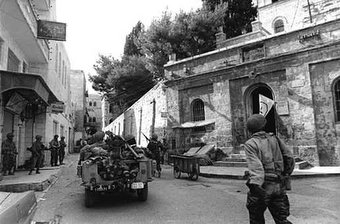 Razboiul de sase zile la Ierusalim: Edelina povesteste odisea ei prin Ierusalimul de vest, cum a ajuns acasa din centrul orasului (Ben Iehuda) pana in cartierul Pat. Pentru cucerirea Ierusalimului de est, inclusiv "orasul vechi" s-au dat lupte grele, doar la "givat ha-miftar" au cazut peste o suta de soldati.
Au urmat insa ani de euforie, nu multi, cam sapte la numar, cand orasul parea intr-adevar unit. Astazi din pacate este din nou despartit de un zid care nu se vede, mult mai greu de dat jos decat zidul Berlinului, un zid construit cu caramizi de neincredere sau suspiciune, de teama sau pe alocuri ura. Ierusalimul insa, este prin natura lui un oras cu ziduri, vazute si nevazute. Zidurile adauga la misterul, farmecul si specificul lui. Fara aceste ziduri nu ar fi...Ierusalim

de la EDELINA STERLING-STOIAN,"Razboiul de sase zile"
La fiecare razboi nou, israelienii isi aduc aminte de cele vechi. Cum sunt multe la numar, unul dupa celalalt, unul peste celalat, iti dai seama, ca de fapt, de la infintarea statului Israel(1948) si pana astazi este un singur razboi, cu perioade mai scurte sau mai lungi de incetare a focului.
Edelina isi aminteste cu nostalgie de cele sase zile fierbinti ale lui 1967. Si eu la fel, de primul razboi la care aveam sa particip ca soldat, sase ani mai tarziu. Poate "notalgie" nu este un cuvant potrivit. Sau poate ca da, caci atunci, in urma cu aproape 40 de ani, eram atat de tineri...
L.D-C.
Razboiul de Sase Zile
"Six days you shall do your work and on the seventh you shall find rest..."(Exodus 23:12)*Calamity Jane, Ziarista, Baby si Tarzan, Bucla si Buca, Chaplin si CeaPlina, Mutu si Muta, Casanova, Algeria si... Shalom Aleichem.
Cu ei si cu parintii mei aveam sa-mi petrec in adapost trei din cele sase zile ale razboiului.......-
DIMINEATA SIRENELOR -
Bucuria si nerabdarea m-au facut ca in dimineata aceea din iunie 1967sa plec mai devreme de-acasa. Cum tot se apropia vacanta de vara si de invatat nu prea mai invatam, parintii se solidarizasera cu intentia mea declarata de a chiuli, indemnindu-ma: du-te si alege-ti ceva pentru ziua ta! Stiam de mult ce vreau: o salba de argint, cum vazusem ca poarta femeile beduinilor. O "vizitam" aproape zilnic, admirind-o in vitrina unui mic magazin de bijuterii din actuala zona pietonala, in centrul Ierusalimului. Acolo, in fata vitrinei, a inceput pentru mine razboiul. Sirenele!! Am incremenit. Ne asteptam cu totii la ceva rau (de luni de zile plutea in aer amenintarea unei confruntari militare, Israelul avertiza tarile arabe, indemnindu-le sa puna capat atacurilor teroriste asupra populatiei civile din zonele de granita), dar sperasem ca totusi nu se va ajunge la razboi. Ce sa fac? Cum sa ma comport? Paralizata de urletul sinistru al sirenelor, uitasem ce era mai important: "Intrati imediat in adaposturi!" Pe strada, unii, la fel ca mine, ramasesera pe loc, dezorientati; altii, incovoiati,alergau pe linga ziduri, ferindu-se de gloantele deocamdata imaginare.Am auzit cum, linga mine, cineva tipa: "Ce faci aici? Hai in adapost!Hai repede!" Era doamna Wolf de la pravalia de dulciuri, ma cunostea,eram clienta ei, avea fondante ca cele din Romania. Mi le impacheta("ca pe un cadou de nunta!") intr-o cutie aurie, ma fascinau dexteritatea cu care innoda panglicile lucioase si numarul tatuat pe bratul sting... Am urmat-o in adapostul magazinului universal de peste drum, plin pina la refuz de clientii surprinsi de sirene in toiul cumparaturilor.Nu, nu pot ramine aici, trebuie sa ajung cumva acasa, fratele meu e pe front, macar eu sa fiu acum alaturi de parinti. Profitind de faptul ca doamna Wolf ma uitase, alaturindu-se unui grup care asculta stirile la tranzistor, m-am furisat afara din adapost, insotita de vocea crainicului: "Astazi, 5 iunie 1967, Israelul a decis sa lanseze un atac preventiv impotriva Egiptului. Israelul a apelat la Iordania,cerindu-i sa nu intre in razboi...."
*
"CIND TE LOVESTI SAU TI-E TEAMA...... cinta corale de Bach!". Asa am parafrazat in ziua aceea sfatul intelept al bunicii: cind te lovesti si te doare sau ti-e teama de ceva, incepe sa cinti si-ti trece imediat!*Intre timp strada se golise. Disparusera forfota multimii,claxoanele, vinzatorii de ziare care isi ademeneau clientii racnind titluri senzationale, chelneritele vorbarete care se invirteau printre mesele cafenelelor, nu mai era nici macar cersetorul iemenit poreclit"Discount", care nu se lasa clintit din fata bancii cu acelasi nume,teritoriu cucerit cu greu, dupa certuri interminabile cu colegii debreasla... Aveam senzatia ca sint singurul supravietuitor intr-un oras-fantoma invaluit intr-o liniste nefireasca, tulburata doar de trecerea in mare viteza a jeepurilor armatei. Eram sigura ca soldatii ma vor duce in vreun adapost daca ma prind bintuind pe strazi. Iar eu trebuia neaparat sa ajung acasa, mi-o imaginam pe mama ravasita de grija... Cum auzeam ca se apropie o masina, ma piteam dupa vreo arcada, intr-un gang, sub un pom. Inaintam mult prea incet, mi-am facut socoteala ca in ritmul asta nu voi ajunge la ai mei decit inciteva zile (intr-adevar, aveam sa parcurg in trei zile o distanta pentru care, in mod normal, nu aveam nevoie decit de cel mult o ora).M-am hotarit sa-mi schimb traseul. Daca au de gind sa bombardeze orasul, vor ataca in primul rind centrul. Trebuie asadar sa ma indepartez de zonele populate. Ei, bravo, unde gasesti intr-un oras ozona nepopulata? Cum unde? Parcul! Ah, sigur, numai bine, traversez Parcul Independentei spre hotelul "King George", de acolo nu mai sint decit doi pasi pina la Academia de Muzica, intru la Academie in adapost, imi intilnesc colegii, mai aflu ceva stiri, pornesc mai departe...Dupa cum aveam sa constat peste citva timp, ideea cu parcul nu fusese una originala, mi-o luasera altii inainte. Din loc in loc, sub pomi,se adunase cite un grup de 4-5 oameni. Am trecut rind pe rind pe linga fiecare.O femeie in virsta s-a uitat cu tristete la mine, m-a mingiiat pe cap si a oftat, incurajindu-ma: "Of, meidale[*], va trece si asta!". Altii, tacuti, seriosi, mi-au oferit apa si fructe. Dar eu altceva cautam. L-am gasit aproape cind eram pe punctul sa ies din parc: un batrin cu urechea lipita de aparatul de radio: "Iordania a respins apelul Israelului de a nu se alatura ostilitatilor..."Pina la strada Academiei nu mai ramasesera decit vreo suta de metri.I-am parcurs in fuga. In coltul strazii m-a oprit un militar, iesise din ghereta de la intrarea in resedinta ministrului de externe.- Ce cauti aici?- Sintem vecini.- Locuiesti pe strada asta, te duci acasa?- Nu, ma duc alaturi, la Academie.- In ordine, du-te si sa cinti frumos!- ???*In adapost, profesorii de teorie, drama si canto impartisera partiturile. Mi-am ocupat locul linga mezzosoprane si m-am alaturat celorlalte voci. Nu cred ca eu sau vreunul din colegii mei sa fi interpretat vreodata cu mai multa convingere coralele lui Bach. Si stiu si de ce: "cind te lovesti si te doare sau ti-e teama de ceva,incepe sa cinti si-ti trece imediat!"Ne-a intrerupt usa deschisa cu zgomot. Venise directoarea sa ne comunice ultima stire ascultata la radio: "Aproape intreaga aviatie egipteana a fost distrusa la sol. Peninsula Sinai se afla in miinile fortelor israeliene..."
*
- COVRIGI PENTRU COPII -"Uite un leu, sa-ti cumperi un covrig!"... asa ma trimetea mama la scoala in fiecare dimineata. Ma saruta pe amindoi obrajii si-mi dadea sfatul zilnic: "ai grija pe drum!"*Nu mai vazusem niciodata un barbat in toata firea plingind in hohote.Un plins infundat, dureros, ridicol, inspaimintator. Plingea si framinta aluatul... Pe el il cautam, mi se facuse foame, banuisem ca il voi gasi. Era intotdeauna acolo, zi si noapte. Si acum, in zori...O simigerie mica, foarte aproape de poarta Jaffa, una din cele sapte porti ale orasului vechi, la granita dintre Ierusalimul de vest si cel de est. De cite ori aveam drum pe acolo ma opream sa-mi cumpar covrigi, erau ca cei de un leu, ma simteam ca in recreatia mare. Sa-mi cumpar covrigi si sa stam de vorba.- De ce plingi?- Nu pling, mi-a intrat faina-n ochi.(Mi-am amintit ce-mi spusese femeia din parc).- Nu mai plinge, nu-ti fie teama, va trece si asta!- Mie nu mai are de ce sa-mi fie teama. Dar mi-e mila de copii.- Care copii?! (stiam ca pe ai lui, un baiat si o fata, gemeni, ii arsesera in lagar).- Copiii, soldatii nostri. Le fac covrigi, poate trec pe aici si le e foame.- Care e situatia? Ai ascultat stirile?- N-ai auzit bubuiturile? Iordanienii au deschis focul asupra Ierusalimului si a zonei Tel-Aviv-ului, ai nostri au lansat ocontra-ofensiva, asa ziceau la radio. Vezi zidul si turnul lui David? acolo va fi macel.Oricit m-as fi straduit, nu mi-as fi putut imagina asa ceva. Nu simteam decit linistea si pacea zorilor in orasul de aur, de arama si lumina, cum avea sa-l numeasca Naomi Shemer[*]:"Yerushalaim all of goldYerushalaim, bronze and light Within my heart I shall treasure Your song and sight..."*- Nu te duci nicaieri, ramii aici!- Dar trebuie sa ajung la parintii mei.- Daca vrei sa-i mai vezi, trebuie sa ramii azi aici, nu te las sa pleci! Nu stiu daca a insistat pentru ca nu voia sa ramina singur sau pentru ca se temea sa ma stie singura pe drum. Probabil si una si alta. Am cedat cu conditia sa ne ascundem in pivnita si sa-mi povesteasca...... Supravietuise numai datorita meseriei lui. Cu doar citeva zile inaintea eliberarii il trimisesera intr-un sat din apropiere, sa coaca piine si prajituri pentru o petrecere pe care urma s-o dea comandantul lagarului. A reusit sa fuga, l-a tinut ascuns o familie de tarani .Dupa vreo trei saptamini i-au spus sa plece. Unde sa se duca? Nu mai avea pe nimeni. A pornit pe jos inapoi, spre Romania, spre locul ce fusese odata "acasa", in apropiere de Cluj. Se ferea de orasele mari,unde s-ar fi putut rataci dar si de sate, unde nu ar fi putut trece neobservat. Dormea ziua pe unde apuca, isi continua drumul pe intuneric. Si-a amintit zimbind cum, undeva, linga Budapesta, localnicii aruncau in drum piine pentru cei care... "poate trec pe aici si le e foame".A doua zi ne-am despartit. Mi-a dat o punga cu covrigi, m-a sarutat pe amindoi obrajii si mi-a spus: "ai grija pe drum!". Inainte de a pleca ascultasem impreuna stirile: "Fortele israeliene au ocupat Cisiordania si Ierusalimul de est, inainte ca Iordania sa accepte cererea ONUpentru incetarea focului".[*] Naomi Shemer > compozitoare si poeta israeliana.
"OPEN DOOR! Aduceti curaj si voie buna, oferim cafele si saltele."*M-a atras nu atit anuntul scris mare, de mina, pe usa larg deschisa, cit larma dinauntru: muzica, palavrageala, risete. Ce mai e si asta? N-au aflat ca e razboi? Sau poate razboiul s-a terminat si eu nu stiu?... Nici una, nici alta. Era un apartament studentesc, in subsolul unei cladiri din cartierul german al orasului ("ha'moshava ha'ghermanit"), locuit in cea mai mare parte de evrei din Germania,porecliti "Jeckes"[*]. Il transformasera in adapost public, oricine trecea pe acolo era binevenit. Erau vreo 20 de persoane: sedeau pe jos, in cerc, se strinsesera in jurul aparatului de radio, ca la un foc de tabara; discutau, gesticulau, o tinara ii "acompania" la chitara, vocea crainicii se straduia parca sa le acopere zarva:"Fortele israeliene au capturat Iudeea si Samaria. In seara zilei de 7 iunie, Iordania a acceptat cererea ONU pentru incetarea focului".Retrasa de grup intr-un colt al camerei, o femeie rasfoia cu aer absent o revista, plingind demn, aparent fara motiv, cu o vadita stapinire launtrica, muscindu-si buzele fiindca altfel ar fi izbucnit in hohote. Din cind in cind inalta capul, se uita in gol, nicaieri, isi relua rasfoitul mecanic. M-am asezat la o departare cuviincioasa de ea, dar continuam s-o observ. Mi-a surprins privirea si mi-a facut semn sa ma apropii:- Toti trei, sint toti trei pe front, baietii si sotul meu. Macar sa fi avut si eu o fata... stai aici, linga mine.Mi-au dat cafeaua promisa, am facut un dush si am inceput sa-mi iau ramas bun de la fiecare. Nu m-au lasat sa plec, se facuse noapte."Oricum nu ajungi departe pe intuneric, e inca prea periculos, ramii aici, pleci miine in zori". Am cedat in fata argumentului si a oboselii...*Desi din stiri reiesea ca Ierusalimul ar fi in afara pericolului,orasul continua sa fie pustiu. Absurda imagine! Parca il intorsese cineva pe dos: in subterana viata continua sa pulseze, la suprafata incremenise. Simteam nevoia sa pasesc pe virfuri, sa nu-l trezesc, sa nu-l sperii. Inaintam fara dificultate, n-am intilnit nici un om, nici o masina a armatei. Dupa citeva strazi am vazut miscare la o benzinarie, tineau deschis pentru jeepurile militare. Mi-au spus ca, dupa Iordania, Egiptul acceptase deasemeni incetarea focului. Luptele urmau sa se concentreze pe frontul sirian. Fratele meu! trebuie sa ma grabesc!
*
- CADOUL -Calamity Jane, Ziarista, Baby si Tarzan, Bucla si Buca, Chaplin siCeaPlina, Mutu si Muta, Casanova, Algeria si... Shalom Aleichem. Cu ei si cu parintii mei mi-am petrecut in adapost ultimele zile ale razboiului.......*Mi-am lipit urechea de usa metalica. Era liniste, nu se auzea decit cineva care citea cu glas tare. Am recunoscut imediat vocea sitextul: era tata - citea, interpreta din Shalom Aleichem,"leacul-minune contra durerilor de suflet", cum il numea el. Am inceput sa bat cu pumnii in usa. Dupa graba cu care mi-au deschis mi-am dat seama ca cei din adapost ma asteptasera tot timpul."Spectatorii" tatei si-au indreptat atentia spre mine, aplaudind,vorbind toti deodata. Calamity Jane (asa o poreclise tata pe d-na Jana, povestea cu voluptate numai despre accidente, furturi, divorturi, boli) si Ziarista (avea un chiosc de ziare) au sarit pe mine imbratisindu-ma cam... umed pentru gustul meu. Baby (vecina de la parter, care se adresa oricui cu apelativul "Baby", pina si macelarului, o namila paroasa cu fatza cit o perna) incerca parca sa se catere ca o liana pe sotul ei, Tarzan (atirnase pe balcoanele intregii strazi fringhiile de uscat rufe) care, dupa felul in care deschidea si inchidea gura ca pestele pe uscat, fara sa scoata o vorba, parea sa fie total coplesit de aparitia mea. In spatele lor se ridicau pe virfuri, sa ma vada mai bine, Bucla (dentistul care isi masca crestetul plesuv cu o suvita de par lipicios, adus din stinga spre dreapta si intepenit in forma de bucla deasupra urechii) si Buca, sotia lui (cosmeticiana care nu obosea sa impartaseasca oricui dispus sa o asculte principiul suprem al esteticii: tenul de femeie trebuie sa fie neted ca o buca!). Chaplin (mustacioara si mers de pinguin) se inghesuia sa-si faca loc mai in fatza, orice progrese fiindu-i insa blocate de prezenta lata a sotiei sale, CeaPlina. Mutu si Muta, vecinii surdo-muti de la etajul trei, zimbeau pina la urechi si gesticulau frenetic, incercind sa-mi comunice bucuria revederii. Am simtit cum, in spatele meu, cineva imi zgiltiia umerii, incercind sa-mi atraga atentia. Era Casanova, botezat de ai mei cu numele curtezanului venetian cu care de altfel nu avea nimic in comun; ne anunta insa de mult, la intervale din ce in ce mai scurte, ca se va muta in casa_ noua pentru ca sotia lui este alGericala galagia strazii. Intr-adevar, pe Algeria parea s-o deranjeze pina si zgomotul iscat de intrarea mea, se chinuia sa-si puna in urechi antifoanele...Nu mai stiam cum sa ma eliberez din imbratisari, n-o vazusem inca pe mama. I-am ghicit prezentza intr-un colt al incaperii. In stilul ei,nedemonstrativ, astepta rabdatoare sa se sature ceilalti de mine.Privea amuzata scena, tinind in mina goblenul la care broda de fiecare data cind era foarte ingrijorata, cind nu voia sa arate altora ca ceva o doare. In zilele acelea, fiecare impunsatura de ac a fost un gind bun, o speranta trimisa catre fratele meu si ceilalti tineri care isi riscau viata. Goblenul la care brodase atunci, rabdarea, grija si sperantele ei, se afla acum pe un perete, la Montreal, in casa fratelui meu....Am reusit in cele din urma sa ne retragem doar noi trei intr-un capat al adapostului. "Ti-e sete?" m-a intrebat tata, oferindu-mi sa beau din termosul cu apa, fara de care nu pleca nicaieri, niciodata. Nu scapase de teama obsesiva ca va ramine fara apa de cind il transportasera intr-unul din "trenurile mortii"[*]. Inghesuiti, striviti in vagoane, timp de citeva zile i-au fortat sa manince numai scrumbii sarate, fara sa le dea nici un strop de apa. Orele, zilele urmatoare au trecut pe nesimitite. Doborita de oboseala si emotiile ultimelor zile, linistita de siguranta pe care mi-o dadea prezentza parintilor, am dormit aproape tot timpul. M-a trezit vocea mamei: La multi ani! scoala-te, e ziua ta! Ghici ce cadou avem pentru tine: e pace, SHALOM![*] cu "trenurile mortii" au fost transportati evreii dupaasa-numitul "pogrom de la Iasi" in vara lui 1941.
Edelina Sterling-Stoian
Edelina isi aminteste cu nostalgie de cele sase zile fierbinti ale lui 1967. Si eu la fel, de primul razboi la care aveam sa particip ca soldat, sase ani mai tarziu. Poate "notalgie" nu este un cuvant potrivit. Sau poate ca da, caci atunci, in urma cu aproape 40 de ani, eram atat de tineri...
L.D-C.
Razboiul de Sase Zile
"Six days you shall do your work and on the seventh you shall find rest..."(Exodus 23:12)*Calamity Jane, Ziarista, Baby si Tarzan, Bucla si Buca, Chaplin si CeaPlina, Mutu si Muta, Casanova, Algeria si... Shalom Aleichem.
Cu ei si cu parintii mei aveam sa-mi petrec in adapost trei din cele sase zile ale razboiului.......-
DIMINEATA SIRENELOR -
Bucuria si nerabdarea m-au facut ca in dimineata aceea din iunie 1967sa plec mai devreme de-acasa. Cum tot se apropia vacanta de vara si de invatat nu prea mai invatam, parintii se solidarizasera cu intentia mea declarata de a chiuli, indemnindu-ma: du-te si alege-ti ceva pentru ziua ta! Stiam de mult ce vreau: o salba de argint, cum vazusem ca poarta femeile beduinilor. O "vizitam" aproape zilnic, admirind-o in vitrina unui mic magazin de bijuterii din actuala zona pietonala, in centrul Ierusalimului. Acolo, in fata vitrinei, a inceput pentru mine razboiul. Sirenele!! Am incremenit. Ne asteptam cu totii la ceva rau (de luni de zile plutea in aer amenintarea unei confruntari militare, Israelul avertiza tarile arabe, indemnindu-le sa puna capat atacurilor teroriste asupra populatiei civile din zonele de granita), dar sperasem ca totusi nu se va ajunge la razboi. Ce sa fac? Cum sa ma comport? Paralizata de urletul sinistru al sirenelor, uitasem ce era mai important: "Intrati imediat in adaposturi!" Pe strada, unii, la fel ca mine, ramasesera pe loc, dezorientati; altii, incovoiati,alergau pe linga ziduri, ferindu-se de gloantele deocamdata imaginare.Am auzit cum, linga mine, cineva tipa: "Ce faci aici? Hai in adapost!Hai repede!" Era doamna Wolf de la pravalia de dulciuri, ma cunostea,eram clienta ei, avea fondante ca cele din Romania. Mi le impacheta("ca pe un cadou de nunta!") intr-o cutie aurie, ma fascinau dexteritatea cu care innoda panglicile lucioase si numarul tatuat pe bratul sting... Am urmat-o in adapostul magazinului universal de peste drum, plin pina la refuz de clientii surprinsi de sirene in toiul cumparaturilor.Nu, nu pot ramine aici, trebuie sa ajung cumva acasa, fratele meu e pe front, macar eu sa fiu acum alaturi de parinti. Profitind de faptul ca doamna Wolf ma uitase, alaturindu-se unui grup care asculta stirile la tranzistor, m-am furisat afara din adapost, insotita de vocea crainicului: "Astazi, 5 iunie 1967, Israelul a decis sa lanseze un atac preventiv impotriva Egiptului. Israelul a apelat la Iordania,cerindu-i sa nu intre in razboi...."
*
"CIND TE LOVESTI SAU TI-E TEAMA...... cinta corale de Bach!". Asa am parafrazat in ziua aceea sfatul intelept al bunicii: cind te lovesti si te doare sau ti-e teama de ceva, incepe sa cinti si-ti trece imediat!*Intre timp strada se golise. Disparusera forfota multimii,claxoanele, vinzatorii de ziare care isi ademeneau clientii racnind titluri senzationale, chelneritele vorbarete care se invirteau printre mesele cafenelelor, nu mai era nici macar cersetorul iemenit poreclit"Discount", care nu se lasa clintit din fata bancii cu acelasi nume,teritoriu cucerit cu greu, dupa certuri interminabile cu colegii debreasla... Aveam senzatia ca sint singurul supravietuitor intr-un oras-fantoma invaluit intr-o liniste nefireasca, tulburata doar de trecerea in mare viteza a jeepurilor armatei. Eram sigura ca soldatii ma vor duce in vreun adapost daca ma prind bintuind pe strazi. Iar eu trebuia neaparat sa ajung acasa, mi-o imaginam pe mama ravasita de grija... Cum auzeam ca se apropie o masina, ma piteam dupa vreo arcada, intr-un gang, sub un pom. Inaintam mult prea incet, mi-am facut socoteala ca in ritmul asta nu voi ajunge la ai mei decit inciteva zile (intr-adevar, aveam sa parcurg in trei zile o distanta pentru care, in mod normal, nu aveam nevoie decit de cel mult o ora).M-am hotarit sa-mi schimb traseul. Daca au de gind sa bombardeze orasul, vor ataca in primul rind centrul. Trebuie asadar sa ma indepartez de zonele populate. Ei, bravo, unde gasesti intr-un oras ozona nepopulata? Cum unde? Parcul! Ah, sigur, numai bine, traversez Parcul Independentei spre hotelul "King George", de acolo nu mai sint decit doi pasi pina la Academia de Muzica, intru la Academie in adapost, imi intilnesc colegii, mai aflu ceva stiri, pornesc mai departe...Dupa cum aveam sa constat peste citva timp, ideea cu parcul nu fusese una originala, mi-o luasera altii inainte. Din loc in loc, sub pomi,se adunase cite un grup de 4-5 oameni. Am trecut rind pe rind pe linga fiecare.O femeie in virsta s-a uitat cu tristete la mine, m-a mingiiat pe cap si a oftat, incurajindu-ma: "Of, meidale[*], va trece si asta!". Altii, tacuti, seriosi, mi-au oferit apa si fructe. Dar eu altceva cautam. L-am gasit aproape cind eram pe punctul sa ies din parc: un batrin cu urechea lipita de aparatul de radio: "Iordania a respins apelul Israelului de a nu se alatura ostilitatilor..."Pina la strada Academiei nu mai ramasesera decit vreo suta de metri.I-am parcurs in fuga. In coltul strazii m-a oprit un militar, iesise din ghereta de la intrarea in resedinta ministrului de externe.- Ce cauti aici?- Sintem vecini.- Locuiesti pe strada asta, te duci acasa?- Nu, ma duc alaturi, la Academie.- In ordine, du-te si sa cinti frumos!- ???*In adapost, profesorii de teorie, drama si canto impartisera partiturile. Mi-am ocupat locul linga mezzosoprane si m-am alaturat celorlalte voci. Nu cred ca eu sau vreunul din colegii mei sa fi interpretat vreodata cu mai multa convingere coralele lui Bach. Si stiu si de ce: "cind te lovesti si te doare sau ti-e teama de ceva,incepe sa cinti si-ti trece imediat!"Ne-a intrerupt usa deschisa cu zgomot. Venise directoarea sa ne comunice ultima stire ascultata la radio: "Aproape intreaga aviatie egipteana a fost distrusa la sol. Peninsula Sinai se afla in miinile fortelor israeliene..."
*
- COVRIGI PENTRU COPII -"Uite un leu, sa-ti cumperi un covrig!"... asa ma trimetea mama la scoala in fiecare dimineata. Ma saruta pe amindoi obrajii si-mi dadea sfatul zilnic: "ai grija pe drum!"*Nu mai vazusem niciodata un barbat in toata firea plingind in hohote.Un plins infundat, dureros, ridicol, inspaimintator. Plingea si framinta aluatul... Pe el il cautam, mi se facuse foame, banuisem ca il voi gasi. Era intotdeauna acolo, zi si noapte. Si acum, in zori...O simigerie mica, foarte aproape de poarta Jaffa, una din cele sapte porti ale orasului vechi, la granita dintre Ierusalimul de vest si cel de est. De cite ori aveam drum pe acolo ma opream sa-mi cumpar covrigi, erau ca cei de un leu, ma simteam ca in recreatia mare. Sa-mi cumpar covrigi si sa stam de vorba.- De ce plingi?- Nu pling, mi-a intrat faina-n ochi.(Mi-am amintit ce-mi spusese femeia din parc).- Nu mai plinge, nu-ti fie teama, va trece si asta!- Mie nu mai are de ce sa-mi fie teama. Dar mi-e mila de copii.- Care copii?! (stiam ca pe ai lui, un baiat si o fata, gemeni, ii arsesera in lagar).- Copiii, soldatii nostri. Le fac covrigi, poate trec pe aici si le e foame.- Care e situatia? Ai ascultat stirile?- N-ai auzit bubuiturile? Iordanienii au deschis focul asupra Ierusalimului si a zonei Tel-Aviv-ului, ai nostri au lansat ocontra-ofensiva, asa ziceau la radio. Vezi zidul si turnul lui David? acolo va fi macel.Oricit m-as fi straduit, nu mi-as fi putut imagina asa ceva. Nu simteam decit linistea si pacea zorilor in orasul de aur, de arama si lumina, cum avea sa-l numeasca Naomi Shemer[*]:"Yerushalaim all of goldYerushalaim, bronze and light Within my heart I shall treasure Your song and sight..."*- Nu te duci nicaieri, ramii aici!- Dar trebuie sa ajung la parintii mei.- Daca vrei sa-i mai vezi, trebuie sa ramii azi aici, nu te las sa pleci! Nu stiu daca a insistat pentru ca nu voia sa ramina singur sau pentru ca se temea sa ma stie singura pe drum. Probabil si una si alta. Am cedat cu conditia sa ne ascundem in pivnita si sa-mi povesteasca...... Supravietuise numai datorita meseriei lui. Cu doar citeva zile inaintea eliberarii il trimisesera intr-un sat din apropiere, sa coaca piine si prajituri pentru o petrecere pe care urma s-o dea comandantul lagarului. A reusit sa fuga, l-a tinut ascuns o familie de tarani .Dupa vreo trei saptamini i-au spus sa plece. Unde sa se duca? Nu mai avea pe nimeni. A pornit pe jos inapoi, spre Romania, spre locul ce fusese odata "acasa", in apropiere de Cluj. Se ferea de orasele mari,unde s-ar fi putut rataci dar si de sate, unde nu ar fi putut trece neobservat. Dormea ziua pe unde apuca, isi continua drumul pe intuneric. Si-a amintit zimbind cum, undeva, linga Budapesta, localnicii aruncau in drum piine pentru cei care... "poate trec pe aici si le e foame".A doua zi ne-am despartit. Mi-a dat o punga cu covrigi, m-a sarutat pe amindoi obrajii si mi-a spus: "ai grija pe drum!". Inainte de a pleca ascultasem impreuna stirile: "Fortele israeliene au ocupat Cisiordania si Ierusalimul de est, inainte ca Iordania sa accepte cererea ONUpentru incetarea focului".[*] Naomi Shemer > compozitoare si poeta israeliana.
"OPEN DOOR! Aduceti curaj si voie buna, oferim cafele si saltele."*M-a atras nu atit anuntul scris mare, de mina, pe usa larg deschisa, cit larma dinauntru: muzica, palavrageala, risete. Ce mai e si asta? N-au aflat ca e razboi? Sau poate razboiul s-a terminat si eu nu stiu?... Nici una, nici alta. Era un apartament studentesc, in subsolul unei cladiri din cartierul german al orasului ("ha'moshava ha'ghermanit"), locuit in cea mai mare parte de evrei din Germania,porecliti "Jeckes"[*]. Il transformasera in adapost public, oricine trecea pe acolo era binevenit. Erau vreo 20 de persoane: sedeau pe jos, in cerc, se strinsesera in jurul aparatului de radio, ca la un foc de tabara; discutau, gesticulau, o tinara ii "acompania" la chitara, vocea crainicii se straduia parca sa le acopere zarva:"Fortele israeliene au capturat Iudeea si Samaria. In seara zilei de 7 iunie, Iordania a acceptat cererea ONU pentru incetarea focului".Retrasa de grup intr-un colt al camerei, o femeie rasfoia cu aer absent o revista, plingind demn, aparent fara motiv, cu o vadita stapinire launtrica, muscindu-si buzele fiindca altfel ar fi izbucnit in hohote. Din cind in cind inalta capul, se uita in gol, nicaieri, isi relua rasfoitul mecanic. M-am asezat la o departare cuviincioasa de ea, dar continuam s-o observ. Mi-a surprins privirea si mi-a facut semn sa ma apropii:- Toti trei, sint toti trei pe front, baietii si sotul meu. Macar sa fi avut si eu o fata... stai aici, linga mine.Mi-au dat cafeaua promisa, am facut un dush si am inceput sa-mi iau ramas bun de la fiecare. Nu m-au lasat sa plec, se facuse noapte."Oricum nu ajungi departe pe intuneric, e inca prea periculos, ramii aici, pleci miine in zori". Am cedat in fata argumentului si a oboselii...*Desi din stiri reiesea ca Ierusalimul ar fi in afara pericolului,orasul continua sa fie pustiu. Absurda imagine! Parca il intorsese cineva pe dos: in subterana viata continua sa pulseze, la suprafata incremenise. Simteam nevoia sa pasesc pe virfuri, sa nu-l trezesc, sa nu-l sperii. Inaintam fara dificultate, n-am intilnit nici un om, nici o masina a armatei. Dupa citeva strazi am vazut miscare la o benzinarie, tineau deschis pentru jeepurile militare. Mi-au spus ca, dupa Iordania, Egiptul acceptase deasemeni incetarea focului. Luptele urmau sa se concentreze pe frontul sirian. Fratele meu! trebuie sa ma grabesc!
*
- CADOUL -Calamity Jane, Ziarista, Baby si Tarzan, Bucla si Buca, Chaplin siCeaPlina, Mutu si Muta, Casanova, Algeria si... Shalom Aleichem. Cu ei si cu parintii mei mi-am petrecut in adapost ultimele zile ale razboiului.......*Mi-am lipit urechea de usa metalica. Era liniste, nu se auzea decit cineva care citea cu glas tare. Am recunoscut imediat vocea sitextul: era tata - citea, interpreta din Shalom Aleichem,"leacul-minune contra durerilor de suflet", cum il numea el. Am inceput sa bat cu pumnii in usa. Dupa graba cu care mi-au deschis mi-am dat seama ca cei din adapost ma asteptasera tot timpul."Spectatorii" tatei si-au indreptat atentia spre mine, aplaudind,vorbind toti deodata. Calamity Jane (asa o poreclise tata pe d-na Jana, povestea cu voluptate numai despre accidente, furturi, divorturi, boli) si Ziarista (avea un chiosc de ziare) au sarit pe mine imbratisindu-ma cam... umed pentru gustul meu. Baby (vecina de la parter, care se adresa oricui cu apelativul "Baby", pina si macelarului, o namila paroasa cu fatza cit o perna) incerca parca sa se catere ca o liana pe sotul ei, Tarzan (atirnase pe balcoanele intregii strazi fringhiile de uscat rufe) care, dupa felul in care deschidea si inchidea gura ca pestele pe uscat, fara sa scoata o vorba, parea sa fie total coplesit de aparitia mea. In spatele lor se ridicau pe virfuri, sa ma vada mai bine, Bucla (dentistul care isi masca crestetul plesuv cu o suvita de par lipicios, adus din stinga spre dreapta si intepenit in forma de bucla deasupra urechii) si Buca, sotia lui (cosmeticiana care nu obosea sa impartaseasca oricui dispus sa o asculte principiul suprem al esteticii: tenul de femeie trebuie sa fie neted ca o buca!). Chaplin (mustacioara si mers de pinguin) se inghesuia sa-si faca loc mai in fatza, orice progrese fiindu-i insa blocate de prezenta lata a sotiei sale, CeaPlina. Mutu si Muta, vecinii surdo-muti de la etajul trei, zimbeau pina la urechi si gesticulau frenetic, incercind sa-mi comunice bucuria revederii. Am simtit cum, in spatele meu, cineva imi zgiltiia umerii, incercind sa-mi atraga atentia. Era Casanova, botezat de ai mei cu numele curtezanului venetian cu care de altfel nu avea nimic in comun; ne anunta insa de mult, la intervale din ce in ce mai scurte, ca se va muta in casa_ noua pentru ca sotia lui este alGericala galagia strazii. Intr-adevar, pe Algeria parea s-o deranjeze pina si zgomotul iscat de intrarea mea, se chinuia sa-si puna in urechi antifoanele...Nu mai stiam cum sa ma eliberez din imbratisari, n-o vazusem inca pe mama. I-am ghicit prezentza intr-un colt al incaperii. In stilul ei,nedemonstrativ, astepta rabdatoare sa se sature ceilalti de mine.Privea amuzata scena, tinind in mina goblenul la care broda de fiecare data cind era foarte ingrijorata, cind nu voia sa arate altora ca ceva o doare. In zilele acelea, fiecare impunsatura de ac a fost un gind bun, o speranta trimisa catre fratele meu si ceilalti tineri care isi riscau viata. Goblenul la care brodase atunci, rabdarea, grija si sperantele ei, se afla acum pe un perete, la Montreal, in casa fratelui meu....Am reusit in cele din urma sa ne retragem doar noi trei intr-un capat al adapostului. "Ti-e sete?" m-a intrebat tata, oferindu-mi sa beau din termosul cu apa, fara de care nu pleca nicaieri, niciodata. Nu scapase de teama obsesiva ca va ramine fara apa de cind il transportasera intr-unul din "trenurile mortii"[*]. Inghesuiti, striviti in vagoane, timp de citeva zile i-au fortat sa manince numai scrumbii sarate, fara sa le dea nici un strop de apa. Orele, zilele urmatoare au trecut pe nesimitite. Doborita de oboseala si emotiile ultimelor zile, linistita de siguranta pe care mi-o dadea prezentza parintilor, am dormit aproape tot timpul. M-a trezit vocea mamei: La multi ani! scoala-te, e ziua ta! Ghici ce cadou avem pentru tine: e pace, SHALOM![*] cu "trenurile mortii" au fost transportati evreii dupaasa-numitul "pogrom de la Iasi" in vara lui 1941.
Edelina Sterling-Stoian
Thursday, July 13, 2006
Mortii desertului- The dead of the desert
Comentariul biblic din aceasta saptamana , pasajul citit, este povestea evreilor, care pregatindu-se sa intre in tara sfanta, se infricoseaza la auzul povestilor spuse de "spioni" - iscoadele trimise de Moshe in pamantul promis- si vor sa se intoarca la craticiora cu carne, din robia Egiptului. Un neam nascut in robie, neam de slugi, nu sunt demni sa primeasca o tara. D-zeu ii condamna la moarte lenta, 40 de ani de ratacire prin desert, unde robii aveau sa dispara unul dupa celelalt, iar in Tara Fagaduita intrau doar cei nascuti liber, sub cerul plin de stele al desertului.:
Portion of the Week / The dead of the desert
By Miron C. Izakson (Ha-Aretz)
In this week's Torah reading, the Israelites' progress through the desert toward the Promised Land takes a dramatic turn. They were supposed to reach their destination quickly; instead, the itinerary changes completely. Except for Joshua, son of Nun, and Caleb, son of Jephunneh, all the Jews leaving Egypt are doomed to wander in the wilderness until they die. The image of the metei midbar - dead of the desert - symbolizes for us today people who set off on a mission and die before its completion, preparing the way for those who come afterward. The restlessness referred to in the portion described last week is reinforced in this reading, and assumes the dimensions of a catastrophe. The major change begins with the dispatching of the spies to the Promised Land. The members of the elite and representatives of the 12 tribes are instructed thus: "And see the land, what it is; and the people that dwelleth therein, whether they be strong or weak, few or many; And what the land is that they dwell in, whether it be good or bad; and what cities they be that they dwell in, whether in tents, or in strong holds" (Numbers 13:18-19). Returning "from searching of the land" (13:25), they report on the Land of Canaan's positive features, quickly adding that its residents are powerful, their cities are large and fortified, and the Israelites have no chance of defeating them. Only Joshua and Caleb remain faithful to the goal of the mission: launching a reconnaissance expedition in advance of the land's conquest. The Jews begin weeping bitterly and, in a rebellious spirit, abandon the vision of the Promised Land. Initially, God intends to kill them all. However, when Moses intercedes, the decree is altered: The members of the desert generation will wander through the wilderness until they perish; only their children will enter the Promised Land.
The sins of the spies and of the desert generation can be viewed from various angles. The former are sent "to spy the land" (13:16). However, their mission is not espionage; God instructs them to tour the land and register their impressions, without drawing conclusions. In Deuteronomy, Moses recalls: "And ye came near unto me every one of you, and said, We will send men before us, and they shall search us out the land, and bring us word again by what way we must go up, and into what cities we shall come" (1:22). Here the idea is that this is an espionage mission initiated by the Jews themselves. List of grievancesThe mood changes in this week's reading: In the opening verses, we sense that the Israelites will soon enter the Promised Land. However, the spies' sin raises serious issues that cast doubts on whether the desert generation, irrespective of that transgression, deserves to enter the Promised Land altogether: "And the Lord said unto Moses, How long will this people provoke me? And how long will it be ere they believe me, for all the signs which I have shewed among them?" (Num. 14:11). The spies' sin constitutes one element that is but another link in the chain of the Israelites' complaints and expressions of lack of faith. Thus, the festive tone in the initial verses is unrealistic. The Jews' lament here - "were it not better for us to return into Egypt?" (14:3) - is only one stage in the long list of their grievances. In the Deuteronomy account, the spies' mission is initiated by the Israelites, who require additional reinforcements for the Promised Land, whereas in Numbers, God seems more interested in inspecting the people, rather than the land. That is why he chooses their leaders for the mission. The word "what" is repeated in the spies' instructions, stressing the subjective nature of their mission - the idea that "beauty is in the eyes of the beholder." The spies are sent to engage in their own introspection, not to inspect the land. Their mission is intended not to make the conquest easier, but rather as an expression of their nation's emotional state. In our own emotional awareness, the desert generation represents those who "do not quite make it," who never reach their destination. The so-called dead of the desert are still with us, sometimes arousing elements in our collective historical memory. In the fifth chapter of the Babylonian Talmud's Bava Batra Tractate, "The seller of a ship," we read accounts of ships and sailors. In one of them, Rabba, son of Bar Hana, relates his encounter with the "dead of the desert": They appear as if they are drunk and are lying on their backs. The knee of one of them is bent upward. An Arab, riding on a camel and holding a javelin, passes under that knee: The being lying on the ground is so huge that he can get by without even touching the knee. When Rabba cuts off a small corner of the light blue material of the recumbent figure's tallit (prayer shawl), together with one of the tallit's four fringes, he finds himself suddenly paralyzed. The Arab asks him whether he has taken anything, adding that according to tradition, if you take something from these beings, you will be immobilized. In this account, the dead of the desert are thus depicted as if they are in suspended animation, and indeed that is how they are thought of throughout Jewish history. In his epic poem, "Metei midbar," Haim Nahman Bialik, intending to create a "naive poetic legend" centering on the desert generation, actually produces a poem that is an allegory on Jewish history and on humanity in general. These beings are apparently slumbering eternally, but are also visited by regal beasts. After they rise up in rebellion, the desert returns to its previous silence: "The mighty phalanx awakes. They suddenly rouse themselves, the stalwart/men of war, lightning ablaze in their eyes, their faces aflame, hands on swords." The dead of the desert are a constant element in Jewish tradition: They are referred to in Psalms 95, part of the Friday evening liturgy. Other key phrases in the week's reading have assumed pivotal importance in Jewish tradition, for instance, "But they presumed to go up unto the hilltop" (14:44). The term ma'apilim (defined as those who presume, who dare) is also used, for example, to describe the illegal Jewish immigrants seeking to enter Palestine before 1948, reflecting the notion of people fighting against almost impossible odds. The eternal presence in Jewish awareness of the desert generation indicates that, despite its tragic fate, it continues till today to convey a message to us.
Portion of the Week / The dead of the desert
By Miron C. Izakson (Ha-Aretz)
In this week's Torah reading, the Israelites' progress through the desert toward the Promised Land takes a dramatic turn. They were supposed to reach their destination quickly; instead, the itinerary changes completely. Except for Joshua, son of Nun, and Caleb, son of Jephunneh, all the Jews leaving Egypt are doomed to wander in the wilderness until they die. The image of the metei midbar - dead of the desert - symbolizes for us today people who set off on a mission and die before its completion, preparing the way for those who come afterward. The restlessness referred to in the portion described last week is reinforced in this reading, and assumes the dimensions of a catastrophe. The major change begins with the dispatching of the spies to the Promised Land. The members of the elite and representatives of the 12 tribes are instructed thus: "And see the land, what it is; and the people that dwelleth therein, whether they be strong or weak, few or many; And what the land is that they dwell in, whether it be good or bad; and what cities they be that they dwell in, whether in tents, or in strong holds" (Numbers 13:18-19). Returning "from searching of the land" (13:25), they report on the Land of Canaan's positive features, quickly adding that its residents are powerful, their cities are large and fortified, and the Israelites have no chance of defeating them. Only Joshua and Caleb remain faithful to the goal of the mission: launching a reconnaissance expedition in advance of the land's conquest. The Jews begin weeping bitterly and, in a rebellious spirit, abandon the vision of the Promised Land. Initially, God intends to kill them all. However, when Moses intercedes, the decree is altered: The members of the desert generation will wander through the wilderness until they perish; only their children will enter the Promised Land.
The sins of the spies and of the desert generation can be viewed from various angles. The former are sent "to spy the land" (13:16). However, their mission is not espionage; God instructs them to tour the land and register their impressions, without drawing conclusions. In Deuteronomy, Moses recalls: "And ye came near unto me every one of you, and said, We will send men before us, and they shall search us out the land, and bring us word again by what way we must go up, and into what cities we shall come" (1:22). Here the idea is that this is an espionage mission initiated by the Jews themselves. List of grievancesThe mood changes in this week's reading: In the opening verses, we sense that the Israelites will soon enter the Promised Land. However, the spies' sin raises serious issues that cast doubts on whether the desert generation, irrespective of that transgression, deserves to enter the Promised Land altogether: "And the Lord said unto Moses, How long will this people provoke me? And how long will it be ere they believe me, for all the signs which I have shewed among them?" (Num. 14:11). The spies' sin constitutes one element that is but another link in the chain of the Israelites' complaints and expressions of lack of faith. Thus, the festive tone in the initial verses is unrealistic. The Jews' lament here - "were it not better for us to return into Egypt?" (14:3) - is only one stage in the long list of their grievances. In the Deuteronomy account, the spies' mission is initiated by the Israelites, who require additional reinforcements for the Promised Land, whereas in Numbers, God seems more interested in inspecting the people, rather than the land. That is why he chooses their leaders for the mission. The word "what" is repeated in the spies' instructions, stressing the subjective nature of their mission - the idea that "beauty is in the eyes of the beholder." The spies are sent to engage in their own introspection, not to inspect the land. Their mission is intended not to make the conquest easier, but rather as an expression of their nation's emotional state. In our own emotional awareness, the desert generation represents those who "do not quite make it," who never reach their destination. The so-called dead of the desert are still with us, sometimes arousing elements in our collective historical memory. In the fifth chapter of the Babylonian Talmud's Bava Batra Tractate, "The seller of a ship," we read accounts of ships and sailors. In one of them, Rabba, son of Bar Hana, relates his encounter with the "dead of the desert": They appear as if they are drunk and are lying on their backs. The knee of one of them is bent upward. An Arab, riding on a camel and holding a javelin, passes under that knee: The being lying on the ground is so huge that he can get by without even touching the knee. When Rabba cuts off a small corner of the light blue material of the recumbent figure's tallit (prayer shawl), together with one of the tallit's four fringes, he finds himself suddenly paralyzed. The Arab asks him whether he has taken anything, adding that according to tradition, if you take something from these beings, you will be immobilized. In this account, the dead of the desert are thus depicted as if they are in suspended animation, and indeed that is how they are thought of throughout Jewish history. In his epic poem, "Metei midbar," Haim Nahman Bialik, intending to create a "naive poetic legend" centering on the desert generation, actually produces a poem that is an allegory on Jewish history and on humanity in general. These beings are apparently slumbering eternally, but are also visited by regal beasts. After they rise up in rebellion, the desert returns to its previous silence: "The mighty phalanx awakes. They suddenly rouse themselves, the stalwart/men of war, lightning ablaze in their eyes, their faces aflame, hands on swords." The dead of the desert are a constant element in Jewish tradition: They are referred to in Psalms 95, part of the Friday evening liturgy. Other key phrases in the week's reading have assumed pivotal importance in Jewish tradition, for instance, "But they presumed to go up unto the hilltop" (14:44). The term ma'apilim (defined as those who presume, who dare) is also used, for example, to describe the illegal Jewish immigrants seeking to enter Palestine before 1948, reflecting the notion of people fighting against almost impossible odds. The eternal presence in Jewish awareness of the desert generation indicates that, despite its tragic fate, it continues till today to convey a message to us.
The forth way? I fish for ideas, you have some?
The end of the Third Way
By Ari Shavit Ha-Aretz)
Initially, there was the First Way - the occupation, nonrecognition of the Palestinians, a belief in the entire Land of Israel. In the 20 years between the Six-Day War and the outbreak of the first intifada, the Israeli worldview was one of war, and nothing else. We will strike them, we will settle among them, we will solve the conflict through force. Then, the Second Way appeared - peace, recognition of the Palestinians, belief in a full peace. In the 13 years between the outbreak of the first intifada and the outbreak of the second intifada, that of the suicide bombers, the Israeli worldview was one of peace, and nothing else. We will recognize them, we will talk with them, we will sign deals with them, we will solve the conflict with a peace agreement.
Only afterward, from among the rubble, did the Third Way arise - unilateral withdrawal, separation from the Palestinians, belief in complete separation. In the almost six years between the collapse of peace in October 2000 and the collapse of the disengagement in June-July 2006, the Israeli worldview was one of fences, and nothing else. We will withdraw from them, we will get them out of our sight, we will solve the conflict with a wall. Our desire was to leave the territories and strike at the Arabs, out of a feeling of "we're sick of it." We're sick of the Palestinians, we're sick of the Arabs, we're sick of the Middle East, and therefore we want to disengage. But the Third Way, the unilateral way, was more than that. It was also the understanding that the demographic clock was ticking, that the democratic Jewish state was under an existential threat, and that the occupation had no future - but also that there was no Palestinian partner for ending the occupation. Therefore, Israel was obligated to act quickly and decisively. However, the action that was taken was rash. Even today, with the disengagement crumbling before our eyes, it should be justified. Even today, with the Israel Defense Forces returning to northern Gaza and Gush Katif, it should be argued that liberating 1.3 million Palestinians from the yoke of the Israeli occupation was fundamentally the right move. Even today, with Hezbollah fighters and Hamas operatives doing exactly what opponents of the disengagement warned they would do, it should be said that it was proper to have conducted the disengagement experiment. Today, however, it is no longer possible to ignore the results of the experiment, which are as follows: With regard to Israel, the disengagement succeeded. It proved that there is a solid majority in Israel that wants to end the occupation, and that there is a government that knows how to act effectively in order to do so. It also proved that Israel is a rational, functioning republic, which is capable of imposing its will on a fanatic minority that made fun of it for generations. But with regard to the Palestinians in particular, and to Muslim zealots in general, the disengagement failed. It strengthened the extremists among them, and weakened the moderates; it bolstered the ethos of an armed struggle, and brought Hamas to power; it undermined Israel's deterrence, and prompted Hezbollah to attack. The disengagement did not create a new Palestinian order, but utter and complete disorder. Instead of establishing a political structure that would stabilize the Middle East conflict, it created political chaos that is intensifying and inflaming the conflict. Before the disengagement, some of its critics predicted that there would be a third intifada. The third intifada has already arrived. This time, it is the intifada of the Qassam, the GRAD, the Katyusha and the abductions - a Hamas-Hezbollah intifada, backed by Iran. This intifada, which has struck at the western Negev and is now striking at the north, is doing to unilateralism what the intifada of the stones did to the occupation and what the intifada of the terror attacks did to peace: It is destroying it. It is making it clear that disengagement is not an option, that there is no withdrawal that will lead to stability, that there is no "we are here and they are there." There is no wall high enough to keep the fanatics away from our homes and the conflict away from our children; there is no way to isolate the Israeli mall from the surrounding Middle East. The crisis of the Third Way is not the end of the Third Way. Some of the understandings that underlay it are still valid. Israel must act to end the occupation and divide the land. But the naive belief that there is a quick and simple way to divide the land departed this world in June-July 2006. The simplistic belief in a simplistic withdrawal has gone bankrupt. Therefore, after Israel has struck at Hamas and at Hezbollah in Lebanon, and has restored its deterrence, it will have to go back to the drawing board and think again. Israel is now desperately in need of a new diplomatic idea, a new strategic idea, a Fourth Way.
By Ari Shavit Ha-Aretz)
Initially, there was the First Way - the occupation, nonrecognition of the Palestinians, a belief in the entire Land of Israel. In the 20 years between the Six-Day War and the outbreak of the first intifada, the Israeli worldview was one of war, and nothing else. We will strike them, we will settle among them, we will solve the conflict through force. Then, the Second Way appeared - peace, recognition of the Palestinians, belief in a full peace. In the 13 years between the outbreak of the first intifada and the outbreak of the second intifada, that of the suicide bombers, the Israeli worldview was one of peace, and nothing else. We will recognize them, we will talk with them, we will sign deals with them, we will solve the conflict with a peace agreement.
Only afterward, from among the rubble, did the Third Way arise - unilateral withdrawal, separation from the Palestinians, belief in complete separation. In the almost six years between the collapse of peace in October 2000 and the collapse of the disengagement in June-July 2006, the Israeli worldview was one of fences, and nothing else. We will withdraw from them, we will get them out of our sight, we will solve the conflict with a wall. Our desire was to leave the territories and strike at the Arabs, out of a feeling of "we're sick of it." We're sick of the Palestinians, we're sick of the Arabs, we're sick of the Middle East, and therefore we want to disengage. But the Third Way, the unilateral way, was more than that. It was also the understanding that the demographic clock was ticking, that the democratic Jewish state was under an existential threat, and that the occupation had no future - but also that there was no Palestinian partner for ending the occupation. Therefore, Israel was obligated to act quickly and decisively. However, the action that was taken was rash. Even today, with the disengagement crumbling before our eyes, it should be justified. Even today, with the Israel Defense Forces returning to northern Gaza and Gush Katif, it should be argued that liberating 1.3 million Palestinians from the yoke of the Israeli occupation was fundamentally the right move. Even today, with Hezbollah fighters and Hamas operatives doing exactly what opponents of the disengagement warned they would do, it should be said that it was proper to have conducted the disengagement experiment. Today, however, it is no longer possible to ignore the results of the experiment, which are as follows: With regard to Israel, the disengagement succeeded. It proved that there is a solid majority in Israel that wants to end the occupation, and that there is a government that knows how to act effectively in order to do so. It also proved that Israel is a rational, functioning republic, which is capable of imposing its will on a fanatic minority that made fun of it for generations. But with regard to the Palestinians in particular, and to Muslim zealots in general, the disengagement failed. It strengthened the extremists among them, and weakened the moderates; it bolstered the ethos of an armed struggle, and brought Hamas to power; it undermined Israel's deterrence, and prompted Hezbollah to attack. The disengagement did not create a new Palestinian order, but utter and complete disorder. Instead of establishing a political structure that would stabilize the Middle East conflict, it created political chaos that is intensifying and inflaming the conflict. Before the disengagement, some of its critics predicted that there would be a third intifada. The third intifada has already arrived. This time, it is the intifada of the Qassam, the GRAD, the Katyusha and the abductions - a Hamas-Hezbollah intifada, backed by Iran. This intifada, which has struck at the western Negev and is now striking at the north, is doing to unilateralism what the intifada of the stones did to the occupation and what the intifada of the terror attacks did to peace: It is destroying it. It is making it clear that disengagement is not an option, that there is no withdrawal that will lead to stability, that there is no "we are here and they are there." There is no wall high enough to keep the fanatics away from our homes and the conflict away from our children; there is no way to isolate the Israeli mall from the surrounding Middle East. The crisis of the Third Way is not the end of the Third Way. Some of the understandings that underlay it are still valid. Israel must act to end the occupation and divide the land. But the naive belief that there is a quick and simple way to divide the land departed this world in June-July 2006. The simplistic belief in a simplistic withdrawal has gone bankrupt. Therefore, after Israel has struck at Hamas and at Hezbollah in Lebanon, and has restored its deterrence, it will have to go back to the drawing board and think again. Israel is now desperately in need of a new diplomatic idea, a new strategic idea, a Fourth Way.
A three front war for Israel
ANALYSIS: Israel is at risk of embarking on three-front war
By Ze'ev Schiff, Haaretz Correspondent
Two weeks after the start of the IDF's extensive operation in the Gaza Strip, Hezbollah opened a second front on the northern border. The second front, which could expand into Israel, started just as the first did - with the abduction of soldiers from inside Israel and the deaths of others.Israel faces the danger of a third front if Syria steps in to assist Hezbollah. Strategically, Israel faces an extreme foursome: Hamas, Hezbollah, Syria and Iran. Two extremist Islamic organizations considered terror organizations, and two states Washington names in the Axis of Evil.Israel has no choice but to hold Lebanon responsible for what happens in its borders and for what comes out of it. Lebanon will likely wail as Israel strikes inside its territory and hits its infrastructure, but the Lebanese government must see itself as responsible for what Hezbollah does out of Lebanon. Particularly since Lebanon essentially rejected UN resolution 1559, which called for disarming the militia. Hamas and Hezbollah made the rules of the game with the ongoing rocket fire into Israel and the abduction of Israeli soldiers. If Israel loses in handling this, its strategic and military standing in the region will change and its deterrence of guerrilla warfare and high-trajectory weapons will be undermined.
From the the moment the ground incursion into Gaza started, it was possible Hezbollah would try to help Hamas by attacking on the Lebanese border. This option was rejected by most military analysts. No unusual alert was evident.In addition to the desire to help Hamas, Hezbollah has its own grudge to bear with Israel. On May 28, Hezbollah taunted Israel with a Katyusha barrage at an IDF base on Mt. Meron. In response, Israel immediately hit a number of Hezbollah positions along the border. It was clear that Hezbollah, whose leader has often declared his organization would abduct Israelis, was waiting for the right moment, which came Wednesday. There is no need for (res.) Major General Giora Eiland to investigate the event in the north as he did the one in the south. It is better to focus on upcoming developments and the question of how to conduct a war on two and maybe three fronts. Hopefully Israel's leaders will give up the harsh words and exaggerated threats we have seen in the past two weeks.Israel's options now are aggression on two fronts. Israeli would best act cautiously in order not to open a third front with Syria, unless Damascus taunts Israel.Clearly Israel will strike Lebanese infrastructure related to Hezbollah and may expand its targets in its wrath. For years, Israel neglected the rocket system Hezbollah built in Lebanon with Iranian and Syrian help. It took no preventative measures against the convoys and storehouses of weaponry. We thought they would rust and now they are directed at Israel. There is also an absurd situation where we ignored Hezbollah positions adjacent to the border and to our Galilee communities. Some of those positions were once IDF outposts.Israel must not allow Hezbollah to return to border positions. This is a clearcut defensive tactic and, in any case, Hezbollah is taking the offensive against Israel. Israel's operation in Gaza is not enough. The Gaza front will become secondary if the fighting in the north expands. If Israel wants even partial international support, it must avoid causing a humanitarian crisis in Gaza. After Wednesday's events on the northern border, international efforts to mediate on the matter of the abductees and the prisoners will increase and address additional issues. In which case, Israel will have little time for a broad military operation.
By Ze'ev Schiff, Haaretz Correspondent
Two weeks after the start of the IDF's extensive operation in the Gaza Strip, Hezbollah opened a second front on the northern border. The second front, which could expand into Israel, started just as the first did - with the abduction of soldiers from inside Israel and the deaths of others.Israel faces the danger of a third front if Syria steps in to assist Hezbollah. Strategically, Israel faces an extreme foursome: Hamas, Hezbollah, Syria and Iran. Two extremist Islamic organizations considered terror organizations, and two states Washington names in the Axis of Evil.Israel has no choice but to hold Lebanon responsible for what happens in its borders and for what comes out of it. Lebanon will likely wail as Israel strikes inside its territory and hits its infrastructure, but the Lebanese government must see itself as responsible for what Hezbollah does out of Lebanon. Particularly since Lebanon essentially rejected UN resolution 1559, which called for disarming the militia. Hamas and Hezbollah made the rules of the game with the ongoing rocket fire into Israel and the abduction of Israeli soldiers. If Israel loses in handling this, its strategic and military standing in the region will change and its deterrence of guerrilla warfare and high-trajectory weapons will be undermined.
From the the moment the ground incursion into Gaza started, it was possible Hezbollah would try to help Hamas by attacking on the Lebanese border. This option was rejected by most military analysts. No unusual alert was evident.In addition to the desire to help Hamas, Hezbollah has its own grudge to bear with Israel. On May 28, Hezbollah taunted Israel with a Katyusha barrage at an IDF base on Mt. Meron. In response, Israel immediately hit a number of Hezbollah positions along the border. It was clear that Hezbollah, whose leader has often declared his organization would abduct Israelis, was waiting for the right moment, which came Wednesday. There is no need for (res.) Major General Giora Eiland to investigate the event in the north as he did the one in the south. It is better to focus on upcoming developments and the question of how to conduct a war on two and maybe three fronts. Hopefully Israel's leaders will give up the harsh words and exaggerated threats we have seen in the past two weeks.Israel's options now are aggression on two fronts. Israeli would best act cautiously in order not to open a third front with Syria, unless Damascus taunts Israel.Clearly Israel will strike Lebanese infrastructure related to Hezbollah and may expand its targets in its wrath. For years, Israel neglected the rocket system Hezbollah built in Lebanon with Iranian and Syrian help. It took no preventative measures against the convoys and storehouses of weaponry. We thought they would rust and now they are directed at Israel. There is also an absurd situation where we ignored Hezbollah positions adjacent to the border and to our Galilee communities. Some of those positions were once IDF outposts.Israel must not allow Hezbollah to return to border positions. This is a clearcut defensive tactic and, in any case, Hezbollah is taking the offensive against Israel. Israel's operation in Gaza is not enough. The Gaza front will become secondary if the fighting in the north expands. If Israel wants even partial international support, it must avoid causing a humanitarian crisis in Gaza. After Wednesday's events on the northern border, international efforts to mediate on the matter of the abductees and the prisoners will increase and address additional issues. In which case, Israel will have little time for a broad military operation.
Tuesday, July 11, 2006
 Parerile sunt impartite. Doua tabere: tabara pacifistilor si educatorilor cu pilda si vorba buna si tabara celor care fie au crescut pe maidane, fie ca au dat de greu si au invatat sa-si apere drepturile si onoarea cu spada sau cu pumnul gol.
Probabil ca adevarul(?) e undeva la mijloc -si, si.
L-am urmarit cu mare atentie pe ZIDANE cand a vazut cartonasul rosu. Un muschi nu i-a tresarit pe fata. Se vedea ca este deplin impacat cu acel gest care avea sa-l coste mult.
Fac parte din a doua tabara, am crescut (si) pe maidan- norocul meu- si am avut partea mea de greu in viata. Instinctiv simpatia mea se duce spre Zidane...
Marele ZIDANE
I wondered what happened, now I have an answer...
The Zidane mystery: what set him off?
By JEROME PUGMIRE, AP Sports WriterJuly 10, 2006
AP - Jul 10, 10:44 am
BERLIN (AP) -- Was it something he said?
With France and Italy tied in extra time of Sunday's World Cup final, Zinedine Zidane head-butted Marco Materazzi in the chest and was ejected. France went on to lose on penalty kicks.
The day after, still no one knew what the Italian defender might have said to the French star.
"The Italians did everything they could do to provoke Zidane," France defender William Gallas said.
Seconds before, Materazzi had grabbed a handful of Zidane's jersey just as a French attack on goal passed harmlessly by. The two exchanged words as they walked back up the field, well behind the play. Then, without warning, Zidane spun around, lowered his head and rammed Materazzi, knocking him to the ground.
The Paris-based anti-racism advocacy group SOS-Racism issued a statement Monday quoting "several very well informed sources from the world of football" as saying Materazzi called Zidane a "dirty terrorist." It demanded that FIFA, soccer's world governing body, investigate and take any appropriate action.
FIFA, which reviews all red cards at the World Cup, would not comment on the specifics.
"This is a disciplinary matter now. I can't give any statements now," FIFA spokesman Markus Siegler said.
Materazzi, meanwhile, was quoted as denying the terrorist comment.
"It is absolutely not true, I didn't call him a terrorist, I don't know anything about that," the Italian news agency ANSA quoted Materazzi as saying when he arrived with his team at an Italian military airfield.
"What happened is what all the world saw live on TV," the Italian player said, referring to the head-butting.
Zidane's agent, Alain Migliaccio, was quoted by the BBC as saying the France captain told him the Italian "said something very serious to him, but he wouldn't tell me what."
Whatever it was, it was enough to infuriate Zidane.
"Zizou is someone who reacts to things," said Aime Jacquet, Zidane's coach at the 1998 World Cup. "Unfortunately he could not control himself. It's terrible to see him leave this way."
Even with the ejection, Zidane still won the Golden Ball as the World Cup's best player.
Zidane, who came out of retirement to help France qualify for the World Cup and said he would quit soccer completely after the tournament, got 2,012 points in the vote by journalists covering the tournament. The three-time player of the year beat Fabio Cannavaro (1,977) and Andrea Pirlo (715), both of Italy.
Zidane's red card was anything but unusual. He was sent off 14 times in his career at the club and international level.
At the 1998 World Cup, he stomped on a Saudi Arabian opponent. Sitting out a two-match ban, he came back to score two goals against Brazil in the final.
Five years ago with Juventus, he head-butted an opponent in a Champions League match against Hamburger SV after being tackled from behind.
The reaction to Sunday's outburst was mixed in France. President Jacques Chirac called Zidane "a genius of world football," and former Sports Minister Marie-George Buffet said Zidane's aggressive act was unforgivable for its effect on children watching the game.
"This morning, Zinedine, what do we tell our children, and all those for whom you were the living role model for all times?" French sports daily L'Equipe wrote.
Zidane, whose parents emigrated to France from Algeria, became a proud symbol of a multicultural France and is adored in Algeria.
In the mountains where Zidane's parents grew up, Atmanne Chelouah carried off a life-size cardboard cutout of the player at "Cafe Zizou" after the red card.
"We are very disappointed," Chelouah said. "He should have kept his cool."
But lashing out is nothing new to Zidane, who grew up playing on concrete in an impoverished immigrant neighborhood of Marseille, where fouls and insults are met with instant retribution.
Perhaps he could never shake off that you-or-me mentality.
"You can take the man out of the rough neighborhood, but you can't take the rough neighborhood out of the man," striker Thierry Henry said Sunday.
At this year's World Cup, where Zidane sat out one match for getting two yellow cards in the first round, he sent a message to his teammates. In a rare television interview, he said, "We die together."
They were ready to go as far as they could for him, yet he punished them.
"He'll carry that weight for a long time," France coach Raymond Domenech said of Zidane's latest red card.
Zidane nearly won the match with a late header after giving France an early lead with a penalty, taking two steps forward to slowly chip the ball into the air while goalkeeper Gianluigi Buffon dived to his right.
It was his third goal of the tournament and sixth in the last 10 major tournament matches. He scored three at the 2004 European Championship.
Zidane's teammates had all wanted to help him to one last trophy. Failing that, they refused to kick him when he was down.
"For all that Zidane has done for the national team, you have to say 'Thank you and well done,"' said striker David Trezeguet, the only player to miss his penalty kick in the shootout.
By JEROME PUGMIRE, AP Sports WriterJuly 10, 2006
AP - Jul 10, 10:44 am
BERLIN (AP) -- Was it something he said?
With France and Italy tied in extra time of Sunday's World Cup final, Zinedine Zidane head-butted Marco Materazzi in the chest and was ejected. France went on to lose on penalty kicks.
The day after, still no one knew what the Italian defender might have said to the French star.
"The Italians did everything they could do to provoke Zidane," France defender William Gallas said.
Seconds before, Materazzi had grabbed a handful of Zidane's jersey just as a French attack on goal passed harmlessly by. The two exchanged words as they walked back up the field, well behind the play. Then, without warning, Zidane spun around, lowered his head and rammed Materazzi, knocking him to the ground.
The Paris-based anti-racism advocacy group SOS-Racism issued a statement Monday quoting "several very well informed sources from the world of football" as saying Materazzi called Zidane a "dirty terrorist." It demanded that FIFA, soccer's world governing body, investigate and take any appropriate action.
FIFA, which reviews all red cards at the World Cup, would not comment on the specifics.
"This is a disciplinary matter now. I can't give any statements now," FIFA spokesman Markus Siegler said.
Materazzi, meanwhile, was quoted as denying the terrorist comment.
"It is absolutely not true, I didn't call him a terrorist, I don't know anything about that," the Italian news agency ANSA quoted Materazzi as saying when he arrived with his team at an Italian military airfield.
"What happened is what all the world saw live on TV," the Italian player said, referring to the head-butting.
Zidane's agent, Alain Migliaccio, was quoted by the BBC as saying the France captain told him the Italian "said something very serious to him, but he wouldn't tell me what."
Whatever it was, it was enough to infuriate Zidane.
"Zizou is someone who reacts to things," said Aime Jacquet, Zidane's coach at the 1998 World Cup. "Unfortunately he could not control himself. It's terrible to see him leave this way."
Even with the ejection, Zidane still won the Golden Ball as the World Cup's best player.
Zidane, who came out of retirement to help France qualify for the World Cup and said he would quit soccer completely after the tournament, got 2,012 points in the vote by journalists covering the tournament. The three-time player of the year beat Fabio Cannavaro (1,977) and Andrea Pirlo (715), both of Italy.
Zidane's red card was anything but unusual. He was sent off 14 times in his career at the club and international level.
At the 1998 World Cup, he stomped on a Saudi Arabian opponent. Sitting out a two-match ban, he came back to score two goals against Brazil in the final.
Five years ago with Juventus, he head-butted an opponent in a Champions League match against Hamburger SV after being tackled from behind.
The reaction to Sunday's outburst was mixed in France. President Jacques Chirac called Zidane "a genius of world football," and former Sports Minister Marie-George Buffet said Zidane's aggressive act was unforgivable for its effect on children watching the game.
"This morning, Zinedine, what do we tell our children, and all those for whom you were the living role model for all times?" French sports daily L'Equipe wrote.
Zidane, whose parents emigrated to France from Algeria, became a proud symbol of a multicultural France and is adored in Algeria.
In the mountains where Zidane's parents grew up, Atmanne Chelouah carried off a life-size cardboard cutout of the player at "Cafe Zizou" after the red card.
"We are very disappointed," Chelouah said. "He should have kept his cool."
But lashing out is nothing new to Zidane, who grew up playing on concrete in an impoverished immigrant neighborhood of Marseille, where fouls and insults are met with instant retribution.
Perhaps he could never shake off that you-or-me mentality.
"You can take the man out of the rough neighborhood, but you can't take the rough neighborhood out of the man," striker Thierry Henry said Sunday.
At this year's World Cup, where Zidane sat out one match for getting two yellow cards in the first round, he sent a message to his teammates. In a rare television interview, he said, "We die together."
They were ready to go as far as they could for him, yet he punished them.
"He'll carry that weight for a long time," France coach Raymond Domenech said of Zidane's latest red card.
Zidane nearly won the match with a late header after giving France an early lead with a penalty, taking two steps forward to slowly chip the ball into the air while goalkeeper Gianluigi Buffon dived to his right.
It was his third goal of the tournament and sixth in the last 10 major tournament matches. He scored three at the 2004 European Championship.
Zidane's teammates had all wanted to help him to one last trophy. Failing that, they refused to kick him when he was down.
"For all that Zidane has done for the national team, you have to say 'Thank you and well done,"' said striker David Trezeguet, the only player to miss his penalty kick in the shootout.
Monday, July 10, 2006

Secret Einstein revealed
Obscure Einstein lover emerges as Hebrew U. unseals correspondence
By The Associated Press
An obscure lover of Albert Einstein's has emerged in letters unsealed by the Hebrew University of Jerusalem on Monday, shedding new light on the personal life of the 20th century's greatest intellect.Ethel Michanowski, a Berlin socialite, was involved with Einstein in the late 1920s and early 30s - going so far as to chase him to England, said Barbara Wolff, an archivist at the university's Einstein Archives. She was a friend of Einstein's stepdaughters, and was about 30 - 15 years younger than Einstein - at the time of their affair, Wolff said.
The more than 3,500 pages of correspondence were written between 1912 and 1955, the year Einstein died. Among the revelations: Einstein lost much of his Nobel Prize money in the Great Depression, was a more devoted father than previously thought and made no bones about discussing his romantic liaisons with his second wife.Einstein is known to have had 10 lovers, in addition to the two women he married after affairs with them, Wolff said. Michanowski and the others - including a Margarete, an Estella, two Tonis and a Betty - sailed, read books, attended concerts and more with him, archivists told a news conference.Most striking about the more than 1,300 letters released on Monday was the way Einstein openly discussed his extramarital affairs with his second wife and cousin, Elsa, and his stepdaughter and confidante, Margot, they said.Michanowski is mentioned in three of the newly unsealed letters.One letter to Margot in 1931 complained that "Mrs. M." - Michanowski - "followed me [to England], and her chasing me is getting out of control."Einstein was one of the founders of the Hebrew University and he bequeathed it his literary estate and personal papers. The university also has licensing rights to the scientist's image, voice and quotes. Professor Hanoch Gutfreund, a former Hebrew University president and physicist, said those rights have been worth an estimated $1 million a year to the school over the past 15 years.The letters - most of them to Elsa, and from his first wife and their two sons - have been in the Einstein Archives for years. But under the terms of Margot Einstein's will, they could not be made public until 20 years after her death, on July 8, 1986, the university said.This apparently will be the last time the public will receive such a big body of work on Einstein, Gutfreund said.The material released Monday shed no light on Einstein's science or how he reached his tremendous achievements, Gutfreund said. But it illuminated a private side of Einstein the public hadn't known about until now, he said.Einstein's dalliances and abrupt, even cruel treatment of his first wife, Mileva, have been well documented in biographies. He has also been portrayed as an indifferent father unwilling to take on the obligations of parenthood.Gutfreund said the latest collection show Einstein to have been more involved and warmer to his first family than previously thought. Letter from the boys showed "they understood he loved them," he said.By filling in some previous gaps in correspondence, the documents presented a more comprehensive picture of the man, Wolff said. "It added colors to the image we had of Einstein before," she said. "Now we have a high-resolution picture."The letters also provide the full story of Einstein's prize money for the 1921 Nobel prize in physics. Under the terms of his divorce from Mileva, the entire sum was have been deposited in a Swiss bank account, and Mileva was to draw on the interest for her and the couple's two sons, Hans Albert and Eduard.It's been known for some time that there was a problem with Einstein's discharge of the agreement, but the details weren't clear. The new correspondence shows he invested most of it in the U.S., where much of it was lost in the Great Depression. This caused great friction with Mileva, who felt betrayed because he didn't deposit the entire sum as agreed, and repeatedly had to ask him for money, Wolff said.Ultimately, however, he paid her more money than he received with the prize, she added.The man who became best known for his Emc2 equation apparently did not want to be bound up with it eternally. In a 1921 letter to Elsa, Einstein confided, "Soon I'll be fed up with the relativity. Even such a thing fades away when one is too involved with it."
By The Associated Press
An obscure lover of Albert Einstein's has emerged in letters unsealed by the Hebrew University of Jerusalem on Monday, shedding new light on the personal life of the 20th century's greatest intellect.Ethel Michanowski, a Berlin socialite, was involved with Einstein in the late 1920s and early 30s - going so far as to chase him to England, said Barbara Wolff, an archivist at the university's Einstein Archives. She was a friend of Einstein's stepdaughters, and was about 30 - 15 years younger than Einstein - at the time of their affair, Wolff said.
The more than 3,500 pages of correspondence were written between 1912 and 1955, the year Einstein died. Among the revelations: Einstein lost much of his Nobel Prize money in the Great Depression, was a more devoted father than previously thought and made no bones about discussing his romantic liaisons with his second wife.Einstein is known to have had 10 lovers, in addition to the two women he married after affairs with them, Wolff said. Michanowski and the others - including a Margarete, an Estella, two Tonis and a Betty - sailed, read books, attended concerts and more with him, archivists told a news conference.Most striking about the more than 1,300 letters released on Monday was the way Einstein openly discussed his extramarital affairs with his second wife and cousin, Elsa, and his stepdaughter and confidante, Margot, they said.Michanowski is mentioned in three of the newly unsealed letters.One letter to Margot in 1931 complained that "Mrs. M." - Michanowski - "followed me [to England], and her chasing me is getting out of control."Einstein was one of the founders of the Hebrew University and he bequeathed it his literary estate and personal papers. The university also has licensing rights to the scientist's image, voice and quotes. Professor Hanoch Gutfreund, a former Hebrew University president and physicist, said those rights have been worth an estimated $1 million a year to the school over the past 15 years.The letters - most of them to Elsa, and from his first wife and their two sons - have been in the Einstein Archives for years. But under the terms of Margot Einstein's will, they could not be made public until 20 years after her death, on July 8, 1986, the university said.This apparently will be the last time the public will receive such a big body of work on Einstein, Gutfreund said.The material released Monday shed no light on Einstein's science or how he reached his tremendous achievements, Gutfreund said. But it illuminated a private side of Einstein the public hadn't known about until now, he said.Einstein's dalliances and abrupt, even cruel treatment of his first wife, Mileva, have been well documented in biographies. He has also been portrayed as an indifferent father unwilling to take on the obligations of parenthood.Gutfreund said the latest collection show Einstein to have been more involved and warmer to his first family than previously thought. Letter from the boys showed "they understood he loved them," he said.By filling in some previous gaps in correspondence, the documents presented a more comprehensive picture of the man, Wolff said. "It added colors to the image we had of Einstein before," she said. "Now we have a high-resolution picture."The letters also provide the full story of Einstein's prize money for the 1921 Nobel prize in physics. Under the terms of his divorce from Mileva, the entire sum was have been deposited in a Swiss bank account, and Mileva was to draw on the interest for her and the couple's two sons, Hans Albert and Eduard.It's been known for some time that there was a problem with Einstein's discharge of the agreement, but the details weren't clear. The new correspondence shows he invested most of it in the U.S., where much of it was lost in the Great Depression. This caused great friction with Mileva, who felt betrayed because he didn't deposit the entire sum as agreed, and repeatedly had to ask him for money, Wolff said.Ultimately, however, he paid her more money than he received with the prize, she added.The man who became best known for his Emc2 equation apparently did not want to be bound up with it eternally. In a 1921 letter to Elsa, Einstein confided, "Soon I'll be fed up with the relativity. Even such a thing fades away when one is too involved with it."


Saturday, July 08, 2006
East Coast went wilde...(from NYTimes)
For Gay Rights Movement, a Key Setback
·
By PATRICK HEALY
Published: July 7, 2006
When Massachusetts became the first state to legalize gay marriage in November 2003, gay rights advocates imagined a chain reaction that would shake marriage laws until same-sex couples across the nation had the legal right to wed.
Nowhere did gay marriage seem like a natural fit more than New York, where the Stonewall uprising of 1969 provided inspiration for the gay rights movement and where a history of spirited progressivism had led some gay couples to envision their own weddings someday.
Yesterday's court ruling against gay marriage was more than a legal rebuke, then — it came as a shocking insult to gay rights groups. Leaders said they were stunned by both the rejection and the decision's language, which they saw as expressing more concern for the children of heterosexual couples than for the children of gay couples. They also took exception to the ruling's description of homosexuality as a preference rather than an orientation.
"I never would have dreamed that New York's highest court would be so callous and insulting to gay people — not in New York — to have a legal decision that treats us as if we are alien beings," said Matt Foreman, executive director of the National Gay and Lesbian Task Force.
The New York ruling came the same day that the Georgia Supreme Court reinstated a ban on gay marriage.
The New York decision thrusts several challenges before gay activists: Do they continue waging legal battles when more courts seem skeptical about forcing gay marriage on the public? Should the cause turn toward more modest goals like supporting civil unions and domestic-partner benefits, like the law that Connecticut passed last year?
For now, at least, so-called marriage equality is the fight that both sides want to wage, and opponents are predicting that New York will be remembered as the beginning of the end of gay marriage.
"When people look back and write the history of this issue, they will view the New York decision as the Gettysburg in this big contest," said Monte Stewart, president of the Marriage Law Foundation.
Public opinion polls show that many Americans oppose gay marriage, and it is an issue that even separates some gay people, who see the marriage debate as a distraction from such pressing concerns as increasing federal and state support for AIDS research. The debate, in turn, has helped intensify gay marriage's effectiveness as a political weapon, which was widely noted last month when Republicans in the United States Senate were defeated in a vote on their proposed constitutional amendment banning gay unions. The House may take up the issue soon.
Gay supporters who saw hopeful tidings nearly three years ago in the Massachusetts ruling had not believed that a stinging new defeat could happen here.
"The New York Court of Appeals has a long tradition of protecting equal rights for New Yorkers, but today the court let us down," said Christine C. Quinn, the first openly gay speaker of the City Council in New York.
Before the decision, some gay leaders predicted that it would take only a decade for several states to legalize gay marriage and the United States Supreme Court to set a single standard of civil marriage for all states by allowing gays to wed everywhere. Yesterday, some of those leaders said they were dispirited enough to wonder if it would take two decades or more to reach that goal. Not knowing seemed to hurt the most.
"New York just reminded us that we'll have to go through a long period of conflict and confusion before we make it to the other side," said Shannon Minter, legal director of the National Center for Lesbian Rights, who will make arguments in a gay marriage case in California on Monday.
Both sides agreed that the legal analysis in the New York decision would be read by, and perhaps influence, judges in other states who are considering similar cases. A ruling in a New Jersey case is expected by August, and another decision is forthcoming in a case in Washington State. Four other states — California, Connecticut, Iowa and Maryland — have court cases pending.
Opponents of gay marriage immediately hailed the New York decision as a sign that the legal and political campaign toward gay marriage nationwide had stalled. More than 40 states have laws that restrict marriage to a man and woman, and no high court or state legislature has granted gays a right to marry anywhere except Massachusetts.
Mr. Stewart, of the Marriage Law Foundation, said he was particularly pleased by the "superb and straightforward legal analysis" of the New York decision. He argued that it would provide a foundation for jurists in other states to restrict civil marriage to a man and a woman.
Specifically, Mr. Stewart praised Judge Robert S. Smith for refusing to use the racist legacy of miscegenation laws as a justification for extending marriage rights to same-sex couples. Too often, Mr. Stewart said, trial court judges and politicians are cowed by the premise that barring their unions would be the same as barring people of different races to marry.
"It's going to carry a lot of intellectual clout with other judges around the country," Mr. Stewart said.
David S. Buckel, senior counsel and director of the Marriage Project at the Lambda Legal Defense and Education Fund, which is pressing court cases to legalize gay marriage, acknowledged that the New York decision "will certainly be an opinion that other states will look at."
Yet Mr. Buckel and other supporters of gay marriage said parts of the ruling could shock judges and other Americans into seeing gay marriage in a favorable light. In particular, they noted one section suggesting heterosexual couples need marriage to be preserved as a way to shore up their faulty relationships and protect their children who might suffer in broken-home situations.
"It's a mess of a decision that in the end makes a very weak argument: That you can justify barring same-sex couples from marrying because of the unstable relationships of heterosexual couples," Mr. Buckel said.
With the New York case out of the way, the New Jersey case is taking on particular prominence, given that some legal analysts say that the New Jersey Supreme Court has a history as an assertive force for social change. Seven long-time couples sued in 2002 for the right to marry; five of the couples have children.
Joe Solmonese, the president of the Human Rights Campaign, a gay support group, said he was surprised that the New York decision connected the rights and responsibilities of marriage to child-bearing.
He also said he found Judge Smith's use of the phrase "sexual preference" to describe homosexuality — instead of "sexual orientation" — to be provocative, and he predicted that many readers of the opinion would view the decision as retrograde.
"If nothing else, this ruling will cause people — gay and straight alike — to reflect on this judge's unusual view of gay marriage and then come to their own conclusions," Mr. Solmonese said.
Gay leaders also pointed out that more corporate leaders are standing by their side. Yesterday, The Boston Globe reported that 165 business and civic leaders in Massachusetts were mobilizing to protect gay marriage by fighting a proposed constitutional amendment there. That amendment could go before voters in 2008, raising the possibility that the number of states permitting gay marriage could go back to zero.
·
By PATRICK HEALY
Published: July 7, 2006
When Massachusetts became the first state to legalize gay marriage in November 2003, gay rights advocates imagined a chain reaction that would shake marriage laws until same-sex couples across the nation had the legal right to wed.
Nowhere did gay marriage seem like a natural fit more than New York, where the Stonewall uprising of 1969 provided inspiration for the gay rights movement and where a history of spirited progressivism had led some gay couples to envision their own weddings someday.
Yesterday's court ruling against gay marriage was more than a legal rebuke, then — it came as a shocking insult to gay rights groups. Leaders said they were stunned by both the rejection and the decision's language, which they saw as expressing more concern for the children of heterosexual couples than for the children of gay couples. They also took exception to the ruling's description of homosexuality as a preference rather than an orientation.
"I never would have dreamed that New York's highest court would be so callous and insulting to gay people — not in New York — to have a legal decision that treats us as if we are alien beings," said Matt Foreman, executive director of the National Gay and Lesbian Task Force.
The New York ruling came the same day that the Georgia Supreme Court reinstated a ban on gay marriage.
The New York decision thrusts several challenges before gay activists: Do they continue waging legal battles when more courts seem skeptical about forcing gay marriage on the public? Should the cause turn toward more modest goals like supporting civil unions and domestic-partner benefits, like the law that Connecticut passed last year?
For now, at least, so-called marriage equality is the fight that both sides want to wage, and opponents are predicting that New York will be remembered as the beginning of the end of gay marriage.
"When people look back and write the history of this issue, they will view the New York decision as the Gettysburg in this big contest," said Monte Stewart, president of the Marriage Law Foundation.
Public opinion polls show that many Americans oppose gay marriage, and it is an issue that even separates some gay people, who see the marriage debate as a distraction from such pressing concerns as increasing federal and state support for AIDS research. The debate, in turn, has helped intensify gay marriage's effectiveness as a political weapon, which was widely noted last month when Republicans in the United States Senate were defeated in a vote on their proposed constitutional amendment banning gay unions. The House may take up the issue soon.
Gay supporters who saw hopeful tidings nearly three years ago in the Massachusetts ruling had not believed that a stinging new defeat could happen here.
"The New York Court of Appeals has a long tradition of protecting equal rights for New Yorkers, but today the court let us down," said Christine C. Quinn, the first openly gay speaker of the City Council in New York.
Before the decision, some gay leaders predicted that it would take only a decade for several states to legalize gay marriage and the United States Supreme Court to set a single standard of civil marriage for all states by allowing gays to wed everywhere. Yesterday, some of those leaders said they were dispirited enough to wonder if it would take two decades or more to reach that goal. Not knowing seemed to hurt the most.
"New York just reminded us that we'll have to go through a long period of conflict and confusion before we make it to the other side," said Shannon Minter, legal director of the National Center for Lesbian Rights, who will make arguments in a gay marriage case in California on Monday.
Both sides agreed that the legal analysis in the New York decision would be read by, and perhaps influence, judges in other states who are considering similar cases. A ruling in a New Jersey case is expected by August, and another decision is forthcoming in a case in Washington State. Four other states — California, Connecticut, Iowa and Maryland — have court cases pending.
Opponents of gay marriage immediately hailed the New York decision as a sign that the legal and political campaign toward gay marriage nationwide had stalled. More than 40 states have laws that restrict marriage to a man and woman, and no high court or state legislature has granted gays a right to marry anywhere except Massachusetts.
Mr. Stewart, of the Marriage Law Foundation, said he was particularly pleased by the "superb and straightforward legal analysis" of the New York decision. He argued that it would provide a foundation for jurists in other states to restrict civil marriage to a man and a woman.
Specifically, Mr. Stewart praised Judge Robert S. Smith for refusing to use the racist legacy of miscegenation laws as a justification for extending marriage rights to same-sex couples. Too often, Mr. Stewart said, trial court judges and politicians are cowed by the premise that barring their unions would be the same as barring people of different races to marry.
"It's going to carry a lot of intellectual clout with other judges around the country," Mr. Stewart said.
David S. Buckel, senior counsel and director of the Marriage Project at the Lambda Legal Defense and Education Fund, which is pressing court cases to legalize gay marriage, acknowledged that the New York decision "will certainly be an opinion that other states will look at."
Yet Mr. Buckel and other supporters of gay marriage said parts of the ruling could shock judges and other Americans into seeing gay marriage in a favorable light. In particular, they noted one section suggesting heterosexual couples need marriage to be preserved as a way to shore up their faulty relationships and protect their children who might suffer in broken-home situations.
"It's a mess of a decision that in the end makes a very weak argument: That you can justify barring same-sex couples from marrying because of the unstable relationships of heterosexual couples," Mr. Buckel said.
With the New York case out of the way, the New Jersey case is taking on particular prominence, given that some legal analysts say that the New Jersey Supreme Court has a history as an assertive force for social change. Seven long-time couples sued in 2002 for the right to marry; five of the couples have children.
Joe Solmonese, the president of the Human Rights Campaign, a gay support group, said he was surprised that the New York decision connected the rights and responsibilities of marriage to child-bearing.
He also said he found Judge Smith's use of the phrase "sexual preference" to describe homosexuality — instead of "sexual orientation" — to be provocative, and he predicted that many readers of the opinion would view the decision as retrograde.
"If nothing else, this ruling will cause people — gay and straight alike — to reflect on this judge's unusual view of gay marriage and then come to their own conclusions," Mr. Solmonese said.
Gay leaders also pointed out that more corporate leaders are standing by their side. Yesterday, The Boston Globe reported that 165 business and civic leaders in Massachusetts were mobilizing to protect gay marriage by fighting a proposed constitutional amendment there. That amendment could go before voters in 2008, raising the possibility that the number of states permitting gay marriage could go back to zero.
Friday, July 07, 2006
Sad but true (lure of madness- from Ha-Aretz)
The lure of madness
By Doron Rosenblum (Ha-Aretz)
Had an international board of experts convened to invent that action that exemplifies the quintessence of a national march of folly, it is doubtful that it would have achieved the perfection of the launching of rockets from the Gaza Strip into pre-1967 Israel. Even in comparison with past records for silliness, self-defeating behavior and missed opportunities, this is without a doubt a new Palestinian record. It is doubtful that even the launchers of the rockets could state the purpose, or explain the usefulness, of attacks from within the very territory that Israel evacuated to the last meter: What are they trying to prove by this? That the Palestinians are incapable of behaving, and are not even trying to behave, like a normal state entity? That the "resistance" has become an end in itself, and will not stop at the Green Line (pre-1967 borders), or even at the Partition Plan borders? Or perhaps - which is worse - there is not even any plan, but rather a kind of demented nihilism that has become a self-definition?
It is a nightmare in its own right to fight an enemy whose logic, or even the method in his madness, you are already sick and tired of trying to understand. But it is a doubled and redoubled nightmare when we also have to deal with demons of our own, who are no less loony. Especially the sort who tempt us again and again to respond to their irrationality with illogic of our own and to get swept up together in the joys of reciprocal lunacy and self-defeating behavior, which has already been going on for generations. And indeed, the mutual deterrence system of Israelis and Palestinians is reminiscent of the joke about the lunatic who threatened to jump off the roof and was persuaded to climb down only after another lunatic threatened to cut down the building with a razor, "because that nut is capable of doing that." Israel's self-image is indeed one of a rational state, and the world still expects it to behave like the region's responsible adult. This self-perception also triggers our didactic, arrogant and moralistic view of the Arabs. However, alongside the sanity, the pragmatism and the resourcefulness that have contributed to Israel's impressive achievements, there has always existed a certain yearning that comes and goes, depending on the times and the depth of our despair over our neighbors: the temptation to go crazy. The dream of one day shedding the cover of fairness, restraint and purity of arms and acting like one of "the crazy states" (to use an expression coined by Professor Yehezkel Dror). A totally unpredictable state, exempt from responsibilities for its actions, horrifying its neighbors. In this fantasy, after a series of provocations and annoyances in which "the notebook is open and the hand is writing" (as Levi Eshkol warned on the eve of the catharsis of the Six-Day War), Israel, like a lion maddened with fury, suddenly shakes itself and wreaks indiscriminate demolition and destruction all around it, and without the High Court of Justice or B'Tselem (The Israeli Information Center for Human Rights in the Territories), drops bombs that weigh a ton, assassinates Arab leaders like Al Capone in the Saint Valentine's Day massacre, razes entire neighborhoods, shakes the windows in Arab capitals, destroys bridges and infrastructure, turns off the electricity and just plain shoots like a madman with all the weapons in its possession, even it has no clear effect - just because it has them. And then the Arabs will come crawling and say: "Okay, take everything, we've been convinced to make peace..." The trouble with this fantasy is - how can we put this delicately? - that it has already come true. And more than once. In fact, it comes true every Monday and Thursday. And not only that, it has also worn thin through so much use: When F-15 planes are sent to destroy a metal workshop or kill a leader in a wheelchair and hordes of tanks gallop after launchers of primitive rockets and ministries and palaces of Arab leaders are destroyed twice a month, something of the cathartic effect of the redemptive craziness is lost, and everything becomes just barren routine. Moreover, we have already tried everything: occupation, deportation, withdrawal, bombardment, razing, re-occupation, closure, encirclement. But the moment always comes when even the most moderate, balanced and benevolent prime minister "can't take it any longer" in the face of our neighbors' folly and cruelty: Only yesterday, he talked about "sangfroid," but now - after a big attack, and especially after an "attack on the army's honor" - he bangs on the table, like his predecessor, and declares that "the landlord has gone crazy," "the earth will shake" and "the restraint has ended." Now occupation, deportation, withdrawal, bombardment, razing, re-occupation, closure, encirclement and terror attacks will do the talking. And if this sounds tediously familiar, it is not because of us; it is because of them. Despite the impassioned atmosphere among both the media and the public and despite the professional panic-mongers ("because of the soldier's abduction, the whole country is hanging by a thread" - Likud MK Benjamin Netanyahu this week), it must be remembered that we have won and survived until now thanks to cunning, sobriety, resourcefulness, sangfroid and trickery. Going crazy, which does have its pleasures, is a luxury that we cannot afford. But this week, after about two months on the job, Prime Minister Ehud Olmert's turn has come to bang on the table and announce craziness-until-the-Americans-stop-us. This just goes to show that sanity is the first thing from which our leaders sober up.
By Doron Rosenblum (Ha-Aretz)
Had an international board of experts convened to invent that action that exemplifies the quintessence of a national march of folly, it is doubtful that it would have achieved the perfection of the launching of rockets from the Gaza Strip into pre-1967 Israel. Even in comparison with past records for silliness, self-defeating behavior and missed opportunities, this is without a doubt a new Palestinian record. It is doubtful that even the launchers of the rockets could state the purpose, or explain the usefulness, of attacks from within the very territory that Israel evacuated to the last meter: What are they trying to prove by this? That the Palestinians are incapable of behaving, and are not even trying to behave, like a normal state entity? That the "resistance" has become an end in itself, and will not stop at the Green Line (pre-1967 borders), or even at the Partition Plan borders? Or perhaps - which is worse - there is not even any plan, but rather a kind of demented nihilism that has become a self-definition?
It is a nightmare in its own right to fight an enemy whose logic, or even the method in his madness, you are already sick and tired of trying to understand. But it is a doubled and redoubled nightmare when we also have to deal with demons of our own, who are no less loony. Especially the sort who tempt us again and again to respond to their irrationality with illogic of our own and to get swept up together in the joys of reciprocal lunacy and self-defeating behavior, which has already been going on for generations. And indeed, the mutual deterrence system of Israelis and Palestinians is reminiscent of the joke about the lunatic who threatened to jump off the roof and was persuaded to climb down only after another lunatic threatened to cut down the building with a razor, "because that nut is capable of doing that." Israel's self-image is indeed one of a rational state, and the world still expects it to behave like the region's responsible adult. This self-perception also triggers our didactic, arrogant and moralistic view of the Arabs. However, alongside the sanity, the pragmatism and the resourcefulness that have contributed to Israel's impressive achievements, there has always existed a certain yearning that comes and goes, depending on the times and the depth of our despair over our neighbors: the temptation to go crazy. The dream of one day shedding the cover of fairness, restraint and purity of arms and acting like one of "the crazy states" (to use an expression coined by Professor Yehezkel Dror). A totally unpredictable state, exempt from responsibilities for its actions, horrifying its neighbors. In this fantasy, after a series of provocations and annoyances in which "the notebook is open and the hand is writing" (as Levi Eshkol warned on the eve of the catharsis of the Six-Day War), Israel, like a lion maddened with fury, suddenly shakes itself and wreaks indiscriminate demolition and destruction all around it, and without the High Court of Justice or B'Tselem (The Israeli Information Center for Human Rights in the Territories), drops bombs that weigh a ton, assassinates Arab leaders like Al Capone in the Saint Valentine's Day massacre, razes entire neighborhoods, shakes the windows in Arab capitals, destroys bridges and infrastructure, turns off the electricity and just plain shoots like a madman with all the weapons in its possession, even it has no clear effect - just because it has them. And then the Arabs will come crawling and say: "Okay, take everything, we've been convinced to make peace..." The trouble with this fantasy is - how can we put this delicately? - that it has already come true. And more than once. In fact, it comes true every Monday and Thursday. And not only that, it has also worn thin through so much use: When F-15 planes are sent to destroy a metal workshop or kill a leader in a wheelchair and hordes of tanks gallop after launchers of primitive rockets and ministries and palaces of Arab leaders are destroyed twice a month, something of the cathartic effect of the redemptive craziness is lost, and everything becomes just barren routine. Moreover, we have already tried everything: occupation, deportation, withdrawal, bombardment, razing, re-occupation, closure, encirclement. But the moment always comes when even the most moderate, balanced and benevolent prime minister "can't take it any longer" in the face of our neighbors' folly and cruelty: Only yesterday, he talked about "sangfroid," but now - after a big attack, and especially after an "attack on the army's honor" - he bangs on the table, like his predecessor, and declares that "the landlord has gone crazy," "the earth will shake" and "the restraint has ended." Now occupation, deportation, withdrawal, bombardment, razing, re-occupation, closure, encirclement and terror attacks will do the talking. And if this sounds tediously familiar, it is not because of us; it is because of them. Despite the impassioned atmosphere among both the media and the public and despite the professional panic-mongers ("because of the soldier's abduction, the whole country is hanging by a thread" - Likud MK Benjamin Netanyahu this week), it must be remembered that we have won and survived until now thanks to cunning, sobriety, resourcefulness, sangfroid and trickery. Going crazy, which does have its pleasures, is a luxury that we cannot afford. But this week, after about two months on the job, Prime Minister Ehud Olmert's turn has come to bang on the table and announce craziness-until-the-Americans-stop-us. This just goes to show that sanity is the first thing from which our leaders sober up.
Subscribe to:
Posts (Atom)